Searching Case Laws & Precedent on Legal Query.....!
Analysing the retrieved Case Laws
Scanned Judgements…!



Searching Case Laws & Precedent on Legal Query.....!
Analysing the retrieved Case Laws
Scanned Judgements…!
Challenge to Lok Adalat Award - Limited Grounds and ProcedureThe general consensus across multiple sources is that awards passed by Lok Adalat are final and binding, and their challenge is highly restricted. The primary remedy for an aggrieved party is to file a writ petition under Article 226 or 227 of the Constitution of India, but only on very limited grounds such as fraud, coercion, misrepresentation, or vitiation of the settlement ["2024 0 Supreme(Pat) 477"], ["2025 0 Supreme(Bom) 825"], ["2024 0 Supreme(Telangana) 265"], ["2026 0 Supreme(Gau) 8"], ["2026 0 Supreme(Ori) 2"], ["2023 0 Supreme(Del) 4339"].
Jurisdiction and Challenge LimitationsCourts have clarified that a Lok Adalat's award, being deemed as a decree of a civil court, cannot normally be challenged through appeals or other proceedings unless specific grounds are established. Challenges based on fraud or misrepresentation can only be made by parties directly involved, often through a writ petition, and not by third parties ["2024 0 Supreme(Pat) 477"], ["2025 0 Supreme(Bom) 825"], ["2024 0 Supreme(Telangana) 265"], ["2026 0 Supreme(Gau) 8"], ["2026 0 Supreme(Ori) 2"].
Role of Parties and Third PartiesParties to the settlement or compromise are the only ones entitled to challenge the award, and even then, only on limited grounds. Third parties not involved in the original proceedings or settlement generally cannot challenge the award unless they can demonstrate fraud or other exceptional circumstances, typically via a civil suit or a writ petition ["2024 0 Supreme(Bom) 252"], ["2026 0 Supreme(Ori) 2"], ["2026 0 Supreme(Gau) 8"].
Finality and EnforcementOnce an award is passed, especially when it is based on a settlement signed by parties, it becomes final, binding, and executable as a decree of the court. No Lok Adalat has the power to hear parties as a court does or to adjudicate cases independently; its role is to facilitate settlement ["2024 0 Supreme(Pat) 477"], ["2025 Supreme(Online)(Bom) 3966"], ["2026 0 Supreme(Gau) 8"].
Court Jurisdiction and Procedure for ChallengingThe Supreme Court and High Courts have consistently held that challenge to a Lok Adalat award can only be made through a writ petition under Article 226 or 227, and only on specific grounds like fraud or coercion. Challenges on other grounds are generally not entertained, and awards are presumed final and binding ["2025 0 Supreme(Kar) 1912"], ["2024 0 Supreme(Telangana) 265"], ["2024 0 Supreme(Cal) 191"], ["
Shantawwa w/o. Balappa Bhajanatri VS Hanamant Bhimappa Bhajantri - Current Civil Cases
"], ["2023 0 Supreme(Del) 4339"].Analysis and ConclusionThe prevailing legal view is that Lok Adalat awards are final, binding, and cannot be challenged through appeals or other proceedings except in exceptional circumstances such as fraud, coercion, or misrepresentation. The remedy for aggrieved parties is to approach the High Court via a limited writ petition under Article 226 or 227, and even then, only on specific grounds. This ensures the finality and efficacy of Lok Adalat settlements, while safeguarding against frivolous or unwarranted challenges ["2024 0 Supreme(Pat) 477"], ["2025 0 Supreme(Bom) 825"], ["2024 0 Supreme(Telangana) 265"].
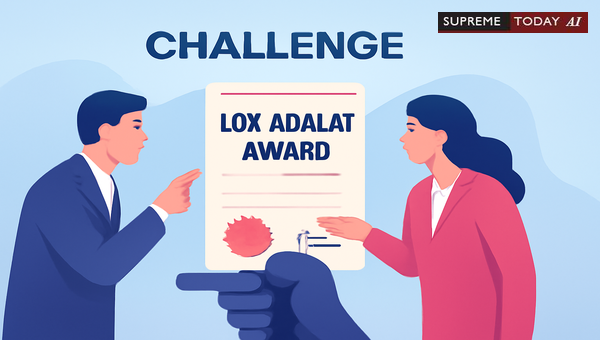
Lok Adalats have revolutionized in India, offering speedy settlements and reducing court backlogs. But what happens when a party feels aggrieved by a Lok Adalat award? Can you challenge it, and if so, how? This guide addresses the common query: lok adalat challenge, providing clarity on the legal framework, remedies, and limitations based on established precedents.
Note: This article offers general information and is not a substitute for professional legal advice. Consult a qualified lawyer for your specific situation.
Lok Adalats, established under the , function as rather than judicial tribunals. Their primary role is to facilitate voluntary settlements between parties, guided by principles of justice, equity, and fair play. When a settlement is reached, the Lok Adalat passes an award that is deemed to be a decree of a and is final and binding on the parties. 2024 0 Supreme(Pat) 477
Key characteristics include:- No : Lok Adalats do not deliver independent verdicts; awards merely record the terms of compromise. 2024 0 Supreme(Pat) 477- Administrative nature: They are conciliatory acts, enforceable only upon genuine settlement. 2024 0 Supreme(Pat) 477- : Under , no appeal lies against such awards, emphasizing their binding nature. 2022 0 Supreme(Ker) 491
This finality promotes expeditious justice but raises questions about remedies when disputes arise post-award.
Challenges to Lok Adalat awards are severely restricted. Courts have consistently held that these awards cannot be questioned like regular judicial decrees. Valid grounds are limited to:- Lack of genuine settlement: Awards passed without actual compromise, based on mere directions or procedural acts, are illegal and may be set aside. 2008 4 Supreme 528- Fraud or misrepresentation: If obtained through deceit, the award can be contested. 2022 0 Supreme(AP) 17- Procedural irregularities or statutory violations: Non-compliance with the Act's provisions. 2017 6 Supreme 698
The has clarified: Lok Adalats have no adjudicatory or judicial function; their role is purely conciliatory, based on settlement or compromise.2024 0 Supreme(Pat) 477
Mere dissatisfaction with the settlement terms or superficial procedural issues do not suffice. Courts will not re-examine the merits of the compromise. 2024 0 Supreme(Pat) 477 2017 6 Supreme 698
The only recognized avenue to challenge a Lok Adalat award is a under Article 226 or 227 of the Constitution before the . Regular appeals, civil suits, or cannot be used to question the award's validity. 2024 0 Supreme(Pat) 477 2017 6 Supreme 698
For instance, objections in do not serve as an alternative remedy; they address incidental issues like possession, not the award itself. 2026 1 Supreme 269
Parties to the proceedings are bound, but third parties adversely affected may challenge under Article 227. Parties not involved in Lok Adalat proceedings can challenge the award in under Article 227, especially if their rights are adversely affected.2025 0 Supreme(Pat) 1266
In one case involving , a non-party successfully invoked writ jurisdiction since civil remedies were barred by the award's finality. 2025 0 Supreme(Pat) 1266
Exceptions include:- Fraudulent awards: Challengeable via writ if signatures were forged or parties impersonated. 2022 0 Supreme(AP) 17- No settlement: Awards without compromise are voidable. 2008 4 Supreme 528- Public utility disputes: Permanent Lok Adalats handle such matters, but challenges follow similar writ routes. 2011 0 Supreme(P&H) 1531
However, courts dismiss petitions lacking substantial grounds: It is trite that the challenge to the award of Lok Adalat can be entertained on very limited grounds... The finality so attained cannot be permitted to be destroyed.2022 0 Supreme(Ker) 491
Courts lack authority to:- Substitute their judgment for the Lok Adalat's.- Re-evaluate settlement terms.- Entertain via suits or execution. 2017 6 Supreme 698
The remedy against an award passed by a Lok Adalat is limited to a , and the courts cannot re-examine the correctness of the award on merits, fraud, or misrepresentation unless a proper challenge is initiated.2024 0 Supreme(Pat) 477 2017 6 Supreme 698
Improper challenges, like using to extend payment timelines in Lok Adalat awards, may be entertained discretionarily but do not invalidate the award. 2020 0 Supreme(Telangana) 828
Execution jurisdiction also cannot reopen awards; transfer issues must follow proper channels. 2017 0 Supreme(AP) 43
To navigate a potential challenge:1. Verify settlement authenticity: Ensure the award reflects a voluntary compromise.2. File promptly: Approach the via writ within limitations.3. Plead specifically: Detail fraud, non-settlement, or violations with evidence.4. Avoid parallel proceedings: Execution objections won't substitute writs. 2026 1 Supreme 2695. Seek legal counsel: High Courts demand precise grounds for intervention.
Lok Adalats aim at amicable resolutions, so parties should approach with good faith.
In summary, while Lok Adalat awards enjoy strong finality, challenges are feasible but confined to writ petitions under Articles 226/227 on narrow grounds like fraud or absent settlement. Regular courts uphold this to preserve the system's efficacy. 2024 0 Supreme(Pat) 477 2017 6 Supreme 698 2008 4 Supreme 528
Key Takeaways:- Awards are binding decrees from genuine settlements.- Writ remedy is exclusive; no appeals or suits.- Third parties protected via Article 227.- Courts limit review to procedural excesses.
By understanding these nuances, litigants can make informed decisions. For personalized guidance, consult a legal expert familiar with the Legal Services Authorities Act.
References: Key cases include 2024 0 Supreme(Pat) 477, 2017 6 Supreme 698, 2008 4 Supreme 528, 2026 1 Supreme 269, 2025 0 Supreme(Pat) 1266, 2022 0 Supreme(Ker) 491, 2022 0 Supreme(AP) 17, and others cited inline.
#LokAdalat, #LegalChallenge, #IndianLaw


Merely because a sitting Judicial Officer is the Lok Adalat or a member of the Lok Adalat, that would not confer jurisdiction on the Court, which he or she normally occupies, with the jurisdiction to challenge the award passed in the Lok Adalat. ... from the Lok Adalat. ... Jalour Singh and Others; (2008) 2 SCC 660, the Hon’ble Supreme Court had categorically laid down that the challenge to an order of Lo....

of the Lok Adalat. ... The conspectus of aforesaid consideration is that the very act of entertaining the challenge to the award passed by the Lok Adalat was not legally sustainable. ... The medium of the proceeding by which the award of the Lok Adalat was sought to be assailed was of no moment. The challenge to the award of the Lok Adalat before the Court in which the original proceedings was filed or before the a....

the appellants was to challenge the order of the Lok Adalat by filing a writ petition under Article 227 of the Constitution. ... The objections filed on 19.09.2022 were, in substance, a defensive step to preserve possession pending a substantive challenge to the Lok Adalat decree. ... of the Lok Adalat. ... But the said petition was dismissed by another Single Judge on the ground that the order of the Lok Adalat pa....

The challenge to the award of Lok Adalat under Article 226 of Constitution can be entertained on very limited grounds raised only by parties to the settlement/compromise before Lok Adalat and not by anybody else.” ... She would submit that the compromise decree is obtained by fraud and only remedy to challenge the decree drawn before the Lok Adalat is the present petition. ... taken by Lok Adalat, the Court shall r....
In that case, the petitioners before the Division Bench were not party to the suit and award passed by the Lok Adalat. They had challenged award passed by the Lok Adalat directly by preferring writ petition, albeit challenge to award in execution had rendered unsuccessful. ... Neither can she challenge the award passed by the National Lok Adalat by preferring any appeal in view of Section 21(1) of the Legal Services Authorities Act, 1987. 6. ... The ....

the Lok Adalat. ... of the Lok Adalat. ... Section 2(d) of the Act, 1987 defines a Lok Adalat to mean a Lok Adalat organied under Chapter VI which deals with the Lok Adalat. Section 19, which is subsumed in Chapter VI, provides for organization of Lok Adalat. ... In addition to the aforesaid restrictions in the matter of challenge to a consent decree on the grou....

The challenge to the award of the Lok Adalat, in proceeding under Article 226 of Constitution of India, can be entertained only at the behest of parties to the settlement/compromise before the Lok Adalat, and not by anyone else (Sanjay Kumar's case cited (supra). ... After examining the scheme of the Act, it would hold that the only remedy available to the aggrieved person was to challenge the award of Lok Adalat by filing a writ petition under Artic....

by the Lok Adalat. ... of the Lok Adalat. ... (2) Every award of the Permanent Lok Adalat under this Act shall be deemed to be a decree of a civil court. (3) The award made by the Permanent Lok Adalat under this Act shall be by a majority of the persons constituting the Permanent Lok Adalat. ... If the parties to a proceeding in Lok Adalat cannot be rendered remediless, so would....

the appellants was to challenge the order of the Lok Adalat by filing a writ petition under Article 227 of the Constitution. ... of the Lok Adalat. ... This court, in no uncertain terms, has laid down that challenge to the award of Lok Adalat can be done only by filing a writ petition under Article 226 and/or Article 227 of the Constitution of India in the High Court and that too on very limited grounds. ... The travails of the parties did not end wi....

the Lok Adalat was passed, but, not by any other court or by any appellate court. ... that, a third party to a suit can challenge the compromise decree passed in suit in the Lok Adalat on the ground of fraud, only by way of a writ petition, if special circumstances are made for challenging the same(Para No.9). ... Lok Adalat and others. : reported in 2025(2) Civil Court Cases-042(A.P.) (D.B.) ... in which, the compromise decree in Lok Ada....

The original petition lacks merits and accordingly, it is dismissed. It is trite that the challenge to the award of Lok Adalat can be entertained on very limited grounds. The petitioner has not raised any grounds sufficient to exercise the power of judicial review to interfere with Ext.P1 award of the Lok Adalat. The finality so attained cannot be permitted to be destroyed, as it would amount to defeating the very aim and object of the Act with which it has been enacted.

It was further observed that ordinarily a third party cannot challenge the award in a writ petition, even if such an award causes prejudice. But, when an award of Lok Adalat was obtained by misrepresentation, fraud or without due compliance with the provisions of the Act and that it was not preceded by a compromise/settlement, it can be challenged in a Writ Petition (Sri Durga Malleswari Educational Society,2012(4) ALD 27). The challenge to the award of the Lok Adalat, in proceeding under Article 226 of Constitution of India, can be entertained only at the behest of parties to the ....

Every award of the Lok Adalat shall be deemed to be a decree of a Civil Court or, as the case may be, an order of any other Court and where a compromise or settlement has been arrived at, by a Lok Adalat in a case referred on it under sub-section (1) of Section 20, the Court-fee paid in such case shall be refunded in the manner provided under the Court-fees Act, 1870 (7 of 1870). (d) "Lok Adalat" means a Lok Adalat organized under Chapter-VI;

6. The learned counsel for the Decree Holder would submit as follows: Under Section 21 of the Act, every award shall be deemed to be a decree of a Civil Court or, as the case may be an order of any other Court. The award of a Lok Adalat is an Award whether passed by the Lok Adalat Bench of the Criminal Courts or the Lok Adalat Bench of the Civil Courts. Every Award made by the Lok Adalat shall be final and binding on the parties to the disputes.

In my view, this argument is wholly erroneous and does not take into account the reason for which the amendment was brought through Chapter VI. K. KANNAN J.(ORAL) - The challenge to the award passed by Permanent Lok Adalat is that the Electricity Board cannot invoke the provisions of the Permanent Lok Adalat since it is available only for an ordinary consumer. The establishment of Permanent Lok Adalat is for deciding the disputes in matters of public utility service and the term ' public utility service' is also defined under Section 22 (A) (b) that includes supply of power....


An indispensable Tool for Legal Professionals, Endorsed by Various High Court and Judicial Officers
Please visit our Training & Support
Center or Contact Us for assistance

Scan Me!
India’s Legal research and Law Firm App, Download now!


For Daily Legal Updates, Join us on :



 Back to top


