


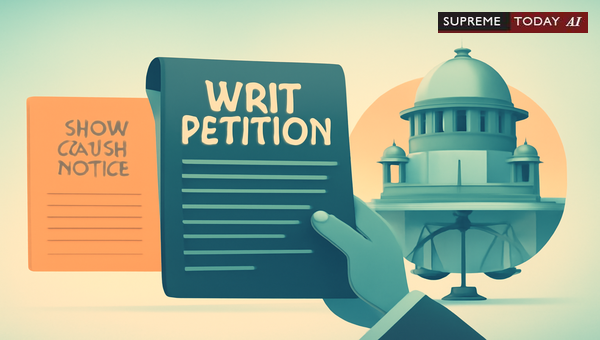
Against : Is It Premature?
In the realm of Indian administrative law, receiving a can be alarming for individuals, businesses, or organizations. It signals potential scrutiny under statutes like the , labor laws, or university regulations. A common impulse is to rush to the with a under to challenge it immediately. But is this the right move? on —this is the burning legal question many face.
This blog post delves into the judicial stance on filing writ petitions against show cause notices, drawing from established case laws and principles. We'll explore why courts typically view such petitions as premature, when exceptions apply, and practical recommendations. Note: This is general information, not specific legal advice. Consult a qualified lawyer for your situation.
Overview of Show Cause Notices and Writ Petitions
A is a procedural step where an authority asks the recipient to explain why action shouldn't be taken against them. It's not a final order but an opportunity for defense. Writ petitions, governed by Article 226, are extraordinary remedies issued by High Courts to enforce fundamental rights or correct jurisdictional errors.
Courts exercise discretion in entertaining writs against show cause notices. They often issue notices to respondents to show cause against granting the writ if issues seem significant 2000 0 Supreme(SC) 2129. However, jumping to judicial intervention at this stage is rarely favored.
Why Writ Petitions Are Often Deemed Premature
The cornerstone principle is . Writ petitions challenging mere show cause notices or charge-sheets are typically dismissed because:
- A doesn't constitute an adverse order affecting rights unless issued without jurisdiction. The authority can drop proceedings or find charges unestablished after response 2006 9 Supreme 370 2014 5 Supreme 403.
- Courts hold that such notices are part of a pre-decisional process, giving the petitioner a chance to respond before finality 2023 0 Supreme(Raj) 1453 2023 0 Supreme(Raj) 669 2023 0 Supreme(AP) 512 2024 0 Supreme(MP) 114 2023 0 Supreme(AP) 1561 2025 0 Supreme(Kar) 533.
As one judgment notes: The reason why ordinarily a should not be entertained against a mere show-cause notice or charge-sheet is that at that stage the may be h.... 2024 0 Supreme(P&H) 923. Petitioners are invariably directed to respond to the and take stands highlighted in the 2024 0 Supreme(P&H) 923.
In university matters, courts reiterate: The is filed, challenging the . The explanation received from the writ petitioner is now pending before the University for consideration. The final decision is yet to be taken by the competent authorities 2019 0 Supreme(Mad) 556 2019 0 Supreme(Mad) 790 2019 0 Supreme(Mad) 792 2019 0 Supreme(Mad) 789 2019 0 Supreme(Mad) 912. Adjudicating merits prematurely under Article 226 is inappropriate.
Maintainability and Proper Procedure
A alone doesn't create a for writs. The petitioner should:
- File a reply and await the final order 2025 0 Supreme(Kar) 1480 2024 0 Supreme(MP) 114 2023 0 Supreme(AP) 512 2025 0 Supreme(Telangana) 312.
- Challenge only if the notice lacks jurisdiction or is arbitrary.
Under the , the dismissed a writ, holding that the remedy is to reply and use Act proceedings, not writs 2001 0 Supreme(SC) 1777. Similarly, in another case, the petitioner was allowed a supplementary response, showing courts prefer procedural engagement 2017 6 Supreme 379.
Exceptions: When Courts May Intervene
Writs may be maintainable if:
- Issued without jurisdiction or in abuse of law 2023 0 Supreme(Raj) 1453 2024 Supreme(Online)(Bom) 8301.
- Violates , e.g., prejudged outcome or mechanical process 2023 0 Supreme(AP) 1561 2025 0 Supreme(Telangana) 312 2025 0 Supreme(Kar) 533.
The authority must consider replies meaningfully. in Union of India v. M. Bhaskaran () reaffirmed: writs against mere notices are premature; await final orders 2024 Supreme(Online)(Bom) 8301.
Case Law Highlights
- Challenge: Dismissed for ; respond to notice instead 2001 0 Supreme(SC) 1777.
- Supplementary Response Allowed: Courts permit further engagement pre-decision 2017 6 Supreme 379.
- General Precedent: No intervention unless jurisdictional defect 2023 0 Supreme(Raj) 669 2023 0 Supreme(AP) 512.
These illustrate judicial reluctance unless exceptional.
Practical Recommendations for Legal Strategy
Before filing a writ:
- Assess the Notice: Is it infringing rights or just procedural? Evaluate jurisdiction.
- File a Detailed Response: Advise clients to engage fully; authorities may drop charges.
- Monitor for Exceptions: Ground challenges in jurisdiction or violations.
- Strategic Timing: Challenge final orders post-response for stronger footing.
Courts have consistently held that challenge to a show-cause notice is not maintainable unless it is issued without jurisdiction or in a manner that violates principles of 2023 0 Supreme(Raj) 1453 2023 0 Supreme(Raj) 669 2024 Supreme(Online)(Bom) 8301.
Conclusion and Key Takeaways
Writ petitions against show cause notices are generally discouraged unless compelling reasons like jurisdictional issues exist. Courts prioritize procedural remedies to uphold fairness. Intervening early undermines the notice's purpose—a fair hearing opportunity.
Key Takeaways:- Respond to notices promptly; writs are premature otherwise 2006 9 Supreme 370 2014 5 Supreme 403.- Exceptions: Jurisdiction lack or breach 2025 0 Supreme(Kar) 1480.- References: 2000 0 Supreme(SC) 2129 2006 9 Supreme 370 2001 0 Supreme(SC) 1777 2017 6 Supreme 379 2014 5 Supreme 403 2024 0 Supreme(P&H) 923 2023 0 Supreme(Raj) 1453 2024 Supreme(Online)(Bom) 8301
Understanding these nuances aids effective representation. For tailored advice, reach out to a legal expert.
#WritPetition, #ShowCauseNotice, #IndianLaw












