


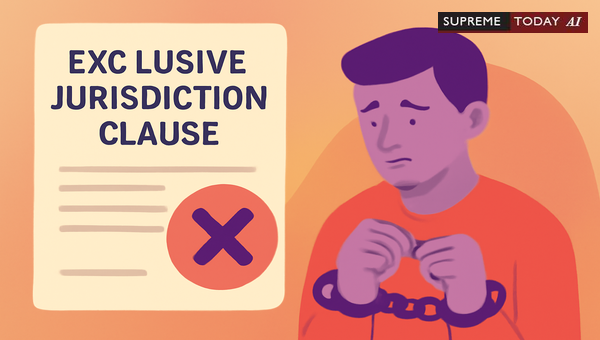
Remedies When a Stronger Party Imposes an on a Weaker Party
In the world of contracts, power imbalances can lead to one-sided terms that favor the stronger party. A common example is an , where disputes must be resolved only in a specific court or location chosen by the dominant party. But what if you're the weaker party—say, a small business, consumer, or employee—forced to accept such a clause? What remedies are available?
This article explores the legal question: Stronger Party Imposed on Weaker Party and what is the Remedy. We'll break down key principles like and , drawing from landmark cases and judicial insights. Note that this is general information, not specific legal advice—consult a qualified attorney for your situation.
Understanding Exclusive Jurisdiction Clauses and Power Imbalances
Exclusive jurisdiction clauses specify that only courts in a particular location can hear disputes arising from a contract. While these clauses promote certainty in commercial dealings, they become problematic when imposed by a stronger party on a weaker party with little bargaining power. Courts generally uphold such clauses as they reflect , but they scrutinize them for fairness, especially in non-commercial or .
For instance, courts recognize that clauses imposed under unequal bargaining power can be challenged as unfair or unconscionable. The in emphasized that courts will strike down contracts or clauses that are so unfair and unreasonable that they shock the conscience of the court and that such contracts are opposed to 2023 0 Supreme(SC) 64. This sets a high bar but provides a pathway for relief.
Key Legal Principles: and
The doctrine of is central to challenging oppressive terms. It applies when a contract or clause is so unfair and unreasonable that it shocks the conscience, particularly where the weaker party had no meaningful choice due to economic disparity or lack of alternatives 2023 0 Supreme(SC) 64 2025 3 Supreme 5.
Courts assess:- : How the clause was imposed (e.g., fine print, no negotiation).- : The clause's oppressive nature (e.g., forcing disputes to a distant, inconvenient forum).
In Central Inland Water Transport Corpn, the Court held that the courts will not enforce and will, when called upon to do so, strike down an unfair and unreasonable contract, or an unfair and unreasonable clause in a contract, entered into between parties who are not equal in bargaining power 2023 0 Supreme(SC) 64. This principle extends to jurisdiction clauses, where the weaker party might be compelled to litigate far from home.
Additional sources reinforce this. In consumer protection contexts, it applies when the weaker party can obtain goods or services only upon the terms imposed by the stronger party or go without them 2022 Supreme(Online)(NCDRC) 128. Similarly, the weaker party is not deemed and may secure remedies, with illegality construed against the stronger party
SEVANASPARAN MANIKAM vs DHARMENDRA KUMAR RAGHAVAN & ORS (ENCL 4) - High Court Malaya Pulau Pinang
.Available Remedies for the Weaker Party
If you're the weaker party, remedies typically involve challenging the clause's enforceability. Here's a breakdown:
- Declare the Clause Unenforceable: Courts may void the clause if unconscionable or obtained via . The burden is on you to prove unfair imposition 2023 0 Supreme(SC) 64 2025 3 Supreme 5.
- Invoke : Clauses shocking the judicial conscience or violating statutory rights can be struck down.
- Judicial Review for Fairness: Courts evaluate the bargaining context, reasonableness, and overall contract equity.
Even without explicit words like 'alone' or 'exclusive,' clauses can be treated as exclusive if intent is clear
. However, if unconscionable, enforcement may be denied
LAI CHIN WAH & ANOR vs SITRAC CORPORATION SDN BHD - Court Of Appeal Putrajaya
.In practice:- File a challenge in the court where the suit is brought, arguing the clause is invalid.- Seek if the designated forum doesn't provide practical remedies 2021 Supreme(Online)(DEL) 1460.- In arbitration-linked clauses, designating a seat often makes jurisdiction exclusive, limiting options 2025 Supreme(Online)(Jhk) 2795 2025 Supreme(Online)(Jhk) 3107.
Judicial Approach: Balancing Enforcement and Protection
Courts favor upholding clear, reasonable clauses entered without coercion. In commercial agreements between equals, interference is rare. But for weaker parties—like consumers or employees—protection is stronger.
Limitations include:- : You must demonstrate imbalance or unfairness 2023 0 Supreme(SC) 64.- No Automatic Invalidity: Clauses are presumed valid unless proven otherwise.- Statutory Safeguards: or consumer laws may override 2021 Supreme(Online)(KER) 7932.
For example, courts discourage bypassing agreed jurisdictions via other forums and may dismiss or return plaints 2025 Supreme(Online)(Kar) 18004. Yet, if the clause grossly restricts access to justice, it may be limited.
Exceptions and When Clauses Hold Up
- Equal Bargaining Power: Commercial peers face stricter enforcement.
- Clear and Reasonable Terms: Without coercion, clauses stand.
- Arbitration Seats: Treated as exclusive, curbing multi-forum tactics 2025 Supreme(Online)(Jhk) 3302.
Practical Recommendations for Weaker Parties
To protect yourself:- Negotiate Upfront: Scrutinize and push back on jurisdiction terms.- Gather Evidence: Document imbalance, duress, or lack of choice.- Seek Early Advice: Challenge before disputes escalate.- Explore Alternatives: Consider consumer forums or statutory remedies that ignore contractual jurisdiction.
Courts may direct compensation or other relief if unfairness deprives you of rights 2022 Supreme(Online)(NCDRC) 128.
Conclusion and Key Takeaways
When a stronger party imposes an , weaker parties have remedies centered on , , and challenges. While courts generally enforce such clauses, they intervene against shocking unfairness, as in 2023 0 Supreme(SC) 64. Integrate statutory protections and evidence of imbalance for the best shot at relief.
Key Takeaways:- Challenge via if bargaining was unequal 2025 3 Supreme 5.- Burden is on you, but courts protect the vulnerable.- Negotiate or document unfairness proactively.- Remedies are limited to the agreed forum unless invalidated.
This analysis draws from established precedents—always tailor to your facts with professional guidance. Stay informed to safeguard your contractual rights.
#JurisdictionClauses, #UnfairContracts, #LegalRemedies















