Searching Case Laws & Precedent on Legal Query..!
Scanned Judgements…!



Searching Case Laws & Precedent on Legal Query..!
Scanned Judgements…!
Can Release Deed be Set Aside?
Validity and Challenges to Release Deeds Release deeds can be challenged or set aside on various grounds, such as lack of registration, fraud, undue influence, or if executed without proper consideration. Several cases highlight that unregistered or unstamped release deeds generally cannot be relied upon as valid evidence (e.g., sources ["2025 0 Supreme(Kar) 724"], ["2024 0 Supreme(Mad) 2465"], ["
Muthu VS Sampath - Madras
"]). When a release deed is unregistered, courts often consider it invalid or non-establishing relinquishment of rights, unless specific exceptions apply.Analysis: Courts tend to scrutinize the registration and stamping of release deeds, with unregistered deeds often being declared inadmissible or invalid. However, in some cases, registered release deeds are upheld, especially if executed on valid stamp paper and properly registered (e.g., ["2025 0 Supreme(Mad) 2824"], ["2024 0 Supreme(Mad) 2465"]).Legal Grounds for Setting Aside Release Deeds Release deeds executed under fraud, undue influence, or misrepresentation are subject to being set aside. For example, in source ["2024 0 Supreme(Mad) 2465"], the court considered a release deed obtained through fraud as voidable. Similarly, unregistered or improperly executed deeds can be challenged in courts, and the burden is on the party asserting the deed's invalidity to prove such grounds.Analysis: Courts recognize that release deeds obtained by fraudulent means or executed without proper registration and stamp duty can be contested and potentially set aside.
Effect of Settlement and Compromise Many cases involve settlement agreements or out-of-court compromises, where release deeds form part of the settlement. Such deeds may be challenged if they are found to be procured through misrepresentation or if the parties later seek to revoke or modify the settlement (e.g., ["2023 0 Supreme(Raj) 1210"]). Courts may set aside such deeds if the circumstances warrant.
Judicial Precedents and Principles Courts consistently emphasize the importance of proper registration, execution on valid stamp paper, and absence of fraud or coercion for the enforceability of release deeds. Several judgments, such as from sources ["2023 0 Supreme(Mad) 991"], ["2023 0 Supreme(Kar) 1198"], clarify that a release deed executed without proper registration or under undue influence can be set aside.Analysis: The main insight is that a release deed's validity hinges on compliance with legal formalities and free consent. If these are lacking, courts are inclined to set aside or declare such deeds void or voidable.
Conclusion:A release deed can be set aside if it is unregistered, executed under fraud or undue influence, or not in compliance with legal formalities. Courts generally favor the principle that only properly executed and registered release deeds are binding, and any irregularity or misconduct can lead to their annulment or cancellation.
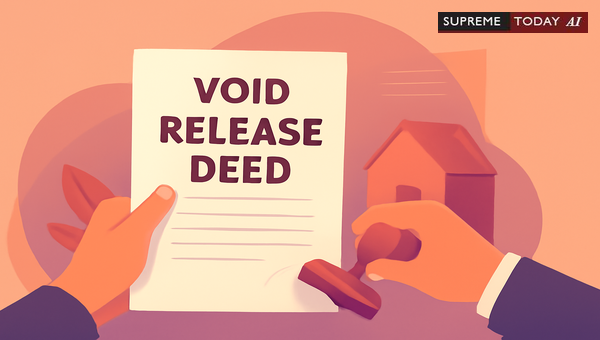
Release deeds are common instruments in property transactions, often used by co-owners or family members to relinquish rights in immovable property. However, not all release deeds hold up in court. What makes a release deed void? Understanding the key grounds for invalidating such deeds is crucial for property owners, heirs, and legal practitioners navigating disputes in India.
This article explores the primary reasons a release deed can be set aside, drawing from judicial precedents and statutory principles. While release deeds can simplify property transfers, flaws in execution or underlying circumstances may render them (invalid from the start) or (challengeable by an aggrieved party). Always consult a legal professional for case-specific advice, as outcomes depend on facts and evidence.
Yes, courts have consistently held that release deeds are not immune to challenge. Indian jurisprudence provides clear grounds for setting them aside, ensuring fairness in property dealings. Below are the key grounds typically invoked:
A release deed obtained through deceit is fundamentally flawed. If a party was induced to sign under false pretenses, such as concealed property defects or false promises, the deed can be . Courts emphasize proving intent to deceive.
For instance, A release deed can be set aside if it was obtained through fraud or misrepresentation. 1966 0 Supreme(SC) 192
Deeds executed in breach of law, like those by a minor's guardian without court approval, are often by the minor or heirs upon attaining majority. If a release deed violates statutory requirements, such as those related to the transfer of property by a minor's guardian, it may be at the instance of the minor or their legal heirs. 2004 0 Supreme(SC) 1239 2023 0 Supreme(Ker) 680
Relatedly, unregistered release deeds lack legal efficacy in partition claims. In one case, the court noted that Unregistered relinquishment deeds lack legal efficacy in partition claims, and clear admissions in pleadings bind parties, negating further claims to share in property. 2025 0 Supreme(Telangana) 112
Under the , agreements without are void unless exceptions apply. A release deed, especially if self-serving, may fail if no value is exchanged. A release deed may be invalid if it is not supported by , especially if it is a self-serving document. 2012 0 Supreme(Ker) 667 2012 0 Supreme(Ker) 957
This ties into disputes, where relinquishment deeds by co-owners do not automatically qualify as gifts requiring higher duty, but evidentiary context matters. Relinquishment deeds by co-owners do not automatically constitute gift deeds requiring higher ; evidentiary context is critical for determination. 2025 0 Supreme(Del) 489
Conditional release deeds can be invalidated if terms are unmet. Notably, under the , a deed conditioned on caring for elders fails if breached. If a release deed was executed with the condition of looking after a senior citizen, and those conditions are not met, the deed may be invalidated under the . 2022 8 Supreme 731
Similar principles apply in development agreements where sale or release violates undertakings. The sale deed has to be set aside and is accordingly set aside. The sale deed executed by the first defendant suffers from lack of bona fide as it was in direct violation of the undertaking given to the plaintiffs... 2020 0 Supreme(Mad) 1498
Even valid grounds don't guarantee success; procedural hurdles apply:
Limitation Period: Suits must generally be filed within three years from discovering the grounds. A suit to set aside a release deed must be filed within the prescribed limitation period, typically three years from the date the plaintiff became aware of the grounds for setting it aside. 1994 0 Supreme(SC) 1056 2023 0 Supreme(Ker) 680
Specific Pleading and Proof: Challengers must plead and prove allegations precisely. Vague claims fail. The party seeking to set aside a release deed must specifically plead and prove the grounds for doing so. 2005 4 Supreme 563
Void vs. : Void deeds (e.g., due to illegality) need no challenge—they're invalid inherently. ones require timely action. A release deed that is (void from the beginning) does not need to be set aside, while a deed must be challenged within the limitation period. 2008 0 Supreme(SC) 933
Additionally, even deeds remain effective until set aside. Even otherwise, if the release deed is construed as a contract, it continues to remain valid until the same is set aside. 2007 0 Supreme(Kar) 769
Release deeds involving immovable property over ₹100 require registration under the . Non-compliance often renders them inadmissible as evidence of title transfer. Courts distinguish releases from conveyances based on context:
In partnership dissolutions, releases of interest aren't conveyances attracting full . Release deed by which a partner or partners release their rights and interest in partnership in favour of remaining partners or Firm does not amount to and cannot be demanded on....
Onkar Rice Mills VS State of U. P. Thru Secy. Tax & Registration
However, relinquishment of defined shares in joint property may constitute . and interest in joint property constitutes a , as established in the case of . 2006 0 Supreme(Raj) 1843
Stamp disputes can lead to impounding, but premature classification as gifts is improper without evidence. Courts have quashed orders for refunds in such cases. 2022 0 Supreme(Guj) 1485
Nomenclature isn't decisive; substance prevails. In order to determine whether a document is a release or , the nomenclature or the language used is not decisive. 2004 0 Supreme(Bom) 1214
The Indian judiciary underscores:- : Plaintiffs bear the onus, with success hinging on facts, law, and evidence.- and Admissions: Parties bound by pleadings or conduct affirming the deed. 2007 0 Supreme(Kar) 769- Co-Ownership Nuances: Releases enlarge existing titles but can't create new ones where none exist. 2006 0 Supreme(Raj) 1843
Release deeds offer a streamlined way to transfer property interests but are vulnerable to challenges on grounds like fraud, statutory breaches, lack of , and unmet conditions. Time limits and proof requirements are strict, distinguishing void from deeds.
Key Takeaways:- Prove specific grounds with evidence to succeed.- Act within limitation periods.- Ensure registration, adequate , and .- Special protections exist for minors and seniors.
This overview draws from established case law but is for informational purposes only. Property disputes are fact-intensive—seek tailored advice from a qualified lawyer to protect your rights.
#ReleaseDeed, #PropertyLaw, #LegalGrounds


Therefore, the first plaintiff need not to file suit either to set aside the document in Ex.A.2 viz., release deed or file a suit to challenge the same. 22. ... Aggrieved by the same, the defendants 6 & 7 filed appeal suit and the same was allowed and also set aside the judgment and decree passed by the trial Court, thereby dismissing the suit. Hence, the plaintiffs filed this present S....

The appeals filed by the appellants before the first appellate Court were allowed and the first appellate Court, set aside the common judgment and decree dated 15.03.2010 passed by the trial Court. ... Hence, the same is liable to be set aside. Accordingly, prays to allow the appeals. 22. ... (ii) The common judgment and decrees passed by the first appellate Court is set aside and the c....

No.69 of 2013 on the file of the Principal District Munsif, Mayiladuthurai, is hereby set aside. There shall be no order as to costs. Consequently, connected Miscellaneous Petition is closed. ... Admittedly, the document sought to be produced is an unregistered and unstamped Release Deed. ... No.171 of 2016 seeking to introduce an unstamped and unregistered Release Deed dated 17.06.2002....

When these appeals came up for final hearing, a representation was made on the side of the petitioner to the effect that the matter had been settled between the parties, that the petitioner had obtained a release deed from the Government and that the sale deed dated 30.10.1996 has been set aside. ... No.308 of 2005 that the matter had been settled and he was stated to have obtained the release#H....

The Impugned Order dated 05.03.2019, therefore, cannot be sustained and is accordingly set aside. The petition succeeds.” 8. ... In light of the aforesaid question of law which has been set out and settled by the decisions of various high courts, the impugned orders dated 02.07.2019 and 03.06.2020 are quashed and set aside and the respondents are directed to refund the entire amount recovered from the pe....
Insofar as allowing amendment to challenge registered gift deed dtd. 17/10/2019 executed by plaintiff in favour of her mother is set aside. ... herself in pursuance to the release deed. ... The proposed amendment to include additional prayer to declare the registered release deed dtd. 26/7/2019 and rectification deed dtd. 31/10/2019 would be in cont....

aside and order dated 30.05.2023 (Annexure-6) passed by Board of Revenue in Revision/ Petition/LR/ 2022/ 3237/ Jodhpur ‘Mumal Vs Devaram And Others’ may also be quashed and set aside and Board of Revenue be directed to restore the Revision Petition no.REVISION/LR/NO.3237/2022 and same be decided afresh ... The petitioner thereafter, filed a civil suit on 12.07.2023 against the respondent no.2 before the Additional Civil Judge No.2, Jodhpur ....

Thus, Ex.B2 demolishes the case of plaintiff, even keeping aside the release deed which he says that it cannot be relied upon due to non- registration. Ex.B2 is enough to disprove the case of the plaintiff. ... He further argued that the trial Court has simply relied upon the oral admissions and has dismissed the suit, which is not proper in the eye of law, he therefore, prayed to set aside the judgment a....

(a) if the amount or value of the claim does not exceed Rs. 1,000The same duty as Bond (No. 15) for such amount or value as set forth in the Release(b) in any other caseOne ... Since this judgment is not with regard to a relinquishment deed or a release deed, the ratio of the same does not apply to the present case. 22. ... The Appeal is accordingly allowed by setting aside the order of ....
The plaintiff thereafter took out an application to amend the plaint in C.S.No.695 of 2003, wherein she wanted to have the registered release deed said to have been executed by her in favour of the defendants 1 to 4 set aside and declared as null and void. ... release deed (Ex.A14). ... relinquished her right by way of registered release deed-Ex.A14 da....

The sale deed has to be set aside and is accordingly set aside. The sale deed executed by the first defendant suffers from lack of bona fide as it was in direct violation of the undertaking given to the plaintiffs, given to the Court and I hold it was a direct attempt to grab the land of the plaintiffs.

In support of his contention he relied upon a decision of the Rajasthan High Court reported in AIR 1998 Rajasthan 223; Gyan Chand Vs. State and Ors., which was a case of joint ownership of a property wherein it was held that every joint owner had his individual title and interest in the property purchased jointly by them, thus, relinquishment of title and interest in the joint property by one joint owner in favour of another joint owner would only be transfer of interest of one joint owner in ....

Even otherwise, if the release deed is construed as a voidable contract, it continues to remain valid until the same is set aside. As far as the release deed Ex.P-1 is concerned, it is submitted that all the pleas that the release deed having been .obtained by fraud .or misrepresentation etc., have not been proved by the appellant before the trial Court and, therefore, any am aunt of pleading not backed up by necessary evidence cannot be looked into.
Aforementioned decision lays down that deed of release can enlarge title where there is one but cannot create title where there is none. 8. Under Section 45 of the Transfer of Property Act, 1882 where immovable property is transferred for consideration to two or more persons jointly makes them co-owners of the property transferred, their interest are in proportion to the share of the consideration they have advanced. In the absence of evidence of share of the consideration the co-owners shall ....

In this regard, the learned Counsel for the petitioner invited our attention to the ruling of Madras High Court in the case of (Chief Controlling Revenue Authority v. Rustom Nusserwanji Patel)2, A.I.R. 1968 Mad. 159, wherein it is observed that, in order to determine whether a document is a release or conveyance, the nomenclature or the language used is not decisive. A release deed is valid not only when it is gratuitous, as release deed can be validly executed also for some benefit ....


An indispensable Tool for Legal Professionals, Endorsed by Various High Court and Judicial Officers
Please visit our Training & Support
Center or Contact Us for assistance

Scan Me!
India’s Legal research and Law Firm App, Download now!


For Daily Legal Updates, Join us on :



 Back to top


