


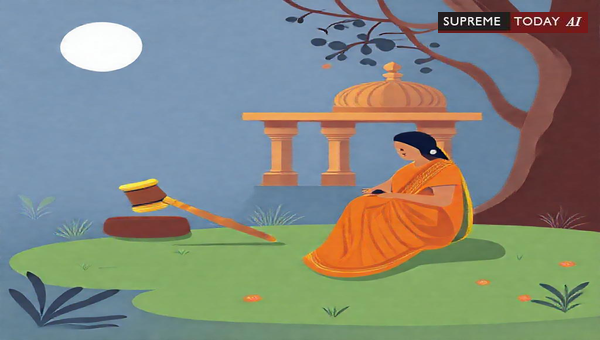
Children Born From a Second and Their Right to Share Parental Property
A widely held belief in family property disputes is that children born from a second marriage—particularly one that is void under Hindu law—are not entitled to any share in the family estate. This assumption, often repeated at home and even in litigation, does not reflect the current state of Indian law. The contains a specific provision designed to protect such children, and the 's 2023 decision in has firmly settled their inheritance rights, including in .
Why the Misconception Exists
A second marriage during the subsistence of a valid first marriage is null and void under of the . Historically, children of such unions were treated as illegitimate and excluded from inheritance. This social stigma led many families—and even some courts in earlier decades—to assume that these children could be completely disinherited.
Parliament intervened to correct this injustice. of the Act, as amended in 1976, statutorily confers on children of void and voidable marriages, whether or not a is ever passed.
What Actually Provides
(1) declares that notwithstanding that a marriage is null and void under , any child of such marriage who would have been legitimate had the marriage been valid, shall be legitimate—whether born before or after the 1976 amendment, and whether or not a is granted 2023 6 Supreme 202.
Key features of the provision include:
- by operation of law: The child is deemed legitimate regardless of the marriage's invalidity.
- No dependency on court orders: attaches even if no nullity petition is ever filed.
- Retroactive coverage: Children born even before the 1976 amendment benefit from the provision.
The Scope of Property Rights Under (3)
(3) does place one limit: the property rights of such children are confined to the property of their parents—they cannot claim rights in the property of any other relative. But within that limit, the entitlement is broad. As the explained, (3) does not impose any restriction on the property rights of the children born of a void or voidable marriage except limiting it to the property of their parents, meaning such children have a right to whatever becomes their parents' property, whether self-acquired or ancestral 2023 6 Supreme 202.
In practical terms, this means:
- Children of a inherit their parents' like any other child.
- They are entitled to a share in that comes to their parents.
- They stand on the same footing as children born of a valid marriage when it comes to their parents' estates 2005 0 Supreme(Pat) 602.
The Rise and Fall of the Restriction
The law did not always read this way. In , the had taken a narrow view, holding that under (3) a child born from a had no right to inherit ancestral or coparcenary property 2003 1 Supreme 441. Decisions such as and followed this restrictive line 2006 0 Supreme(SC) 411 and 2010 4 Supreme 433.
That position was ultimately rejected. In , the correctness of was doubted and referred to a larger bench 2011 0 Supreme(SC) 345, and the larger bench in 2023 confirmed that children of void marriages are legitimate and entitled to rights in both self-acquired and ancestral property of their parents 2023 6 Supreme 202. The Court in also emphasized that recognition of under (1) is a matter of public policy, unaffected by the property limitation in (3).
Coparcenary Status and Equal Shares
Even before the 2023 ruling, courts had recognized coparcenary rights for such children. In , it was held that by virtue of (1) as amended in 1976, a child of a can be equated with his natural sons and treated as for properties held by the father, whether joint family property or not 2015 0 Supreme(Mad) 2599.
Trial court attempts to deny shares on the ground of illegitimacy have also been corrected on appeal, with courts repeatedly affirming that even a child born through a cannot be deprived of rights in the father's property 2025 Supreme(Online)(Mad) 65497. Where children of a second wife have been granted shares, however, courts have noted a nuance: during the father's lifetime, a claim may face procedural limits, and shares are typically worked out after the parent's death 2025 Supreme(Online)(Mad) 72803.
Important Limitations to Keep in Mind
- Rights are limited to the property of the parents—no claim lies against other family members' property.
- Such children generally cannot seek during the parents' lifetime; the right matures on the parent's death.
- A second wife in a is not treated as a for family pension purposes, but the children from that marriage remain entitled to a proportionate share of the family pension under and the
Durgi Devi W/o Late Bhola Ram VS State of Himachal Pradesh, Through Secretary (Home) to The Government of Himachal Pradesh, Shimla-2 - Himachal Pradesh (2022)
. - under also supports related claims, such as maintenance, since the law compels performance of moral obligations toward maintaining children so they do not face destitution 2020 Supreme(Online)(MAD) 8284.
Key Takeaways
- The belief that children of a second get no share in property is legally incorrect.
- of the confers full on such children.
- After (2023), these children can claim shares in of their parents, on par with legitimate children.
- The only restriction is that their claim is confined to their parents' property and typically matures after the parent's death.
Because succession disputes often turn on specific facts—such as the nature of the property, the religion of the parties, and prior partitions—anyone facing such an issue should seek advice tailored to their circumstances, as this discussion is general information rather than specific legal advice.
#HinduMarriageAct #Section16 #InheritanceRights #SecondMarriage #SupremeCourtOfIndia












