


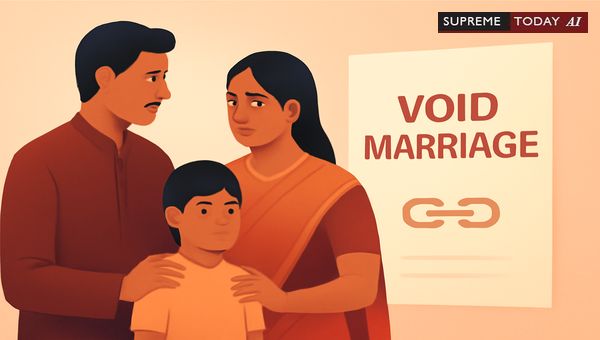
Can a Subsequent Born Child Challenge a Sach Property Transfer?
In family law disputes, questions about children's rights to property often arise, especially when marriages are later declared void. Imagine a scenario where a child is born during a marriage that is subsequently annulled. Can this subsequent born child step in to challenge a property transfer, such as a Sach transfer, years later? This is a common concern in Hindu law cases involving inheritance and .
The short answer, generally speaking, is no—such a child typically cannot challenge transfers of property beyond their parents' estate. This stems from key provisions in the (HMA), particularly , which balances child protection with clear limits on inheritance. Let's break it down step by step, drawing from judicial precedents and statutory interpretations. Note: This is general information, not specific legal advice. Consult a qualified lawyer for your situation.
Understanding the Legal Principle: vs. Inheritance Rights
Subsequent Born Child Cannot Challenge Sach Transfer—this phrase captures a pivotal ruling rooted in and 16 of the HMA. declares certain marriages void from the outset (e.g., bigamy or prohibited relationships). Yet, provides to children born of such unions.
: Children from void or are deemed legitimate, whether born before or after the . This protects the child from social stigma and ensures basic rights.
0010007522
2021 0 Supreme(Chh) 189Inheritance Limitation: Crucially, (3) restricts these rights: Such children shall have the same rights in the property of their parents as are conferred by or under this Act on a legitimate child. They cannot inherit from any other person, like grandparents or collateral relatives.
0010007522
2021 0 Supreme(Chh) 189
In essence, while the child is legitimate for parental property purposes, they lack in or claims against . A Sach transfer—often referring to ancestral or joint family land sales in regions like Himachal Pradesh (as seen in cases from Sach Tehsil)—falls outside this scope if it doesn't involve the parents' self-acquired or direct property. 2022 Supreme(Online)(HP) 1385
interpretations reinforce this: The legislature aimed to safeguard the child's welfare without upending broader family property structures.
0010007522
Key Findings and Judicial Precedents
Courts have consistently upheld (3)'s boundaries:
Limited to Parental Property: While these children are considered legitimate, (3) explicitly limits their inheritance rights to the property of their parents. They cannot inherit property from any other person.
0010007522
2021 0 Supreme(Chh) 189Nuance: In one case, a plaintiff born from a claimed a share in ancestral properties. The court granted under but limited the share to what traces back to parental entitlement—not full . Children born from void marriages are deemed legitimate under of the Hindu Marriage Act, allowing them to inherit from their parents' property, including . The plaintiff received a 1/20th share, affirming the parental limit. 2024 0 Supreme(Mad) 2248
This aligns with amendments (), where enables parental inheritance but not beyond. Defendants' arguments of illegitimacy failed, yet broader claims were curtailed. 2024 0 Supreme(Mad) 2248
Other rulings echo this:- Challenges to mutations or partitions succeed only if tied to parental property. A blanket challenge to a Sach Tehsil was deemed meaningless without assailing the core order. 2022 Supreme(Online)(HP) 1385- A minor in the womb (or born subsequently) can challenge alienations affecting inheritance interests, but only within statutory bounds like . 2018 0 Supreme(Mad) 3814
Real-World Applications: Custody, Transfers, and Family Disputes
These principles extend to practical disputes. For instance, in custody battles under or 26, courts prioritize child welfare but don't expand property rights. One involved a child (Eshan, born ) from a contested marriage; the court transferred proceedings for fairness but didn't address inheritance challenges. 2022 0 Supreme(SC) 1238
In , minors or subsequent children may reopen deeds if unfair, but success hinges on parental shares: The court found that the partition deed was unequal... plaintiff was entitled to reopen the partition and claim her share. Yet, this was under , 2005, respecting limits. 2018 0 Supreme(Mad) 3814
Unrelated but illustrative cases highlight child-centric policies:- Maternity benefits for surrogacy or step-children emphasize postnatal care, not property. 2017 0 Supreme(Chh) 5 2022 0 Supreme(SC) 834- Exceptions for third children post-sterilization failure show welfare flexibility, but not inheritance expansion. 2021 0 Supreme(Raj) 94
Why Can't They Challenge Non-Parental Transfers?
Statutory Intent: (3) prevents open-ended claims that could destabilize family estates. Courts invoke for equity but respect limits. 2022 0 Supreme(SC) 1238
: Challengers must prove parental ownership. In ancestral joint family property, illegitimacy bars coparcenary entry. The plaintiff who is born out of a marriage which is not a legal one cannot claim any share in the ancestral properties. 2024 0 Supreme(Mad) 2248
Time and Procedure: Mutations or sales (e.g., Ext.D-5 orders) stand unless directly challenged timely. Subsequent children risk procedural bars. 2022 Supreme(Online)(HP) 1385
Key Takeaways for Families and Heirs
- Protected but Limited: Subsequent children from void marriages inherit from parents only—self-acquired or their ancestral share. No rights to grandparents' or collaterals' property.
- Plan Ahead: Families should document transfers clearly to avoid disputes. Wills under can clarify intents.
- Seek Fair Trials: Courts may transfer cases for convenience, ensuring child interests. 2022 0 Supreme(SC) 1238
In conclusion, a subsequent born child generally cannot challenge a Sach transfer unless it directly impacts parental property. of the HMA provides without unlimited inheritance, as affirmed in multiple rulings.
0010007522
2021 0 Supreme(Chh) 189 2024 0 Supreme(Mad) 2248 This framework promotes child welfare while preserving family property stability.If facing such issues, review documents like marriage certificates and property titles with a family law expert. Stay informed—laws evolve with amendments and judgments.
#HMASection16 #InheritanceRights #VoidMarriageChild















