


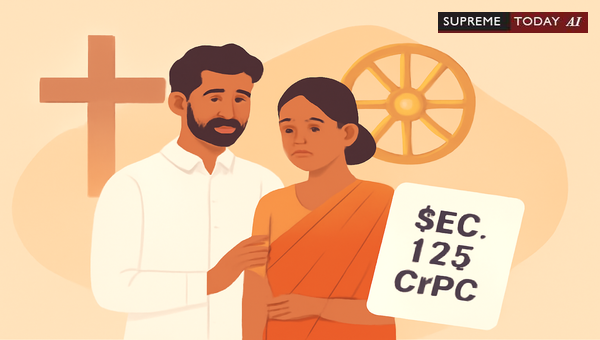
Christian Husband, Buddhist Wife: Navigating Marriage Validity and Maintenance in India
In today's diverse India, are increasingly common, yet they often raise complex legal questions. What happens when a Christian husband marries a Buddhist wife? Is their union legally valid, and can the wife claim maintenance if needed? These issues touch on , statutory provisions, and judicial interpretations, making them critical for couples to understand.
This article explores the legal landscape surrounding such unions, drawing from established laws like the , the , and . We'll break down validity concerns, maintenance rights, and insights from relevant precedents. Note: This is general information based on legal principles and cases; it is not personalized legal advice. Consult a qualified lawyer for your specific situation.
The Core Question: Wife Buddhist and Husband Christian
The scenario involves a Buddhist wife and Christian husband seeking clarity on their marriage's validity and her maintenance rights. Under Indian law, marriage validity depends on the applicable personal law, which varies by religion. Maintenance, however, offers broader protections, often transcending formal marriage recognition.
Validity of : Key Legal Frameworks
Limitations Under the
The Hindu Marriage Act applies to Hindus, Sikhs, Jains, and Buddhists, defining a valid marriage strictly between two Hindus. The , stipulates that a valid marriage can only be between two Hindus. Marriages between individuals of different religions, such as a Hindu and a Christian, are not recognized under this Act 2012 0 Supreme(AP) 280.
Buddhists are typically governed by Hindu law for marriage purposes unless specified otherwise. However, a union with a Christian falls outside this Act. Related cases highlight this: In a dispute involving a Hindu claimant against a Christian's estate, courts noted, there is no statutory provision which disqualifies a Hindu, Muhammadan, Buddhist, Sikh or Jaina from inheriting the property of a Christian
, but marriage validity is distinct from succession.
Provisions of the
For Christians, the , permits marriages between Christians and non-Christians if per its rules. The , allows for marriages between Christians and non-Christians, provided they are conducted according to the Act's provisions 2003 0 Supreme(Mad) 843.
If the marriage wasn't registered or performed under this Act—or another like the —it may lack formal validity. A case involving a Christian husband and Hindu wife under the Special Marriage Act confirms flexibility for interfaith couples: The husband belongs to Christian religion and the wife is a Hindu. After a love affair, the parties have agreed for solemnizing and registering the marriage under the provisions of the 2018 0 Supreme(Ker) 460.
Buddhists' status adds nuance. Some rulings group them with Hindus: It also covers any other person not a Muslim, Christian, Parsi, or Jew, unless it's proven they are not governed by Hindu law or custom 2025 Supreme(Online)(All) 2587. Thus, without proper solemnization, challenges may arise, but courts often look beyond formalities for rights like maintenance.
Maintenance Rights: A Lifeline Under
Even if marriage validity is questionable, maintenance rights persist. Under , husbands—regardless of faith—must support wives unable to maintain themselves, provided she fulfills . Under both Hindu and Christian , a husband has a legal obligation to maintain his wife. This obligation exists as long as the wife is willing to fulfill her 1955 0 Supreme(Ker) 48 1953 0 Supreme(Ker) 187.
Broad Scope of
is secular, aiding wives (including from ) unable to self-support. This section provides for maintenance to wives who are unable to maintain themselves. The courts have held that a wife can claim maintenance irrespective of the validity of the marriage, provided there is evidence of a marital relationship 1990 0 Supreme(Mad) 780 1990 0 Supreme(Ori) 454. and mutual recognition suffice.
Judicial Precedents: Lessons from the Courts
Courts have addressed similar interfaith scenarios. In , the ruled: a Hindu-Christian marriage isn't valid under the Hindu Marriage Act, but maintenance under is available if customs were followed 1990 0 Supreme(Mad) 780. The courts have also emphasized that the mere fact of and recognition as husband and wife can establish a basis for maintenance claims, even if the marriage lacks formal validity 1955 0 Supreme(Ker) 48 1956 0 Supreme(AP) 189.
Other cases reinforce this. A Buddhist couple's for non-disclosure of sickle cell anemia highlighted material facts in consent, but also cruelty via false dowry claims 2017 0 Supreme(Bom) 1176. Interfaith divorce under the , for a Hindu husband and Christian wife noted no solemnization barrier if parties were Hindu-Christian respectively 2015 0 Supreme(Mad) 3439. These underscore courts' pragmatic approach.
Conversion impacts are noted too: Conversion from Hinduism to Christianity disqualifies individuals from 2025 Supreme(Online)(All) 2587, but irrelevant here unless benefits are claimed.
In succession contexts, religious differences don't bar claims: Part 5 of the , will not apply to the property of any Hindu, Muhammadan, Buddhist, Sikh or Jaina 1976 0 Supreme(Mad) 365, showing law's compartmentalization.
Additional Considerations from Related Rulings
Buddhist-Christian unions mirror broader interfaith challenges. A case on religious harmony stressed India's secular fabric: India is not a Hindu, Muslim, Sikh, Buddhist or Christian India 2013 0 Supreme(J&K) 285, urging protection of diverse practices. For maintenance, evidence like trumps formalities.
Special Marriage Act offers a neutral path for interfaith couples, as seen in Christian-Hindu unions 2018 0 Supreme(Ker) 460. Desertion or cruelty in mixed marriages can lead to divorce, but maintenance endures 2015 0 Supreme(Mad) 3439.
Conclusion and Key Takeaways
A marriage between a Christian husband and Buddhist wife may not be formally valid without proper solemnization under the Indian Christian Marriage Act or Special Marriage Act. However, the wife can typically claim maintenance under , supported by relationship evidence and precedents like .
Key Takeaways:- Validity Check: Ensure registration under applicable laws to avoid disputes.- Maintenance Strength: Secular provisions protect dependent spouses broadly.- Evidence Matters: Document , ceremonies, and acknowledgments.
Recommended Action Steps:1. Gather Evidence: Collect proofs of relationship, like photos, witnesses, or joint documents.2. File Petition: Approach the under for maintenance.3. Seek Counsel: Engage a family law expert to assess validity and strategize.
Interfaith love deserves legal security. Stay informed, and prioritize formalities for peace of mind. References: 2012 0 Supreme(AP) 280 2003 0 Supreme(Mad) 843 1955 0 Supreme(Ker) 48 1990 0 Supreme(Mad) 780 1990 0 Supreme(Ori) 454
1976 0 Supreme(Mad) 365 2025 Supreme(Online)(All) 2587 2018 0 Supreme(Ker) 460 2017 0 Supreme(Bom) 1176 2015 0 Supreme(Mad) 3439 2013 0 Supreme(J&K) 285. #InterfaithMarriage #FamilyLawIndia #MaintenanceRights















