


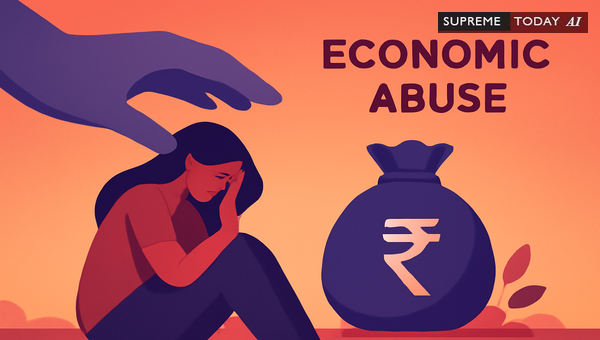
in Cases Under DV Act
In today's society, extends beyond physical harm, encompassing subtle yet devastating forms like . Many women face , denial of household resources, or restrictions on economic independence within relationships. A common question arises: Can be claimed under an case? This blog delves into the legal framework under the (DV Act), key court principles, and practical insights to help you understand your potential rights.
Note: This article provides general information based on legal precedents and is not a substitute for professional legal advice. Consult a qualified lawyer for your specific situation.
Understanding as
The DV Act, , broadly defines to include , marking a progressive step in protecting women. involves deprivation of all or any economic or financial resources to which the is entitled under any law or custom or prohibiting access to . 2010 7 Supreme 321 2015 0 Supreme(SC) 1065
This recognition means that even without physical or emotional abuse, financial control or denial can qualify as . For instance, refusing to provide or restricting access to joint finances triggers remedies under the Act. Courts have consistently upheld this, emphasizing that economic violence undermines a woman's dignity and security.
In one case, the awarded of Rs. 2,000 per month to the wife and child despite no proven physical abuse, solely based on established . The affirmed: It includes also. Any kind of deprivation of of any economic or financial resources would e....
Entitlement to Under the DV Act
A woman subjected to may seek under the DV Act, regardless of her marital status as a legally wedded wife. This entitlement holds even if she cannot claim under (CrPC). 2018 0 Supreme(SC) 1716
Key takeaway: The DV Act's scope is wider, covering women in domestic relationships, including live-in partners. Similarly, on the same basis a woman who is in a with the '' would also be entitled to claim under the Act of if she can prove that that she has been subjected to within the shared household. 2017 0 Supreme(P&H) 2702
Moreover, under the DV Act is in addition to awards under Section 125 CrPC or the . The statutes serve distinct purposes: CrPC focuses on preventing , while the DV Act addresses violence-specific reliefs. Courts must avoid overlapping orders, requiring disclosure of prior rulings. 2020 6 Supreme 322(D)) 2020 6 Supreme 322(E))
Factors Courts Consider for Quantum
Determining isn't arbitrary. Courts evaluate several factors to ensure fairness:
- 's financial capacity: Income, assets, and ability to pay.
- Applicant's standard of living: Pre-violence lifestyle and needs.
- Relationship duration: Longer relationships may warrant higher support.
- Applicant's self-sufficiency: Earning potential, but refusal to maintain can still constitute even if she's employed. 2017 0 Supreme(Raj) 8
- Children's needs: Prioritizing minors' welfare. 2020 6 Supreme 322(I)), (J))
The relief must be adequate, fair and reasonable and consistent with the standard of living to which the is accustomed. 2017 0 Supreme(Raj) 8
In a notable ruling, was enhanced to Rs. 45,000 monthly (Rs. 15,000 for the son) from a husband's Rs. 1,49,580 salary, underscoring the husband's burden to prove income details. 2017 0 Supreme(P&H) 2702(D))
Expeditious Disposal: No Room for Delays
Delays undermine the DV Act's protective intent. Courts are urged to streamline procedures for timely resolution. Delays in adjudication of claims defeat the very purpose of the legislation. 2020 6 Supreme 322(F)), (G))
Non-payment of itself can breach under , invoking penalties under . The court held that non-payment of allowance constitutes a breach of protection order under , and therefore, proceedings under of the Act can be invoked. 2017 0 Supreme(MP) 930
Insights from Landmark Cases
Several judgments reinforce these principles:
- Even post-divorce claims: A divorced woman can file under for , as past domestic relationships qualify. The aforesaid uncontroverted allegations per se disclose a case of ‘’ which is a species of ‘’ under of the Act.
- No physical abuse needed: Economic deprivation alone suffices, as in cases quashing dismissals for lack of physical evidence.
- Acquittal under IPC no bar: acquittal doesn't affect DV Act if violence is proven civilly. 2017 0 Supreme(P&H) 2702
- scope: Includes expenses from violence, rental for shared households, and ongoing claims. 2017 0 Supreme(MP) 930
These cases illustrate the Act's victim-centric approach, enlarging to cover economic aspects like rental payments and denial. 2017 0 Supreme(MP) 930
Application to Typical Scenarios
Consider a live-in partner denied finances: She may claim under DV Act for , distinct from CrPC. Or a wife facing post-divorce economic denial: Proceedings remain maintainable against the ex-husband, though residence rights under cease.
Applicants must disclose prior orders to prevent conflicts. Courts balance self-sufficiency but prioritize necessity, rejecting claims only if the wife is fully independent without neglect. 2017 0 Supreme(Raj) 8
Conclusion and Key Takeaways
is a recognized form of under the DV Act, , opening doors to claims that complement other laws. Courts prioritize timely, fair awards based on holistic factors, ensuring no woman endures financial destitution due to abusive control.
Key Takeaways:- alone justifies DV Act . 2018 0 Supreme(SC) 1716- Additional to CrPC/HMA awards; disclose priors. 2020 6 Supreme 322(D)), (E))- Consider capacity, lifestyle, and children for quantum. 2020 6 Supreme 322(I)), (J))- Seek expeditious hearings to enforce rights promptly. 2020 6 Supreme 322(F)), (G))
If facing , document evidence and approach a under . For personalized guidance, reach out to legal experts or women's helplines. Empower yourself with knowledge—justice under the DV Act is accessible and robust.
Word count: Approximately 1050. Sources cited are for illustrative purposes from public legal databases.
#EconomicAbuse, #DVActIndia, #MaintenanceRights















