


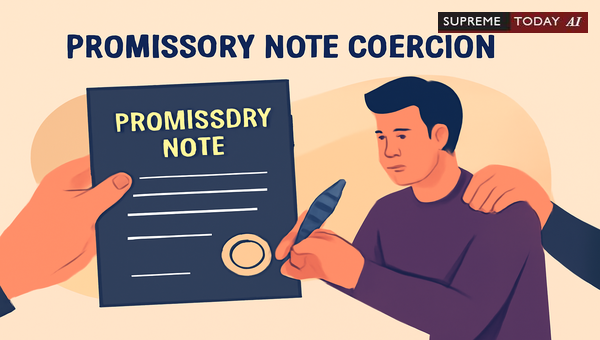
Coerced : Enforceable in India?
Imagine signing a under intense pressure—threats of harm or unlawful detention of property—forcing your hand. Can the lender still enforce it in court? This is a critical question for borrowers and lenders alike in India. A obtained by is generally not enforceable under Indian law, as it lacks the required for a valid contract. In this post, we dive into the legal principles, key judgments, and practical insights to help you understand this defense.
We'll explore the Indian Contract Act, judicial precedents, exceptions, and related issues like and document validity, drawing from established case law.
What Makes a Valid?
A is a under the , promising unconditional payment of a sum. However, its enforceability hinges on core contract elements: , , and capacity. directly attacks , making the note voidable.
The question at hand— Obtained by is Not Enforceable under Law—strikes at this foundation. Under Indian law, such notes are typically unenforceable if is proven.
Legal Framework: Under Indian Contract Act
Sections 15 and 16 of the , are pivotal. Section 15 defines as committing, or threatening to commit, any act forbidden by the , or the unlawful detaining, or threatening to detain, any property, to the prejudice of any person whatever, with the intention of causing any person to enter into an agreement 2025 0 Supreme(AP) 419.
When consent is vitiated by or , the contract—including promissory notes—is voidable at the coerced party's option. Courts emphasize that without , there's no valid contract1953 0 Supreme(Ker) 56. Judicial decisions reinforce: a contract entered into by using fraud, , etc., is a voidable but not a void contract2006 0 Supreme(AP) 424.
Key Judicial Precedents on and Promissory Notes
Indian courts have consistently ruled against enforcing coerced notes:
- In a notable case, the defendant alleged the was procured by threats and . The court noted that without detailed pleadings and evidence, the presumption under holds. However, if proven, invalidates the note
.
- Another ruling states , if proven, can nullify enforceability, as it undermines voluntary agreement 2025 0 Supreme(AP) 419.
- A obtained through threats, violence, or lacks and is unenforceable
.
These cases highlight that renders the note voidable, allowing the coerced party to rescind it.
's Impact on Consideration
Promissory notes require (Section 118, Negotiable Instruments Act). taints this: the agreement isn't voluntary, so consideration may be invalid. Courts view such notes as lacking enforceable support, enabling refusal to honor them.
Exceptions and Limitations: Proving
While is a strong defense, it's not automatic:- The lies on the party claiming . They must show it occurred at the time of execution
.- Mere allegations without detailed evidence or pleadings are insufficient; courts demand specifics like threats or
.
Related cases underscore proof challenges. For instance, the reverse burden is on the petitioner, who has to prove the existence of legally enforceable debt... by leading cogent evidence. However, he did not produce any evidence2024 Supreme(Online)(Mad) 58306. Similarly, in loan disputes, failure to rebut presumptions upholds enforceability unless defenses like are substantiated 2023 Supreme(Online)(Mad) 86540.
Broader Issues Affecting Enforceability
isn't the only pitfall. Integrating insights from other rulings:
- void the instrument: A void instrument/document cannot be enforced in a Court of law. , which is having material alteration, thus cannot be enforced2018 0 Supreme(Mad) 828 2014 0 Supreme(Mad) 4169. Under , alterations in date or amount render it unenforceable, regardless of benefit to holder.
- Execution disputes: Signatures added later or improper formats invalidate notes. The name of the 1st defendant was not shown in body of Ex.A1/suit , though his signature contains on revenue stamp, which was obtained afterwards, which not amounts to execution2024 0 Supreme(AP) 767.
- Succession and validity: Notes can be enforced without immediate if validity is proven 2024 0 Supreme(AP) 767.
These reinforce that courts scrutinize execution circumstances rigorously, much like claims.
In cheque-bounce appeals, petitioners must prove enforceable debt with evidence, or acquittals stand, emphasizing proof's role across instruments 2024 Supreme(Online)(Mad) 58306 2024 Supreme(Online)(Mad) 77467.
Practical Recommendations
To avoid disputes:- Ensure : Document voluntary execution, perhaps with witnesses or notaries.- Challenge suspected : File detailed pleadings with evidence promptly.- Scrutinize documents: Check for alterations or irregularities before suits.
Lenders should verify capacity and consideration; borrowers, gather proof for defenses.
Note: This is general information based on legal principles and cases. Consult a qualified lawyer for advice specific to your situation.
Key Takeaways
- Coerced promissory notes are generally unenforceable due to vitiated consent under Sections 15-16, Indian Contract Act 2025 0 Supreme(AP) 419.
- Proven shifts the balance, but burden lies on the claimant
.
- Related defenses like alterations or proof failures bolster challenges 2018 0 Supreme(Mad) 828.
- Always prioritize voluntary agreements to sidestep litigation.
Understanding these nuances protects parties in financial dealings. Stay informed, and seek professional guidance for your matters.
#PromissoryNote, #CoercionLaw, #IndianContractAct












