SupremeToday Landscape Ad
AI Thinking

AI Thinking...

Searching Case Laws & Precedent on Legal Query.....!

Scanned Judgements…!

Checking relevance for Punjab Land Development And Reclamation Corporation LTD. , Chandigarh: Divisional Controller, Maharashtra State Road Transport Corporation, Amravati: Regional Manager (West Zone) Now Known As Kanpur Region, Bank Of Baroda, Regional Office, Lucknow: Mana VS Presiding Officer, Labour Court, Chandigarh: Chandrashekhar Maribhau Deshmukh: Secretary, U. P. Bank Employees Union, C/o Bank Of Baroda, Latouche Road, Kanpur. : Labour Court, Ranchi: Namdeo: Secretary (Labour) , Delhi Administration, Delhi: Larsen And...

1990 0 Supreme(SC) 310 : According to Hans Kelsen in his Pure Theory of Law, the law to be applied is a frame that may allow for several possible applications. The legal act applying a legal norm may conform to one or more of the following: (a) one or the other of different meanings of the legal norm, (b) the will of the norm-creating authority, (c) the expression chosen by the norm-creating authority, (d) one or the other of contradictory norms, or (e) the concrete case to which two contradictory norms refer may be decided under the assumption that the norms annul each other. This indicates that law is not always a single, determinate answer but a framework within which legal decisions can be made, and interpretation involves both cognitive and normative elements.Checking relevance for RAMJIT SINGH KARDAM VS SANJEEV KUMAR...

Checking relevance for Ramanlal Bhailal Patel VS State of Gujarat...

Checking relevance for High Court Of Gujarat VS Gujarat Kishan Mazdoor Panchayat...

Checking relevance for B. H. E. L. VS B. K. Vijay...

Checking relevance for Jayantilal Amratlal Shodhan VS F. N. Rana...

1963 0 Supreme(SC) 253 : The concept of law, in the broadest sense, signifies a command which obliges a person or persons to a course of conduct. It must issue from a determinate person or group of persons, with the threat of displeasure if the rule is not obeyed. However, this command-based definition has been broadened by Salmond, who defines law as ''''a body of principles recognised and applied by the State in the administration of Justice''''. Peton defines law as ''''a legal order tacitly or formally accepted by a community, and it consists of the body of rules which that community considers essential to its welfare and which it is willing to enforce by the creation of a specific mechanism for securing compliance.'''' Thus, law must consist of a body of rules that govern the conduct of persons in a community and are enforceable through judicial or other mechanisms. An order or notification has the force of law only if it contains a rule or body of rules regulating conduct and is enforceable by courts or other authorities.Checking relevance for Indira Nehru Gandhi, Raj Narain VS Raj Narain, Indira Nehru Gandhi...

1975 0 Supreme(SC) 440 : According to Friedmann, the most essential element in the concept of law is a degree of generality: ''''THE first desideratum of a system for subjecting human conduct to the governance of rules is an obvious one: there must be rules. This may be stated as a requirement of generality.'''' He emphasized that a community without general prescriptions—only individual commands—would not be regarded as having a legal order, as it would dissolve into millions of individual relationships. Patterson also contributed to the understanding of law by stating that the generality of a law depends upon its being applicable to an indefinite number of human beings, which is the most significant aspect of law. He argued that an ordinary court judgment is not law because it applies only to a limited number of individuals, the parties to the case, and rejected the idea of an ''''individual legal norm'''' as self-contradictory.Checking relevance for Vigyan Parishad VS Union Of India...

2023 0 Supreme(All) 1239 : The legal documents define ''''due course of law'''' as a course of legal proceedings according to the rules and principles established in the system of jurisprudence for the enforcement and protection of private rights. It requires a competent tribunal, proper jurisdiction, the right to be present, to be heard, and to have material facts conclusively proved or presumed against the individual. This concept is part of the broader principle of due process, which ensures fairness in legal proceedings affecting life, liberty, or property.Checking relevance for Harshadhipati, S/o. Shri Mukesh Kumar VS State Of Rajasthan, Through Its PP. ...

2024 0 Supreme(Raj) 716 : Law is derived from basic human senses and needs such as hunger, shelter, growth, protection, and equitable development. It serves as a code of conduct indispensable for protecting and balancing these intrinsic human needs. Law ensures the smooth, peaceful, and uninterrupted execution of daily life, enabling human society to function cohesively and prosperously. It is the cornerstone of societal stability, respecting and balancing individual rights against the collective good, and provides the framework within which individuals can achieve their potential while maintaining harmonious relationships with others. Law emerges from the necessity of peaceful coexistence and is established as supreme, ensuring that no individual is above the legal system. It is inseparable from society, with each reinforcing and sustaining the other, and is essential for the collective and individual good, underpinning societal stability and the well-being of individuals.


AI Overview

AI Overview...

  • Meaning of Law - Law is a system of rules created and enforced by social or governmental institutions to regulate behavior and maintain order. It provides a framework for resolving disputes, protecting rights, and establishing standards of conduct General understanding.

  • Legal Application and Interpretation - Courts and authorities interpret laws to ensure justice and fairness. Errors in applying the law, procedural unfairness, or irrational decisions can be grounds for judicial review or appeal. For example, courts scrutinize decisions for errors of law, as seen in cases involving immigration, criminal appeals, and administrative proceedings ["2025 Supreme(HK)(HKCA) 205"], ["2025 Supreme(HK)(HKCA) 203"].

  • Law in Specific Contexts - Laws vary across jurisdictions and contexts, such as employment law (e.g., compassionate appointments), immigration law (non-refoulement), and procedural law (limitation periods, appeals). The law also defines rights and obligations, such as the right to appeal within prescribed timeframes or the conditions under which rights are recognized (e.g., vested rights in law for compassionate appointments) ["2025 Supreme(Online)(MP) 8556"], ["2025 Supreme(Online)(MP) 8882"], ["2025 Supreme(Online)(SCDRC) 32396"].

  • Legal Principles and Procedural Aspects - Key principles include the requirement of showing sufficient cause for condoning delays, the importance of adhering to prescribed legal procedures, and the need for decisions to be based on proper application of law rather than errors or irrationality. Courts emphasize the importance of following legal standards to prevent abuse of process and ensure justice ["2025 Supreme(Online)(SCDRC) 32396"], ["2025 Supreme(Online)(Ker) 43042"].

Analysis and Conclusion:Law serves as a fundamental framework governing societal conduct, ensuring justice through clear rules and procedures. Its interpretation and application are crucial in resolving disputes, protecting rights, and maintaining order. Errors in legal reasoning or procedural lapses can be challenged through appeals, judicial review, or other legal remedies, underscoring the importance of adherence to legal principles for fair and lawful decision-making All sources.

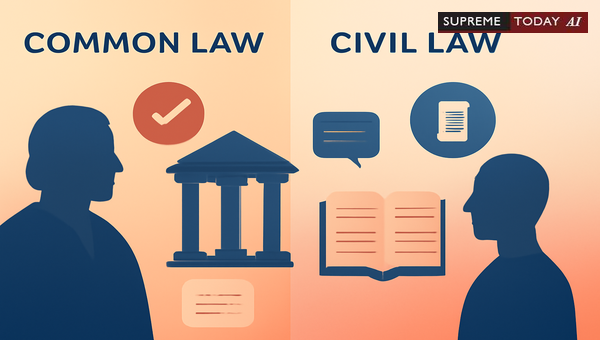
Common Law vs Civil Law: Judicial Precedents, Statutes, and Procedural Frameworks

Common Law vs Civil Law: Key Differences Explained

Introduction

In the vast world of legal systems, two dominant traditions stand out: common law and civil law. If you've ever wondered, Differentiate between Common Law and Civil Law, you're not alone. These systems shape how justice is administered in countries worldwide, influencing everything from court procedures to how laws are interpreted and applied. Understanding their differences is crucial for law students, business professionals operating internationally, and anyone curious about global jurisprudence.

This post breaks down the essentials, drawing from foundational legal principles and real-world examples. Note that while we provide general insights, this is not legal advice—consult a qualified attorney for specific matters.

What is Common Law?

Common law originates from medieval England and is characterized by its reliance on judicial precedents (stare decisis). Judges play a pivotal role in developing the law through case decisions, which bind future courts.

Key features include:- Sources of law: Primarily case law supplemented by statutes.- Adversarial system: Parties present their cases, and the judge acts as a neutral referee.- Flexibility: Law evolves organically through rulings.

In common law jurisdictions like India, the UK, the US, and Australia, law is viewed as a body of rules and principles that govern human conduct within a society, applicable generally and enforceable through authority 2024 0 Supreme(Raj) 716. For instance, The generality of a law depends upon its being applicable to an indefinite number of human beings 2024 0 Supreme(Raj) 716. This generality ensures laws aren't mere individual commands but broad societal rules.

What is Civil Law?

Civil law traces its roots to Roman law and was codified in comprehensive statutes, such as the Napoleonic Code in France. It's the prevailing system in continental Europe, Latin America, and parts of Asia and Africa.

Key features include:- Sources of law: Primarily written codes and statutes; precedents are persuasive but not binding.- Inquisitorial system: Judges actively investigate facts, with less emphasis on party advocacy.- Codification: Laws are systematically organized into codes for predictability.

While civil law also embodies generality and enforceability, it prioritizes legislative enactments over judicial interpretation. As noted in legal norms discussions, for a rule to have the force of law, it must regulate conduct and be enforceable 1975 0 Supreme(SC) 440

Key Differences: Common Law vs Civil Law

Here's a side-by-side comparison to highlight the distinctions:

| Aspect | Common Law | Civil Law ||---------------------|-------------------------------------|-------------------------------------|| Origin | England (11th century) | Roman Empire (Justinian Code) || Primary Source | Judicial precedents (case law) | Codified statutes and codes || Role of Judges | Interpret and create law via rulings | Apply existing codes || Court Procedure | Adversarial (party-driven) | Inquisitorial (judge-led) || Legal Evolution | Incremental through cases | Through legislative reforms || Examples | India, USA, UK | France, Germany, Japan |

These differences impact daily legal practice. In common law, a judge's ruling in one case can set a precedent for others, ensuring consistency. In civil law, comprehensive codes like the German BGB provide exhaustive rules, reducing judicial discretion.

Both systems share core traits: law as a body of principles recognized and applied by the State in administering justice 2023 0 Supreme(All) 1239, emphasizing enforceability and societal order.

Detailed Analysis: Generality and Enforceability in Both Systems

A fundamental concept in both is generality. Law must apply to an indefinite number of persons, distinguishing it from private judgments 2024 0 Supreme(Raj) 716. Law signifies a command which obliges a person or persons to a course of conduct and must emanate from authority 2024 0 Supreme(Raj) 716.

Enforceability is key: rules lacking enforcement machinery aren't true law 1975 0 Supreme(SC) 440. This holds across systems—common law via precedents and courts, civil law via codes.

Jurisprudential views reinforce law as a normative framework, created or recognized by societal or legislative authority 1990 0 Supreme(SC) 310. Customs can become law if recognized, bridging both traditions.

Real-World Examples from Legal Practice

Common law shines in flexible applications, as seen in Indian cases. In a dowry harassment matter, petitioners (husband, in-laws) sought anticipatory bail under Section 438 CrPC, 1973. Despite serious allegations, the court granted bail with conditions to avoid investigation interference—typical judicial discretion 2025 Supreme(Online)(Ker) 44071. This balances rights, showcasing adversarial balancing.

Another example: GST registration revocation. A petitioner sought manual application processing; the court directed authorities to decide per law, highlighting procedural fairness in administrative law 2025 Supreme(Online)(Tel) 20986.

In eviction disputes, courts upheld reasoned findings based on settled law positions, rejecting inapplicable precedents—demonstrating stare decisis 2025 Supreme(Online)(Del) 8593.

Civil law examples, though less represented here, contrast by prioritizing code application over evolving precedents.

Corporate contexts, like electricity supply disputes, also invoke enforceable rules under statutes, aligning with both but procedural via common law avenues 2025 Supreme(Online)(Kar) 28778.

Exceptions and Nuances

  • Hybrid Systems: Louisiana (US) blends civil and common law; Scotland mixes elements.
  • Convergence: Globalization leads to similarities, e.g., codified elements in common law (US Uniform Commercial Code).
  • Limitations: Individual orders without generality or enforceability aren't law 1975 0 Supreme(SC) 440; customs may qualify if societally enforced 2023 0 Supreme(All) 1239

Conclusion and Key Takeaways

Differentiating common law and civil law reveals how legal traditions adapt to societal needs. Common law offers adaptability through precedents, while civil law provides certainty via codes. Both uphold law's essence: general, enforceable rules governing conduct.

Key Takeaways:- Common law relies on precedents; civil law on codes 2024 0 Supreme(Raj) 716 1975 0 Supreme(SC) 440.- Procedures differ: adversarial vs. inquisitorial.- Verify generality and enforceability in any system.- Recognize customs as potential law sources.

For international dealings, understanding these aids compliance. Always seek professional advice tailored to your jurisdiction.

References

  1. 2024 0 Supreme(Raj) 716: Generality and nature of law.
  2. 1975 0 Supreme(SC) 440: Enforceability criteria.
  3. 2023 0 Supreme(All) 1239: Law as state principles.
  4. 1990 0 Supreme(SC) 310: Norm interpretation.
  5. 2025 Supreme(Online)(Ker) 44071: Anticipatory bail example.
  6. 2025 Supreme(Online)(Tel) 20986: Administrative procedure.
  7. 2025 Supreme(Online)(Del) 8593: Eviction law application.
  8. 2025 Supreme(Online)(Kar) 28778: Corporate dispute.
#CommonLawVsCivilLaw, #LegalSystems, #LawDifferences
Chat Download
Chat Print
Chat R ALL
Landmark
Strategy
Argument
Risk
Chat Voice Bottom Icon
Chat Sent Bottom Icon
SupremeToday Portrait Ad
logo-black

An indispensable Tool for Legal Professionals, Endorsed by Various High Court and Judicial Officers

Please visit our Training & Support
Center or Contact Us for assistance

qr

Scan Me!

India’s Legal research and Law Firm App, Download now!

For Daily Legal Updates, Join us on :

whatsapp-icon Back to top