


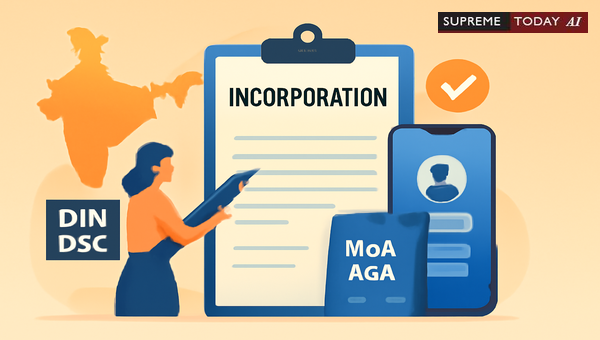
How to Register a Company in India: Complete Guide
Starting a business in India is an exciting venture, but navigating the legal requirements can seem daunting. If you're wondering how to register a company, understanding the process under the , is crucial. This guide provides a comprehensive, step-by-step overview to help entrepreneurs like you establish a legal entity efficiently. Whether you're opting for a Private Limited Company, One Person Company (OPC), or Public Limited Company, compliance with the is key.
Note: This information is for general guidance only and not a substitute for professional legal advice. Consult a qualified attorney or chartered accountant for your specific situation.
Overview of Company Registration in India
Company registration in India is governed primarily by the , which streamlines the process through the SPICe+ (Simplified Proforma for Incorporating Company Electronically Plus) form on the MCA portal. The journey typically takes 7-15 days, depending on document accuracy and approvals. Key benefits include , , and easier access to funding.
Step-by-Step Guide to Registering a Company
1. Choose the Right Company Type
Decide on the structure that suits your business:- Private Limited Company: Ideal for startups; minimum 2 directors and shareholders.- One Person Company (OPC): For solo entrepreneurs; single director and nominee.- Public Limited Company: For larger ventures; minimum 3 directors and 7 shareholders.
Consider factors like liability, compliance burden, and scalability.
2. Obtain (DSC)
All proposed directors need a Class 3 DSC for e-signing documents. Apply through certifying authorities like or . This ensures secure electronic filings.
3. Acquire (DIN)
Every director must have a unique DIN. Up to three DINs can be applied via SPICe+; additional ones require Form DIR-3. Note that directors disqualified under (2) for defaults like non-filing of annual returns cannot hold DIN actively, though DIN deactivation solely on disqualification grounds may be challenged. Directors of can seek restoration under before the 2021 0 Supreme(Ker) 417.
4. Reserve Your Company Name
Select a unique name compliant with MCA guidelines—no abbreviations, vulgar words, or resembling existing companies. Use Part A of SPICe+ for reservation (two resubmissions allowed). Importantly, avoid names with restricted emblems or state names that could mislead the public. Under the , no competent authority shall register any company, firm or other body of persons which bears any name containing prohibited emblems or names without permission 2022 0 Supreme(Ker) 375. For instance, using 'Kerala' in Kerala Deaf Cricket Association was restricted to prevent deception as a state entity, though non-commercial sports associations may be exempt 2021 0 Supreme(Ker) 1098. Always check for colourable imitations.
5. Draft Essential Documents
Prepare:- (MoA): Outlines the company's objectives and scope.- (AoA): Internal rules governing operations. Ensure AoA compliance, as it may impose extra requirements for share transfers and registrations 2017 0 Supreme(Kar) 771.- Proofs: ID/address of directors, registered office utility bill, NOC from owner.
outlines share transfer processes, giving companies discretionary power to register shareholders 2017 0 Supreme(Kar) 770. Only persons entered in the register of members are considered members 1985 0 Supreme(Ori) 426.
6. File Incorporation Application
Submit SPICe+ (Part B) with MoA, AoA, and declarations. This integrated form also handles PAN, TAN, EPFO/ESIC, and bank account linkage.
7. Pay Registration Fees
Fees depend on authorized capital (e.g., ₹1,000 for up to ₹1 lakh). Use MCA portal for payment.
8. Receive
Upon verification, get the digital Certificate, assigning CIN (). This marks your company's birth.
9. Post-Incorporation Compliances
Don't stop at incorporation:- Open a current bank account.- Apply for PAN/TAN (auto-generated via SPICe+).- Register for GST if turnover exceeds thresholds.- File (Form INC-20A) for companies with share capital.- Maintain registers: /164 mandates register of members, open for inspection 1968 0 Supreme(Cal) 35 2000 0 Supreme(HP) 79. Dormant status under requires minimum directors and fees if inactive 2021 0 Supreme(Ker) 417.
Key Legal Provisions and Considerations
The is the cornerstone:- : Membership requires entry in the register 1985 0 Supreme(Ori) 426.- : Governs share transfers 2017 0 Supreme(Kar) 770.
Beware name pitfalls: BCCI faced challenges over 'India' and emblems, but public functions were upheld; frivolous claims dismissed 2019 0 Supreme(Mad) 930. For beneficial owners, only registered names count as shareholders 2015 0 Supreme(Del) 420.
Pro Tip: Use professionals for filings to avoid rejections. Common pitfalls include mismatched documents or non-compliant names.
Challenges and How to Overcome Them
- Director Disqualifications: Defaults pre-2014 may be invalid; provisos from 2018 amendments apply retrospectively 2021 0 Supreme(Ker) 417.
- Name Rejections: Seek Central Government nod for sensitive names under 1950 Act.
- Compliance Burden: Post-registration, adhere to annual filings to avoid strikes/strikes-off.
Conclusion and Key Takeaways
Registering a company in India empowers your business dreams with legal backing. Follow these steps meticulously: choose type → DSC/DIN → name → documents → file → comply. Integrate learnings from case laws to sidestep issues like improper names or director bars.
Key Takeaways:- Use SPICe+ for efficiency.- Prioritize compliant names 2022 0 Supreme(Ker) 375.- Maintain registers diligently 2017 0 Supreme(Kar) 770 1985 0 Supreme(Ori) 426.- Seek expert help for smooth sailing.
Ready to launch? Head to the MCA portal today. For tailored advice, consult a legal expert.
Word count approx. 1050. This post draws from official guidelines and judgments for informational purposes.
#CompanyRegistration #IndiaBusiness #StartupIndia












