


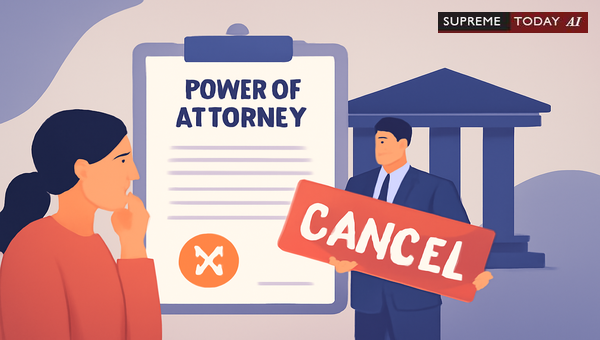
Company's to Challenge Power of Attorney Cancellation: Key Legal Insights
In the complex world of corporate transactions and property dealings, powers of attorney (PoAs) play a crucial role in authorizing representatives to act on behalf of companies. But what happens when such a PoA is canceled? Can the company itself step in to challenge that cancellation in court? The question arises: Does a company have to file a suit questioning the cancellation of a power of attorney executed in favor of its representative as it is the aggrieved party?
This issue hinges on the fundamental principle of —Latin for ''—which determines whether a party has the legal right to bring a case. Not every interested party can sue; courts require proof of direct harm to legal rights or interests. This blog post delves into the legal framework, drawing from key case law and judicial precedents to clarify when a company qualifies as a '' and can pursue such a challenge. Note: This is general information and not specific legal advice; consult a qualified attorney for your situation.
Understanding and ''
is not granted lightly. Courts consistently hold that only a —whose legal rights or interests are by an action or judgment—has the standing to challenge it. As clarified in pivotal case law, the concept of '' requires that the individual or entity's rights or interests are by the judgment or action 2020 7 Supreme 432.
Merely being a third party or having a general interest does not suffice. A cannot be permitted to file an appeal or challenge unless they satisfy the court of their status as an aggrieved person2020 7 Supreme 432. Furthermore, the expression ‘’ does not include someone suffering from psychological or imaginary injuries, emphasizing the need for a 2020 7 Supreme 432.
This principle ensures courts focus on genuine disputes, avoiding frivolous litigation from uninvolved parties.
Application to Companies Challenging PoA Cancellation
When a PoA is executed in favor of a company's representative, the company may claim reliance on that authority for business operations, property management, or transactions. However, upon cancellation, the company must demonstrate on its legal rights to establish .
For instance, if the PoA granted powers essential to the company's control or benefits—such as executing sales or managing assets—the cancellation could directly impair those rights. The company must show: - A to the PoA.- on its interests, not just inconvenience.
Without this, courts will dismiss the suit. The legal finding is clear: A company's legal standing to challenge the cancellation of a power of attorney in court depends on whether it can demonstrate that its legal rights or interests have been adversely affected or prejudicially impacted by the cancellation2020 7 Supreme 432. Mere assertion is insufficient; substantiation is required.
Insights from Related Case Law on PoA and Standing
Judicial precedents reinforce these rules across various scenarios involving PoA cancellations and suit filings.
In one case, a said to have been executed in favour of the petitioner - Company by them also came to be cancelled2024 Supreme(Online)(Kar) 45964. The record showed no clear statement linking respondents to the GPA, underscoring the need for evidentiary proof of impact.
Similarly, courts have scrutinized PoA holders' authority: of Attorney holder, is claiming the right to file the suit on the basis of General Power of Attorney dated 24.02.2016... has vis-à-vis subject-matter of the suit
. This highlights that revoked or questionable PoAs strip standing.
Cancellation effects are profound: As already noted, the fourth respondent had already cancelled the power of attorney executed in favour of the fifth respondent in respect of the petition-mentioned property2024 Supreme(Online)(MAD) 18843. Post-cancellation actions, like sale deeds, are often invalidated, as seen where sale deeds executed after cancellation of PoA were contested, and the court decreed in favor of respondents (drawing from patterns in 2025 Supreme(Online)(Mad) 56742 and related analyses).
Ownership is key: Several sources emphasize that a person must have ownership or legal interest in the property to file a suit, especially to challenge documents like Power of Attorney or sale deeds. For instance, Saraswathi Ammal's suit was dismissed as she had executed a sale deed and cancellation deed, indicating she ceased to be the owner and thus lacked 2025 Supreme(Online)(Mad) 78102.
Other cases frame issues directly: Whether the plaintiff has a to file the present suit?2018 0 Supreme(Del) 3212, Whether plaintiff has to file present suit?2017 0 Supreme(Del) 4049, and Whether the plaintiff Usha Rani has to file the suit on the basis of the power of attorney?2012 0 Supreme(Gau) 964. Courts dismissed where standing was absent, such as when PoA was revoked or no ownership existed 2025 0 Supreme(Mad) 2349 2023 0 Supreme(Telangana) 692 2025 Supreme(Online)(Tel) 18336
Even in complaints, On the point as to whether the power of attorney who has filed the complaint, has locus-standi either to file a complaint or to adduce evidence by representing the Company, has been found against the Complainant2022 0 Supreme(Ker) 712.
Limitations and Common Pitfalls
- Third-party challenges fail without direct harm 2020 7 Supreme 432.
- Revoked PoA undermines authority: Agents lose standing post-cancellation unless a new PoA exists 2024 Supreme(Online)(Kar) 45964 2025 Supreme(Online)(Mad) 56742 2023 0 Supreme(Raj) 2010.
- No cross-objections needed if fully favorable, but adverse findings require proof of aggrievement 2023 Supreme(Online)(MAD) 782.
- Speculative harm insufficient: Must be tangible legal injury.
Practical Recommendations for Companies
To strengthen a challenge:- Gather concrete evidence: Show how cancellation compromises specific legal rights, e.g., lost transaction powers or asset control.- Articulate the impact clearly: Detail the direct adverse effects in pleadings.- Verify PoA validity: Ensure it was subsisting and properly executed.- Seek early legal counsel: Courts demand rigorous proof; weak cases risk dismissal.
Absent such evidence, the company’s challenge is unlikely to succeed, as courts require proof of actual adverse effect to establish 2020 7 Supreme 432.
Conclusion and Key Takeaways
A company may have to question PoA cancellation if it proves direct adverse impact on its legal rights, positioning itself as the aggrieved party. However, courts rigorously enforce standing requirements to prevent unauthorized suits, as seen across precedents like 2020 7 Supreme 432 2025 Supreme(Online)(Mad) 78102 2024 Supreme(Online)(Kar) 45964
Key Takeaways:- Demonstrate tangible legal injury, not mere interest.- Revocation typically ends agent authority; companies must show principal-level harm.- Reference robust evidence to avoid dismissal.
Property and corporate disputes demand precision. While these principles guide generally, outcomes vary by facts—always consult professionals.
References:1. 2020 7 Supreme 432: Core case on '' and .2. 2024 Supreme(Online)(Kar) 45964,
, 2024 Supreme(Online)(MAD) 18843, and others as cited for contextual insights. #LocusStandi, #PowerOfAttorney, #LegalStanding












