


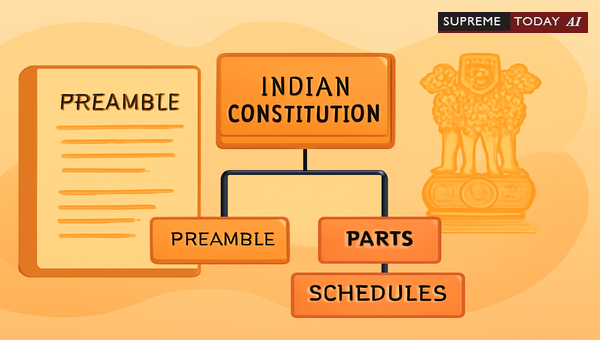
Flow Chart of India's Constitution: Visual Guide
The Constitution of India stands as the bedrock of the world's largest democracy, outlining the structure, powers, and duties of its government. But how does one visualize this complex document? A flow chart of the Constitution of India simplifies its hierarchy, from the Preamble to amendments, making it accessible for students, legal professionals, and curious citizens alike. In this post, we break it down step-by-step, drawing from key legal insights and judicial interpretations. Note: This is general information and not specific legal advice. Consult a qualified lawyer for personalized guidance.
Whether you're preparing for competitive exams like UPSC or simply seeking to understand India's governance, this visual and textual flow chart will guide you through the Constitution's core elements. Let's dive into its creation, structure, and enduring principles.
Overview of the Constitution's Framework
The Constitution of India is a foundational legal document that establishes the framework of the Indian government, delineating the structure, powers, and functions of its primary organs—executive, legislature, and judiciary 2014 0 Supreme(Mad) 1176. It is a product of a constituent act, created through an extraordinary legislative process directly derived from the sovereign will of the people, embodying their social, political, and economic aspirations 2014 0 Supreme(Mad) 1176.
Think of the Constitution as a flow chart starting from the sovereign people:- Source: Collective will of the Indian populace via .- Flow: To Preamble → → Directive Principles → Government Structure → Amendments.
This flow ensures , where the Constitution is the supreme law of India, from which all other laws derive their authority 2014 0 Supreme(Mad) 1176.
Key Components: A Step-by-Step Flow Chart
To represent the Constitution visually, imagine a hierarchical flow chart:
1. Creation and Source (Starting Point)
Enacted as a sovereign act by the , it reflects the people's will 2014 0 Supreme(Mad) 1176. Unlike ordinary laws, it is a capital political fact, not merely a legal act, and is designed to endure beyond ephemeral legal rules 2024 Supreme(Online)(ATFP) 1805.
Flow: Sovereign People → → Adoption () → Enforcement ().
2. Preamble (Guiding Philosophy)
The Preamble declares India as a and emphasizes justice, liberty, equality, and fraternity 2014 0 Supreme(Mad) 1176. It sets the tone for the entire document, flowing into the operative parts.
Key Quote: Declares the sovereignty, socialist, secular, democratic republic nature of India, and emphasizes justice and equality 2014 0 Supreme(Mad) 1176.
3. Structure and Machinery (Core Branches)
Defines the organization of government institutions:- Union Level: President, Parliament (Lok Sabha, Rajya Sabha), .- State Level: Governors, State Legislatures, High Courts.- Local Bodies: Panchayats, Municipalities (via amendments).
Interrelations ensure checks and balances 2014 0 Supreme(Mad) 1176. For instance, Constitution of India is the and all laws flow therefrom 2020 0 Supreme(Kar) 1672.
Visual Flow:1. Executive (President/PM) ←→ Legislature (Parliament) ←→ Judiciary ().2. Parallel state structures mirroring the center.
4. Fundamental Principles (Guiding Ideals)
Enshrines justice, liberty, equality, and fraternity 2014 0 Supreme(Mad) 1176. Includes basic features like secularism, which cannot be amended away 2024 Supreme(Online)(ATFP) 1805 2024 0 Supreme(Gau) 1092.
- (): Flow from equality to protect citizens.
- Directive Principles (): Non-justiciable but guide policy-making.
: When conflicts arise, courts apply to uphold unity and secularism 2024 0 Supreme(Gau) 1092 2024 0 Supreme(Jhk) 170.
5. Amendments and Growth (Dynamic End Point)
allows evolution: Designed to evolve with societal changes, allowing amendments to adapt to new needs while maintaining core principles 2014 0 Supreme(Mad) 1176. Over 100 amendments reflect this adaptability, but remains intact (Kesavananda Bharati case doctrine).
Flow Chart Extension: Original Text → Amendment Process → Ratification → Updated Framework.
Legal Significance and Judicial Role
The Constitution establishes the and ensures branches operate within limits 2014 0 Supreme(Mad) 1176. Courts interpret it as a living document, upholding core principles through 2024 0 Supreme(Gau) 1092 2024 0 Supreme(Jhk) 170.
In practice, flow charts appear in judgments to clarify processes, such as timelines or title flows, underscoring the Constitution's practical application. For example, statutory timelines in assessments are mapped against constitutional articles 2025 Supreme(Online)(Kar) 37862.
Judicial Insights:- Any law which violates the principles of the Constitution would be tested for / violation of the / / abridgement of etc. 2020 0 Supreme(Kar) 1672.- Basic features like secularism are integral, protected via 2024 Supreme(Online)(ATFP) 1805.
This judicial flow reinforces the Constitution's supremacy.
Visual Representation: Simplified Flow Chart in Text
For those seeking a quick reference:
Sovereign People | |Preamble () |+-- & Duties| | Fundamental Principles (Justice, Liberty, Equality, Fraternity)|+-- Government Structure - Executive - Legislature - Judiciary |Amendments () → Doctrine |Supreme Law ()
This textual flow chart mirrors judicial diagrams used in cases for clarity, like bidding processes or evacuation policies referencing constitutional timelines
2021 Supreme(Online)(KER) 48512.
Challenges and Modern Relevance
While the Constitution adapts, challenges like federal tensions or rights enforcement require ongoing interpretation. Courts use flow charts in judgments to demystify complex title flows or procedural timelines, ensuring alignment with constitutional mandates 2025 Supreme(Online)(Kar) 36432 2025 Supreme(Online)(Del) 10465.
For instance, in property disputes, title flow charts trace back to constitutional property rights 2025 Supreme(Online)(Del) 10465. Similarly, economic laws are tested against the 2020 0 Supreme(Kar) 1672.
Conclusion and Key Takeaways
The flow chart of the Constitution of India reveals a dynamic, people-centric framework rooted in sovereignty and designed for endurance. From the Preamble's ideals to amendments' flexibility, it guides India's governance.
Key Takeaways:- Supreme Authority: All laws flow from the Constitution 2020 0 Supreme(Kar) 1672.- : Unamendable core like secularism 2024 Supreme(Online)(ATFP) 1805.- Living Document: Evolves via amendments and 2014 0 Supreme(Mad) 1176.- Practical Tool: Flow charts aid understanding in legal practice.
For deeper study, refer to the full text and landmark judgments. This overview is for educational purposes; seek professional advice for legal matters.
#IndianConstitution, #ConstitutionFlowChart, #LegalGuideIndia












