


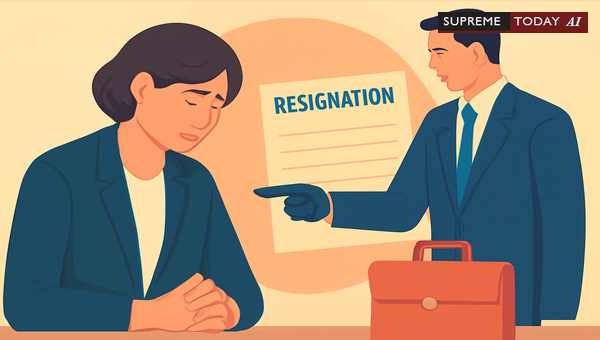
What Is Constructive Dismissal? Definition, Examples & Implications
Imagine showing up to work every day only to face escalating harassment, a sudden demotion without explanation, or drastic changes to your role that make your job unrecognizable. Feeling forced to resign? You might be experiencing constructive dismissal—a concept in employment law where your resignation is treated as a dismissal by the employer. But what exactly does this mean legally?
In this comprehensive guide, we'll answer the key question: What is Constructive Dismissal in Employment Law, including its legal definitions, examples, and implications? We'll break down the essentials, explore real-world scenarios, and highlight arguments from both sides, all while emphasizing that this is general information and not specific legal advice. Always consult a qualified employment lawyer for your situation.
Defining Constructive Dismissal
Constructive dismissal generally occurs when an employee resigns because the employer's conduct has made the working conditions intolerable. In such cases, the resignation is typically treated as a dismissal, enabling the employee to pursue claims for wrongful termination or unfair dismissal. This principle protects employees from employers who breach the employment contract through their actions or inactions, effectively forcing the employee out.2012 0 Supreme(J&K) 797
The core idea is rooted in contract law: the employer has fundamentally breached the implied terms of the employment contract, such as mutual trust and confidence. Courts often assess whether a reasonable person in the employee's position would find the situation unbearable. Key to this is proving the employer's behavior went beyond normal management rights.2012 0 Supreme(J&K) 791
Key Legal Elements of a Constructive Dismissal Claim
To succeed in a constructive dismissal claim, employees typically must establish three main elements:
- Employer's Conduct: Demonstrate a significant breach of contract or an intolerable work environment. This could include:
- Persistent harassment or bullying.
- Unjustified demotion or salary reduction.
Major unilateral changes to job duties, location, or hours without agreement. 2012 0 Supreme(J&K) 758
Resignation as a Last Resort: Show that resignation was the only reasonable option. Employees often need to prove they raised concerns with the employer first, giving them a chance to remedy the situation—much like the principle that decisions without hearing necessary parties are invalid. 2012 0 Supreme(J&K) 797
Causation: Link the employer's actions directly to the resignation decision. External factors shouldn't undermine this connection.
Failure on any element can doom the claim. For instance, if an employee resigns impulsively without complaining, courts may view it as voluntary. 2012 0 Supreme(J&K) 753
Real-World Examples of Constructive Dismissal
Here are common scenarios where constructive dismissal claims arise:
Harassment Case: An employee endures repeated derogatory comments from a manager, creating a hostile environment. After HR ignores complaints, they resign. Courts may rule this a breach of trust and confidence.
Demotion Example: A long-term sales manager is suddenly reassigned to a junior role with less pay, no consultation. This unilateral change often qualifies as constructive dismissal.
Workload Overhaul: An employer drastically increases hours or responsibilities without support, leading to burnout. If unaddressed, resignation may be justified.
These examples illustrate how subtle escalations can cross into legal territory. Importantly, minor disagreements rarely suffice; the breach must be serious. 2012 0 Supreme(J&K) 777
Arguments from Both Sides
Employee's Perspective (Claimant)
- The employer's actions severely breached the contract, making continued employment untenable.
- Reasonable efforts were made to resolve issues, proving resignation wasn't hasty.
- Any reasonable worker would have left under similar intolerable conditions.
Employer's Defense
- Actions were legitimate management decisions, not breaches (e.g., restructuring for business needs).
- The employee didn't exhaust internal remedies, making resignation premature.
- Other factors, like personal issues, influenced the departure, breaking causation.
The burden of proof rests primarily on the employee to substantiate the claim. Employers defend by showing justification and procedural fairness. This mirrors broader legal principles where findings based on facts can't be overturned lightly unless perverse. 2012 0 Supreme(J&K) 791
Implications for Employees and Employers
For Employees:- Successful claims may yield compensation for lost wages, notice periods, or emotional distress.- Time limits apply (e.g., 3 months for tribunal claims in some jurisdictions), so act quickly.- Document everything: emails, meetings, performance reviews.
For Employers:- Risk costly payouts and reputational damage.- Implement clear policies on changes, grievances, and communication to mitigate risks.- Train managers on avoiding behaviors that erode trust.
In related legal contexts, courts stress procedural fairness, such as attesting changes in the presence of all parties or hearing disputes properly—principles that extend to employment relations. For example, mutations without hearing necessary parties amid possession disputes are set aside, underscoring the need for due process. 2012 0 Supreme(J&K) 797 2012 0 Supreme(J&K) 758
Broader Legal Context and Principles
While constructive dismissal is employment-specific, it draws from universal tenets like natural justice. Courts have invalidated decisions violating rules on hearings or where disputes exist without proper inquiry. 2012 0 Supreme(J&K) 753 Similarly, employers should ensure employees are heard before major changes to avoid claims.
Interlocutory or non-final matters may not be revisable immediately, advising parties to pursue remedies step-by-step. 2012 0 Supreme(J&K) 777 This reinforces that constructive dismissal claims require solid evidence from the outset.
Key Takeaways
- Constructive dismissal turns a resignation into a dismissal claim when employers create intolerable conditions.
- Prove breach, no alternatives, and causation—typically by documenting complaints.
- Both sides have strong arguments; outcomes hinge on facts.
- Disclaimer: This article provides general insights into constructive dismissal under employment law. Laws vary by jurisdiction (e.g., UK, Canada, Australia). It is not legal advice. Consult a professional for personalized guidance.
Stay informed, protect your rights, and foster healthy workplaces. If facing issues, seek advice promptly.
#ConstructiveDismissal, #EmploymentLaw, #WrongfulTermination















