


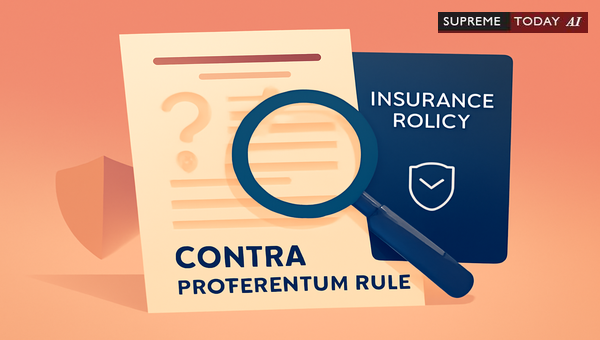
: Essential Guide to Contract Interpretation
In the complex world of contracts, ambiguity can lead to disputes that cost time and money. What happens when contract language is unclear? Enter the , a key principle in contract law that helps resolve such issues. This rule, often invoked in insurance policies and commercial agreements, states that ambiguous terms should be construed against the party who drafted them. But when does it apply, and what are its limits?
If you're a business owner drafting contracts, an insurer, or simply navigating legal agreements, understanding the —Latin for words of the document are to be taken most strongly against the one putting them forward—is crucial. This post breaks it down, drawing from established precedents and recent cases, to provide clarity on its definition, application, limitations, and practical tips.
What is the ?
The is a principle of contract interpretation applied when there's genuine ambiguity in the wording. It directs courts to interpret unclear terms against the interests of the drafter, promoting fairness and cautioning drafters to use precise language.
Key Applications
- Ambiguity Resolution: It kicks in only after determining ambiguity exists. Courts first try to discern the parties' intentions from the document as a whole. If doubt persists, the rule favors the non-drafter. This is common in insurance disputes, where policies are typically drafted by insurers. For instance, ambiguities are construed against the insurer 678.
- Overriding Intentions: The rule yields to the express intentions of the parties. If intentions are clear from the contract's plain language or context, contra proferentum doesn't apply 45.
As noted in historical precedents like , ambiguous terms must be construed against the drafter 14. Similarly, reinforced this in insurance contexts 15.
When Does the Rule Not Apply? Limitations and Exceptions
Not every unclear reading triggers the rule. Courts emphasize restraint:
- Clear Terms: If language is straightforward, the rule is irrelevant. It must be borne in mind, however, that the does not apply if the words in the clause are clear
. In one insurance case, the court rejected the rule because there is no ambiguity in the Policy and therefore, rule Contra Proferentum is not applicable
Manglam Organics Limited VS New India Assurance Co. Ltd.
. - Contextual Balance: Conflicting clauses may invite the rule, but overall context prevails. In a vessel insurance dispute, the appellant tried introducing external factors for ambiguity, but the court held it impermissible under the rule of contra proferentum as no ambiguity in text of policy itself 2025 4 Supreme 121.
- No Ambiguity in Commercial Contexts: In telecom licensing, principles like contra proferentem don't apply without doubt: Principles of Contra proferentem and - Do not apply where there is no ambiguity 2019 0 Supreme(SC) 1189.
Recent federal decisions affirm alignment with parties' expressed intentions 16.
Contra Proferentum in Practice: Case Law Insights
This rule frequently appears in insurance, consumer protection, and commercial contracts. Here's how courts have applied (or rejected) it:
Insurance and Policy Disputes
- In a business interruption fire policy case, the insurer argued no ambiguity, avoiding contra proferentum. The court focused on policy terms like and , awarding the full claim based on clear departmental turnover calculations
Manglam Organics Limited VS New India Assurance Co. Ltd.
. - Motor vehicle insurance invoked it favorably for the insured: We have to apply the doctrine of contra proferentum to interpret this clause covering risks beyond just the driver 2009 0 Supreme(Kar) 236.
- Vessel grounding claim: Despite (utmost good faith), no ambiguity meant no rule application, but the insurer still couldn't repudiate on other grounds 2025 4 Supreme 121.
Consumer and Property Cases
- insurance complaint: Complainant argued contra proferentum for Clause V exclusions, citing precedents like Manmohan Nanda2023 Supreme(Online)(NCDRC) 1468.
- Delayed flat possession: Appellant claimed doctrine violation by ignoring agreement clauses 2021 Supreme(Online)(NCDRC) 79.
Commercial and Arbitration
- case: Documents clear, so rule didn't favor plaintiff
.
- Arbitration award challenge: Rule applicable only on ambiguity; contract enhancements become binding 2007 0 Supreme(Del) 1397.
- VRS scheme: Interpreted against employer who backtracked on disinvestment links 2010 0 Supreme(Del) 368.
These examples show the rule's role as a tiebreaker, not a default.
Strategic Recommendations for Drafters and Litigators
To minimize risks:- Thorough Review: Scrutinize for clarity before signing. Courts won't rewrite clear terms.- Document Intentions: Use recitals or side letters to express mutual understanding, overriding potential ambiguities.- Study Precedents: In insurance, adds layers—disclose fully 2025 4 Supreme 121. Reference cases like Edis v. Bury when arguing ambiguity
.
Businesses should draft precisely, especially in standard-form contracts like policies, where they're presumed the (drafter).
Conclusion: Navigating Ambiguity Wisely
The is a vital safeguard in contract interpretation, particularly for ambiguities, but it's no substitute for clear drafting. It typically favors non-drafters in insurance and consumer cases yet bows to evident intentions or unambiguous text. While powerful, its application is nuanced—courts demand genuine ambiguity first.
Key Takeaways:- Applies to ambiguous terms against drafter.- Excluded if clear or intentions explicit.- Prevalent in insurance; check precedents.- Draft carefully to avoid invocation.
This post provides general information on the and is not legal advice. Consult a qualified attorney for your specific situation.
References: 123456789101112131415162025 4 Supreme 121
2023 Supreme(Online)(NCDRC) 1468 2021 Supreme(Online)(NCDRC) 79
Manglam Organics Limited VS New India Assurance Co. Ltd.
2019 0 Supreme(SC) 1189 2010 0 Supreme(Del) 368 2009 0 Supreme(Kar) 236 2007 0 Supreme(Del) 1397 #ContraProferentum, #ContractLaw, #LegalInterpretation















