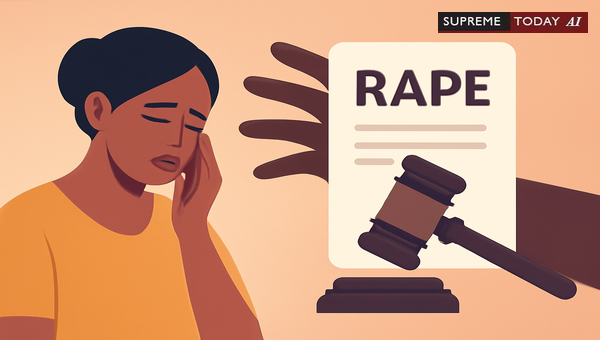
Victim Rights in Rape Cases: Indian Law Explained
Disclaimer: This article provides general information on legal principles in India and is not a substitute for professional legal advice. Consult a qualified lawyer for your specific situation.
In the Indian judicial system, victims of sexual offenses often face complex legal hurdles, especially when key elements like penetration are absent. A common concern arises: Can a victim bring a case to justice even if rape charges cannot be sustained? This question underscores the broader issue of victim's rights, dignity, and access to remedies under Indian law. This blog post delves into the legal framework, key precedents, and practical steps for victims seeking redress.
Drawing from established statutes like the Indian Penal Code (IPC) and Code of Criminal Procedure (CrPC), along with Supreme Court rulings, we'll explore how victims can still secure convictions for lesser offenses and uphold their rights throughout the process. Whether it's identification of the accused or documentation of evidence, understanding these rights empowers victims.
Overview of Victim's Rights in the Indian Judiciary
Victims in criminal cases, particularly sexual offenses such as rape, have enshrined rights to justice, protection, and fair treatment. The judiciary emphasizes dignity and support, ensuring victims are not revictimized during trials. While Section 375 IPC defines rape with penetration as an essential ingredient, the absence of this does not leave victims without recourse. Courts often pivot to lesser charges, balancing accused rights with victim protection. 2006 7 Supreme 741
This analysis is grounded in principles from landmark cases, highlighting how intent and victim testimony play pivotal roles. For instance, victim identification in court remains crucial for establishing guilt, bolstering the prosecution's case. 2006 0 Supreme(Cal) 419
Key Legal Principles Governing Sexual Offenses
1. Definition of Rape and Attempted Rape
Under Section 375 IPC, rape requires proof of penetration—be it penile, object, or other specified acts—sufficient to cause injury or introduce semen. Without this evidence, a rape conviction fails. Similarly, attempted rape demands clear intent and steps towards penetration. Courts have consistently ruled that mere assault without these elements cannot sustain such charges. 2006 7 Supreme 741
However, Section 222 CrPC allows conviction for lesser offenses if their ingredients are proven. For example:- Outraging modesty (Section 354 IPC): Applies if the accused's actions assault or criminally intimidate the victim sexually.- Kidnapping for illicit intercourse (Section 366 IPC): Relevant where intent to compel sexual acts is evident.
The absence of penetration negates the possibility of a rape conviction. However, if the accused's actions indicate an intention to commit sexual assault, they may be charged under other relevant sections... 2006 7 Supreme 741
2. Core Victim's Rights
Victims hold fundamental rights:- Right to file complaints and seek protection: Under CrPC provisions, victims can approach police or magistrates directly.- Right to participate in trials: Including hearing appeals and receiving updates.- Dignity and privacy: Courts protect identities, especially in sexual cases via in-camera trials.- Compensation: Under Section 357A CrPC, states provide victim compensation schemes.
Victim testimony carries significant weight. Victims can identify their assailants in court, and such identification is crucial for establishing the guilt of the accused. The credibility of the victim's testimony is often a key factor... 2006 0 Supreme(Cal) 419
In practice, medical reports, witness statements, and forensic evidence strengthen cases. For age determination in minor victim cases, documents like birth certificates override inconclusive X-rays. Though the Doctor has given opinion about the age of the victim girl... the birth certificate of the victim girl was marked as Ex.P.2... 2021 Supreme(Online)(MAD) 5105
3. Judicial Precedents and Case Law
The Supreme Court has shaped victim's rights through nuanced rulings:- No penetration, no rape: But intent suffices for lesser charges like Section 354. 2006 7 Supreme 741- Victim credibility paramount: Sole testimony can convict if reliable, without corroboration needs.
Related cases illustrate broader applications. In a kidnapping scenario, refusal by the victim led to charges despite no marriage consent. Since the victim girl refused to marry him, the appellant took the victim child from her house... 2021 Supreme(Online)(MAD) 5105
In dowry harassment claims, courts scrutinize intent: The appellant had married the victim knowing about her Caste and Community... the question of the appellant subjecting the deceased to harassment... does not arise...
SAKTHIVEL vs THE DEPUTY SUPERINTENDENT OF POLICE
Even in non-sexual violence, victim injury documentation aids justice: ...the Victim was badly injured and was armed with daos and weapons and attacked the Victim.
Shri Jikham Syrti vs State Of Meghalaya
These precedents affirm that while major charges may fail, judicial flexibility ensures accountability.
Practical Recommendations for Victims
Navigating the system requires proactive steps:- Seek legal aid immediately: Free services via District Legal Services Authorities.- Document everything: Preserve medical reports, FIR copies, photos, and witness contacts.- Leverage support services: NGOs like women's helplines (1091) offer counseling and escorts.- Appeal if needed: Victims have locus standi in higher courts.
Victims should seek competent legal representation... document all evidence... be made aware of their rights... (Adapted from legal analysis 2006 7 Supreme 741)
In evidence-heavy cases, like corruption probes involving private exchanges, detailed statements prove pivotal: EPABX equipment was ordered... installed at 19 places... 2019 0 Supreme(Mad) 1440
Challenges and Additional Contexts
Victims often encounter delays, hostile cross-examinations, or acquittals on technicalities. In abetment to suicide claims, mens rea is key: Even if the rigour... it should be shown that the accused could reasonably foresee... the victim was almost certain... to commit suicide. 2012 0 Supreme(Bom) 869
Property or economic cases also highlight victim persistence, as in tax disputes over agricultural vehicles: Petitioner's case is that he had purchased a tractor... for agricultural purpose which was totally exempted... 2007 0 Supreme(Pat) 1466
These underscore the need for robust evidence across offense types.
Conclusion and Key Takeaways
Victims in India's judiciary, especially sexual offense cases, are not powerless without full rape proof. Lesser offenses under CrPC 222, coupled with strong testimony and precedents, pave the way for justice. Key takeaways:- Penetration is essential for IPC 375, but intent covers alternatives. 2006 7 Supreme 741- Victim identification and credibility drive outcomes. 2006 0 Supreme(Cal) 419- Document evidence and seek representation diligently.
Empowerment lies in awareness. While laws evolve—with POCSO and new criminal codes—victims must assert rights. Stay informed, seek help, and pursue justice relentlessly.
References:- 2006 7 Supreme 741- 2006 0 Supreme(Cal) 419- 2021 Supreme(Online)(MAD) 5105-
SAKTHIVEL vs THE DEPUTY SUPERINTENDENT OF POLICE
-
2012 0 Supreme(Bom) 869(Word count: approx. 1050)
#VictimRightsIndia, #RapeLawIndia, #IndianJudiciary