SupremeToday Landscape Ad
AI Thinking

AI Thinking...

Searching Case Laws & Precedent on Legal Query.....!

Scanned Judgements…!

Checking relevance for Manish Jain VS Akanksha Jain...

2017 0 Supreme(SC) 291 : Under the Hindu Marriage Act, 1955, Section 24, the quantum of maintenance pendente lite depends on the status of the parties, the sufficient independent income of the applicant, and the capacity of the spouse to pay. Merely because the wife is educated and able to support herself is of no relevance, nor is the financial position of her parents. In this case, the wife was not having a permanent employment or permanent source of income at the relevant time, and the High Court''''s award of 60,000/- per month was reduced to 25,000/- as it was considered on the higher side. This establishes that financial self-sufficiency of a spouse, particularly if they lack a permanent income, does not automatically disentitle them to maintenance pendente lite, but the court must consider the actual financial capacity and status of both parties.Checking relevance for Parvin Kumar Jain VS Anju Jain...

Checking relevance for Rinku Baheti VS Sandesh Sharda...

2025 4 Supreme 176 : The court held that permanent alimony should be determined based on a balanced consideration of various factors, including the wife''''s independent income, assets, reasonable needs, and her standard of living during the marriage. The court emphasized that the wife''''s entitlement to maintenance must be decided based on factors applicable to her and not solely on the husband''''s income or what he paid to his ex-wife. In this case, the petitioner-wife had an independent monthly income of Rs. 55,000, fixed deposits worth Rs. 25 lakh, recurring deposits, National Saving Certificates, PPF balance, and bank balances totaling over Rs. 67 lakh. She also owned a residential flat in Pune that she rented out, and she did not suffer from any medical conditions requiring treatment. The court concluded that her financial position and independent sources of income were sufficient to support her standard of living, and therefore, the principle of no alimony for a financially self-sufficient independent spouse was applied. The court ultimately awarded a lump sum of Rs. 12 crores as permanent alimony, which was considered a full and final settlement, recognizing her financial independence and the absence of any need for ongoing maintenance.Checking relevance for Sau. Jiya VS Kuldeep...

2025 3 Supreme 358 : The court explicitly rejected the argument that a financially self-sufficient spouse is not entitled to alimony. It held that even if the wife is earning (from a salon), this does not bar her from receiving maintenance. The court emphasized that the determination of maintenance must assess whether her income suffices to maintain a lifestyle similar to that experienced during the marriage. In this case, the wife''''s income of Rs. 2,00,000 per month was deemed unsubstantiated and exaggerated, and the court found the husband''''s disclosure of income to be misleading. The court awarded a one-time settlement of Rs. 10,00,000/- to the wife, stating that this amount would cover all pending and future claims and serve the purpose of equity and justice, despite her independent income. This demonstrates that financial self-sufficiency does not automatically disqualify a spouse from receiving alimony, especially when the standard of living during marriage was high and the wife''''s income is not proven or sufficient to maintain that standard.Checking relevance for Ramesh Chand Daga VS Rameshwari Bai...

Checking relevance for KALYAN DEY CHOWDHURY VS RITA DEY CHOWDHURY NEE NANDY...

Checking relevance for Aboil alias Yugandhara W/o Tejpal Patil VS Tejpal S/o Premchand Patil...

2022 0 Supreme(Bom) 1612 : The court held that possession of qualifications alone cannot be a reason to deny interim maintenance, and the capability to earn does not automatically disqualify a spouse from maintenance. The court emphasized that mere capability to earn is not sufficient; there must be concrete proof of actual employment or income. The court also distinguished between the ability to earn and actual earning, noting that the Apex Court in Shailja (supra) ruled that merely because a wife is capable of earning, it cannot be a reason to reduce maintenance awarded by the Family Court. Therefore, a financially self-sufficient or independent spouse is not automatically disqualified from receiving alimony if they lack actual income or employment, especially when the other spouse has a significantly higher income.Checking relevance for Sweta Verma, Wife Of Rajesh Kumar Verma vs Rajesh Kumar Verma, Son Of Late Brahmdev Prasad Verma...

2025 0 Supreme(Jhk) 910 : The court held that a spouse who is financially self-sufficient and independent is not entitled to alimony. This principle is supported by the Supreme Court''''s judgment in Rajnesh Vs. Neha (2021) 2 SCC 324, which states that the plea of the wife being educated and capable of supporting herself is not an automatic bar to maintenance, but the court must consider the factual situation, including whether the wife has independent income sufficient for her support. The court emphasized that maintenance is not awarded to a spouse who is financially independent and capable of maintaining herself, as the objective of alimony is to prevent destitution, not to provide financial benefit to a self-sufficient spouse. The trial court''''s failure to consider the financial status and independent income of the respondent was a key reason for setting aside the alimony award.


AI Overview

AI Overview...

When Indian Courts Deny Alimony to Financially Independent Spouses in Divorce Proceedings

No Alimony for Self-Sufficient Spouses in India

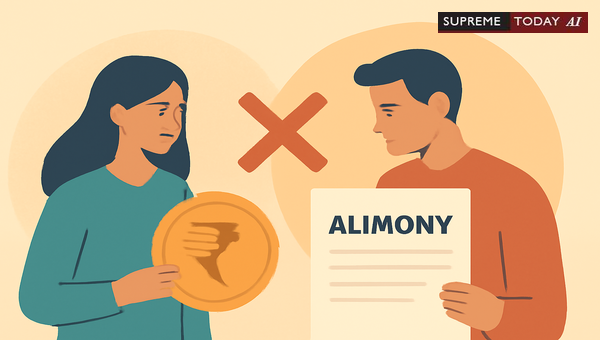
In the emotionally charged world of divorce proceedings, one burning question often arises: No Alimony for Financially Self Sufficient Independent Spouse? Many spouses seek maintenance or alimony post-separation, but what if one party is gainfully employed with ample resources? Under Indian family law, particularly the Hindu Marriage Act, 1955, courts typically deny alimony to those who can support themselves. This post explores the legal framework, key precedents, and nuances to help you understand when self-sufficiency trumps alimony claims.

Note: This is general information based on judicial precedents and not specific legal advice. Consult a qualified lawyer for your situation.

The Purpose of Alimony and Maintenance in Indian Law

Alimony, also known as maintenance or permanent alimony, aims to prevent destitution rather than provide a windfall. Sections 24 and 25 of the Hindu Marriage Act, 1955, along with Section 125 of the CrPC, 1973, emphasize support for the financially weaker spouse. However, courts scrutinize the claimant's independent income, assets, and earning capacity before awarding relief. 2017 0 Supreme(SC) 291

As established in key rulings, maintenance and alimony are primarily meant to support spouses who are unable to support themselves due to lack of income, incapacity, or other hardship. 2017 0 Supreme(SC) 291 This principle underscores that self-sufficient spouses generally lack entitlement.

Key Factors Courts Consider for Denying Alimony

Courts evaluate several elements to determine alimony eligibility:

  • Financial Self-Sufficiency: Independent income or assets that cover reasonable living expenses negate the need for maintenance. For instance, a gainfully employed spouse with sufficient earnings may not claim pendente lite alimony without an application proving need. 2014 0 Supreme(Kar) 629

  • Earning Capacity: Higher qualifications or potential to earn matter, but actual ability and efforts are crucial. Possession of higher qualifications or being capable of earning does not automatically disqualify a spouse from maintenance, but the capacity to support oneself is a significant factor. 2022 0 Supreme(Bom) 1612
  • Status and Lifestyle: Courts balance the parties' social status, standard of living, and conduct, but not at the expense of rewarding idleness. 2017 0 Supreme(SC) 291
  • Evidence of Assets: Suppression of income or assets, like directorship in companies, can lead to denial. The respondent was deemed self sufficient wealthy and financially independent. 2015 0 Supreme(Bom) 2628

In one case, the wife, being gainfully employed with independent income sufficient for her support, did not even apply for interim alimony, reinforcing that need must be proven. 2014 0 Supreme(Kar) 629

Landmark Precedents on Self-Sufficiency

Preventing Destitution, Not Ensuring Luxury

The Supreme Court in Vinny Paramvir Parmar clarified there is no fixed formula for alimony; courts must consider income, properties, conduct, and standard of living. Yet, the purpose remains to avoid destitution for capable spouses. 2017 0 Supreme(SC) 291 The law discourages claims for maintenance based solely on assets or income of the spouse, especially if they have sufficient independent means. 2017 0 Supreme(SC) 291

Qualifications Alone Don't Guarantee Alimony

The Madhya Pradesh High Court held that a well-qualified wife who remains idle without attempting to earn cannot claim maintenance. Possession of qualifications alone cannot be a reason to deny interim maintenance, but genuine efforts are expected. If unemployed without valid reason, claims fail. 2022 0 Supreme(Bom) 1612

Non-Axiomatic Entitlement

Entitlement to permanent alimony is not automatic post-divorce. The entitlement of a spouse for receipt or payment of permanent alimony depends upon various factors. In a Special Marriage Act case, the court refused alimony due to the wife's financial capability and husband's voluntary payments. 2020 0 Supreme(Mad) 1435

Exceptions: When Alimony May Still Be Awarded

Self-sufficiency isn't absolute. Courts award maintenance to:

  • Financially Weak Spouses: Even in irregular marriages, like bigamy, a dependent spouse isn't denied relief. Bigamous marriage may be declared illegal... but it cannot be said to be immoral as to deny even the right of alimony or maintenance to a spouse financially weak and economically dependent. 2025 Supreme(Online)(MP) 10055
  • Genuine Incapacity: Proven inability to work due to health or other hardships overrides potential earnings.
  • Needy Despite Efforts: Voluntary unemployment isn't penalized if efforts to secure employment are evident. However, filing of false criminal cases by wife may be ground to grant husband divorce — It is not ground to deny her permanent alimony if needy.

    K. Narasinga Rao VS K. Neeraja @ Rajini

In contrast, a spouse living in penury without independent income may receive lump-sum alimony, secured against retiral benefits, considering the respondent's salary.

K. Narasinga Rao VS K. Neeraja @ Rajini

Practical Recommendations for Divorce Proceedings

To navigate alimony claims effectively:

  • Claimants: Substantiate incapacity or job search efforts with evidence like bank statements, job applications, or medical records.
  • Respondents: Produce proof of the claimant's income, assets, and employment history to demonstrate self-sufficiency.
  • Both Parties: Disclose full financials transparently; suppression backfires, as seen when a wife hid family business income. 2015 0 Supreme(Bom) 2628
  • Seek Interim Relief Judiciously: Under Section 24, an application is mandatory for pendente lite alimony—courts won't award without it. 2014 0 Supreme(Kar) 629

Courts urge concrete evidence over assumptions, ensuring fairness.

Conclusion and Key Takeaways

In summary, Indian courts generally deny alimony to financially self-sufficient spouses capable of independent support, prioritizing anti-destitution over equalization. Precedents like 2017 0 Supreme(SC) 291 and 2022 0 Supreme(Bom) 1612 affirm that maintenance hinges on proven need, not mere marital status.

Key Takeaways:- Self-sufficiency through income or assets typically bars alimony claims. 2017 0 Supreme(SC) 291- Actual earning efforts matter more than qualifications. 2022 0 Supreme(Bom) 1612- Exceptions exist for genuine dependency. 2025 Supreme(Online)(MP) 10055- Always gather robust financial evidence.

Understanding these principles empowers informed decisions in matrimonial disputes. For personalized guidance, reach out to a family law expert.

References:1. 2017 0 Supreme(SC) 291 – Principles for alimony pendente lite.2. 2022 0 Supreme(Bom) 1612 – Capacity to earn and maintenance.3. 2014 0 Supreme(Kar) 629 – No application for self-sufficient spouse.4. 2015 0 Supreme(Bom) 2628 – Suppression of assets.5. 2020 0 Supreme(Mad) 1435 – Non-axiomatic alimony.6. 2025 Supreme(Online)(MP) 10055 – Protection for weak spouses.7.

K. Narasinga Rao VS K. Neeraja @ Rajini

– Factors for needy spouses. #AlimonyLaw, #FamilyLawIndia, #DivorceMaintenance
Chat Download
Chat Print
Chat R ALL
Landmark
Strategy
Argument
Risk
Chat Voice Bottom Icon
Chat Sent Bottom Icon
SupremeToday Portrait Ad
logo-black

An indispensable Tool for Legal Professionals, Endorsed by Various High Court and Judicial Officers

Please visit our Training & Support
Center or Contact Us for assistance

qr

Scan Me!

India’s Legal research and Law Firm App, Download now!

For Daily Legal Updates, Join us on :

whatsapp-icon Back to top