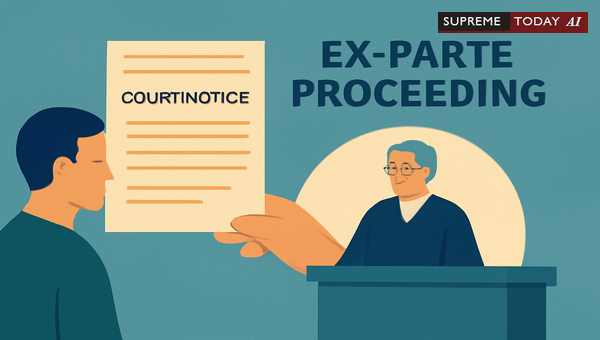
Court on Leave After Defendant's First Hearing: Must Issue Notice?
Imagine showing up to court for your first hearing as a defendant, only to find the judge on leave. The case gets continued, but the next hearing proceeds without further notice. Is this fair? Can the court validly move forward, perhaps even ex-parte? These questions arise frequently in civil litigation, especially under the Code of Civil Procedure (CPC), 1908.
In this post, we dive into the legal scenario: Defendant appear in the court first hearing but court was on leave continue 2 hearing court should issue notice. We'll explore the principles of proper notice, service of summons, and the risks of proceeding without it. This is general information based on legal precedents and should not be taken as specific legal advice—consult a qualified lawyer for your case.
Understanding the Core Issue: Defendant's Appearance and Court Absence
When a defendant appears at the initial hearing but the court is unavailable due to leave or a non-judicial session, the proceedings typically stand adjourned. However, advancing to the second hearing without issuing fresh notice raises serious concerns about due process.
Generally, courts must ensure proper service before any substantive hearing. The defendant's mere appearance at the first instance does not waive this right. As established in key legal documents, The defendant's appearance at the first hearing does not automatically imply consent or waive the requirement for proper service and notice 1992 0 Supreme(MP) 108.
Proceeding ex-parte (without the defendant) in such circumstances can violate natural justice principles, potentially leading to orders being set aside later.
Legal Duty to Issue Proper Notice Under CPC
Mandatory Service of Plaint Copy
Under Order 5 Rule 2 of the CPC, service must include a copy of the plaint alongside the summons. Legal analysis confirms: service by publication or other means does not substitute for proper notice, especially the supply of a copy of the plaint, which is mandatory under Order 5 Rule 2 of the Civil Procedure Code (C.P.C.) 1992 0 Supreme(MP) 108.
Even if the defendant appeared once, the court retains a duty to issue notice for subsequent hearings, particularly after an adjournment due to leave.
Effect of Court Being on Leave
Courts cannot function judicially during leave periods. When the court is on leave or not in judicial session, it cannot proceed with a hearing or pass orders without proper notice, including a copy of the plaint 1992 0 Supreme(MP) 108. Case law like Kranti Kumar Jha v. Dr. J.B. Shrivastava reinforces that such periods deem the court closed for judicial purposes, invalidating any proceedings without rescheduling and notice 1992 0 Supreme(MP) 108.
Failure here questions the court's jurisdiction, making ex-parte decrees vulnerable to challenge under Order 9 Rule 13 CPC.
Defendant's Appearance: No Automatic Waiver
A party's presence at the first hearing signals awareness but doesn't greenlight unchecked progression. A party’s appearance at the first hearing does not automatically entitle the court to proceed without proper service or notice 1992 0 Supreme(MP) 108.
The law adopts a liberal and justice-oriented approach, ensuring that parties are not deprived of hearing unless there is misconduct or gross negligence 1992 0 Supreme(MP) 108. Thus, post-leave, fresh notice—including the plaint copy—is typically required before the second hearing.
Insights from Related Case Law and Principles
This principle aligns with broader jurisprudence on notice and ex-parte risks:
In ex-parte decree challenges, courts scrutinize service rigor. The court has to reach a satisfaction that the defendant had notice of the date of hearing, and had sufficient time to appear before the court 2014 0 Supreme(Raj) 1718. Irregular service, without proof like witness addresses or examination under Order 5 Rule 19, justifies setting aside decrees 2014 0 Supreme(Raj) 1718.
Non-appearance excuses, like counsel busy elsewhere, rarely apply in higher courts where trials are fixed in advance. The principle that non-appearance of a party on account of counsel being busy in another Court is sufficient ground for setting aside the ex-parte decree can be applied to the trial on the original side of the High Court? No 1984 0 Supreme(Del) 135. This underscores preparation and notice importance, but doesn't override initial service duties.
Without-notice applications demand exceptional circumstances and fair disclosure. The duty of fair disclosure and the exceptional nature of without notice applications, emphasizing the importance of time-limited injunctions
Kewal Ashokabhai Vasoya VS Suarabhakti Goods Pvt. Ltd
. Courts limit such orders, reserving liberty for defendants to seek variation with notice Kewal Ashokabhai Vasoya VS Suarabhakti Goods Pvt. Ltd
.Practice often requires notice even for interim steps: the practice in this court has been for the applicant to apply in the first place ‘ex parte’ for a notice of his application to be served on the respondent
BALASUBRAMANIAN PILLAI v. VALLIAPA CHETTIAR
.
These cases highlight that skipping notice post-adjournment risks invalidation, prioritizing principles of natural justice.
Exceptions and Limitations
Exceptions are narrow:- Voluntary participation without objection after gaining case knowledge.- Gross negligence or misconduct by the defendant.
Absent these, the law prioritizes ensuring proper service and notice 1992 0 Supreme(MP) 108. Without-notice orders in IP or urgent matters are time-bound and disclose full facts
Kewal Ashokabhai Vasoya VS Suarabhakti Goods Pvt. Ltd
.
Practical Recommendations for Parties and Courts
To avoid pitfalls:- For Courts: Refrain from proceedings during leave; issue notices (with plaint copies) for rescheduled hearings. Verify service compliance before ex-parte steps.- For Defendants: If appearing amid court absence, demand written notice for future dates. Challenge irregularities promptly via Order 9 Rule 13.- For Plaintiffs: Ensure robust service records; avoid assuming appearance waives future notices.- General Tip: Parties should confirm hearing dates and service modes, as parties shall appear before the Civil Court without notice of first hearing in some restored suits, but this evolves post-initial stages 2020 0 Supreme(Kar) 1487.
Key Takeaways
- Defendant's first-hearing appearance doesn't waive notice for adjourned dates, especially post-court leave.
- Courts must issue proper notice under CPC Order 5, including plaint copies 1992 0 Supreme(MP) 108.
- Ex-parte advances risk invalidation; prioritize service proof 2014 0 Supreme(Raj) 1718.
- Justice favors hearings over technicalities, barring negligence.
In conclusion, yes—the court should issue proper notice before the second hearing. Proceeding without such notice violates established legal principles and can render subsequent orders invalid 1992 0 Supreme(MP) 108. Stay informed, serve diligently, and uphold due process for robust litigation outcomes.
This post draws from precedents like 1992 0 Supreme(MP) 108, 2014 0 Supreme(Raj) 1718, 1984 0 Supreme(Del) 135, Kewal Ashokabhai Vasoya VS Suarabhakti Goods Pvt. Ltd
, and others. For tailored advice, contact a legal professional.
#CourtNotice, #CPCLaw, #ExParteProceedings