


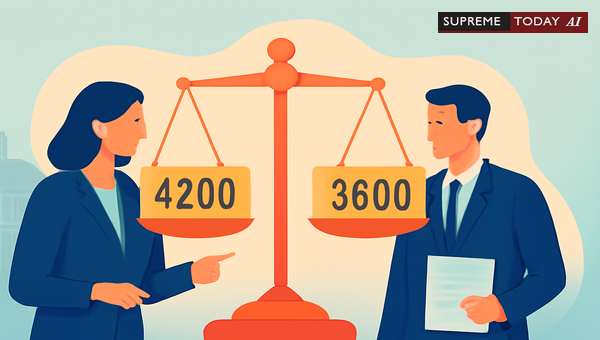
Court Restores Grade Pay 4200 After Unlawful Reduction to 3600
In the realm of employment law, few issues spark as much contention as to an employee's pay scale. Imagine working diligently in a role only to have your grade pay slashed from Rs. 4200 to Rs. 3600 without clear justification or a chance to respond. This is precisely the scenario faced by petitioners in a landmark case where the question arose: Court Allowed Pay Scale Change by State of Appellant from Grade Pay 4200 to 3600? The court's resounding answer? No—such reductions are often unlawful, and restoration to the higher scale is typically warranted when principles of fairness are violated.
This blog post delves into the court's decision, key legal principles upheld, and insights from similar cases. Whether you're an employee navigating pay disputes or an employer aiming to comply with labor laws, understanding these rulings can safeguard your rights or mitigate litigation risks. Note: This is general information based on judicial precedents and not specific legal advice—consult a qualified attorney for personalized guidance.
Background of the Case
The dispute centered on government employees initially placed in the pay band of Rs. 9300-34800 with a grade pay of Rs. 4200. The state later reduced this to Rs. 3600, prompting petitioners to challenge the move as discriminatory. They argued that colleagues in analogous roles retained the higher grade pay, highlighting a breach of —a cornerstone of Indian labor jurisprudence. 2023 0 Supreme(Raj) 276
The court scrutinized the state's actions, finding the reduction lacked adequate reasoning or . This wasn't merely an administrative tweak; it impacted livelihoods without transparency, underscoring broader concerns in public sector . 2023 0 Supreme(Del) 5031
Key Court Findings: Why the Reduction Was Overturned
The judiciary's analysis rested on three pivotal pillars:
1. Violation of
The court held that assigning different pay scales to employees performing identical duties without valid differentiation contravenes constitutional mandates. The petitioners were initially placed in the pay band of Rs. 9300-34800 with a grade pay of Rs. 4200, which was later reduced to Rs. 3600 without adequate reasoning or . 2023 0 Supreme(Raj) 276 This echoed precedents emphasizing statutory clarity in pay determinations. 2023 0 Supreme(Del) 5031
2. Breach of Principles
Any pay-affecting decision demands adherence to , including a hearing opportunity. The abrupt reduction sans notice was deemed unlawful. The court highlighted that any decision affecting pay scales must comply with principles of . The reduction in pay without providing an opportunity for the affected employees to present their case was deemed unlawful. 2017 0 Supreme(Pat) 855
3. Lack of Justification and Transparency
Courts reiterated that pay scales must be rationally classified. , especially post-initial fixation, invite . The bench ordered restoration of the Rs. 4200 grade pay, reinforcing .
Insights from Similar Cases and Judicial Trends
This ruling aligns with a pattern in Indian courts favoring employees against unjust pay reductions. For instance, in cases involving workshop instructors, courts distinguished roles but upheld higher scales where initial entitlements existed: Post of Workshop Instructor was Class-III Non-gazetted in the pay scale of 10300-34800 with 3600 Grade Pay and the post of Workshop Superintendent was Class-I Gazetted post in the pay scale of 15600-39100+5400 Grade Pay. ... Petitioners were initially appointed as Workshop Instructors on regular basis in the pay scale of 1350-2400.
Other precedents highlight fixation errors. But inadvertently, the third respondent has allowed the scale of pay of Rs.5200-20200+2400 as a Selection Grade scale of pay instead of Rs.9300-34800+4200. Courts directed corrections, granting arrears and higher scales. 2020 0 Supreme(Mad) 220
Judicial recognition of unlawful reductions is consistent: Employees demoted from Rs. 4200 to Rs. 3600 without procedure have secured relief. Several judgments indicate that employees who were initially placed in higher pay scales or grade pays (e.g., Rs. 4200) and later had their pay fixed or reduced to Rs. 3600 due to administrative orders or errors have been granted relief by courts. 2024 Supreme(Online)(CAT) 909 2023 Supreme(Online)(DEL) 18489 2024 Supreme(Online)(CAT) 353 2025 Supreme(Online)(CAT) 11661 2024 Supreme(Online)(CAT) 701
In pay revision contexts, exclusions or errors—like omitting cadres from upgrades—have been rectified: In this pay, revision proposal the details of existing pay and the proposed revision was mentioned as under by the . However, in the said GR dated , the cadre of Account Officer was not included granting new pay scale, as its case was still under consideration with the Government. 2022 0 Supreme(Guj) 749
Further, courts have mandated parity: The fixation of the Stamp Reporters is also requi... treated at par with Court Masters for grade pay in Rs.9300-34800. 2020 0 Supreme(Raj) 10 And in promotions, inadvertent lower scales were upgraded: Commercial Assistant (9300-34800+3200 GP) to Assistant (Field)(9300-34800+4200 GP). 2018 0 Supreme(P&H) 3295
These cases collectively affirm: Reductions from higher grade pays like Rs. 4200 to Rs. 3600 are typically set aside if arbitrary, restoring original entitlements with back wages. 2024 Supreme(Online)(CAT) 353 2025 Supreme(Online)(CAT) 11661
Practical Recommendations
For Employees
- Document Everything: Maintain records of appointment letters, pay slips, and comparisons with peers.
- Seek Redressal Promptly: Approach service tribunals or high courts if reductions seem unjust.
- Leverage Precedents: Cite cases like those above to bolster claims of parity and . 2016 0 Supreme(Guj) 1470
For Employers and Authorities
- Justify Changes Transparently: Provide reasoned orders and hearings before alterations.
- Conduct Audits: Review pay fixations to preempt errors, as seen in revision mishaps. 2024 Supreme(Online)(RAJ) 28623
- Follow Rules: Align with pay commission recommendations to avoid litigation.
Conclusion and Key Takeaways
The court's directive to restore Rs. 4200 grade pay underscores a vital message: Pay scales are not administrative whims but rights protected by law. Principles of equality, , and non-arbitrariness prevail, offering hope to affected workers. Key takeaways include the illegality of unprocedural reductions, the power of judicial precedents, and the need for fairness in compensation.
In summary, while states may attempt pay scale changes from Grade Pay 4200 to 3600, courts generally intervene to protect employees when such moves lack foundation. Stay informed, act decisively, and remember—this overview draws from reported judgments (e.g., 2023 0 Supreme(Del) 5031, 2023 0 Supreme(Raj) 276, 2017 0 Supreme(Pat) 855, 2024 Supreme(Online)(CAT) 909) and is for educational purposes only.
References- 2023 0 Supreme(Del) 5031 2023 0 Supreme(Raj) 276 2017 0 Supreme(Pat) 855-
2024 Supreme(Online)(RAJ) 28623 2022 0 Supreme(Guj) 749 2020 0 Supreme(Mad) 220 2020 0 Supreme(Raj) 10 2018 0 Supreme(P&H) 3295 2016 0 Supreme(Guj) 1470- 2024 Supreme(Online)(CAT) 909 2023 Supreme(Online)(DEL) 18489 2024 Supreme(Online)(CAT) 353 2025 Supreme(Online)(CAT) 11661 2024 Supreme(Online)(CAT) 701 2023 Supreme(Online)(DEL) 17374 #PayScaleJustice, #GradePayRestoration, #LaborLawIndia












