


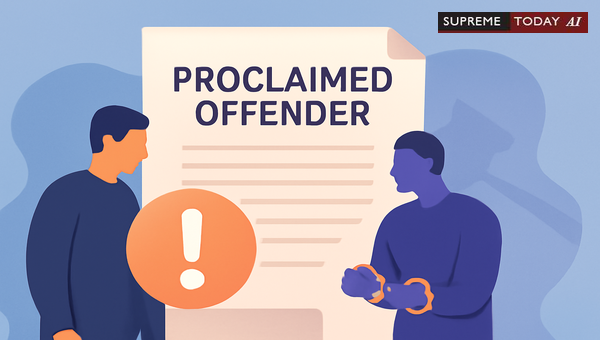
Can a Court Pass a Against the Complainant?
In criminal proceedings, courts wield significant powers to ensure justice, including issuing warrants and proclamations to secure the presence of individuals. But what happens when the question arises: Can a court pass a against the complainant? This issue strikes at the heart of procedural fairness under the , particularly Section 82. Typically, such measures target those evading justice, but applying them to a complainant—who initiates the case—raises serious legal concerns.
This blog post delves into the legal framework, judicial precedents, and strict requirements that generally prohibit courts from issuing proclamation orders against complainants or witnesses. We'll explore why these orders are reserved for accused persons and highlight key cases where improper proclamations were . Note: This is general information based on legal precedents and not specific legal advice. Consult a qualified lawyer for your situation.
Understanding Proclamation Orders Under
A under is a coercive tool designed to compel the appearance of an . It publicly declares someone a if they are concealing themselves to avoid arrest after a warrant has been issued. The primary purpose is to facilitate the arrest of accused individuals who are evading the law. 1997 4 Supreme 490
Key procedural mandates include:- Prior issuance of a warrant of arrest: This is mandatory; no proclamation can be issued without it. 1997 4 Supreme 490- Publication requirements: The proclamation must be published in a newspaper, affixed to the person's residence or a conspicuous place, and allow at least 30 days for appearance. Non-compliance invalidates the order. 1997 4 Supreme 490- Judicial satisfaction: The court must be satisfied that the person has absconded or is concealing themselves, not issue it merely on police request. 1997 4 Supreme 490
Courts have emphasized that these steps are non-negotiable, ensuring fairness and protecting under . 2023 0 Supreme(P&H) 1570
Why Can't Courts Issue Proclamations Against Complainants?
The law strictly limits proclamations to accused persons or proclaimed offenders who are absconding. Complainants or witnesses do not fall under this category, as they are not the targets of in the same manner. Issuing such an order against a complainant would misuse the provision, which is meant solely for those charged with offenses. 1997 4 Supreme 490
Judicial rulings reinforce this:- The Court cannot issue the Proclamation as a matter of course because the Police is asking for it and that the Court must be satisfied that the person has absconded or is concealing himself. 1997 4 Supreme 490- Proclamations against non-accused persons, including those not fulfilling procedural norms, are invalid and liable to be . 2024 0 Supreme(P&H) 1029 2023 0 Supreme(P&H) 3376
In essence, the statutory procedure under cannot be extended to complainants, as they are not persons accused of any offence. This distinction upholds the complainant's role in reporting crimes without fear of retaliation through procedural weapons. 1997 4 Supreme 490
Key Judicial Precedents and Case Analysis
Indian courts have consistently proclamations that deviate from these norms, providing clarity on their limited scope.
Case Highlight: Procedural Lapses Lead to Quashing
In one instance, a proclamation was issued after the complainant stated the accused's fresh address was unavailable, but it was published at an old address. The court it, noting, the proclamation under was not effected in accordance with the law, as the petitioner was not residing at the given address and the mandatory requirements of were not met. 2023 0 Supreme(P&H) 844
Strict 30-Day Notice Requirement
Another ruling stressed the mandatory 30-day period: Mandatory compliance with Section 82 requires a clear thirty-day notice period for appearances of proclaimed offenders... the computation of time must exclude certain dates. Failure here led to setting aside the order. 2023 0 Supreme(P&H) 2044
Non-Compliance Renders Proclamation a
Courts have held that Non-compliance with Section 82 Cr.P.C. renders proclamation of an accused as , warranting quashing of FIR under . This underscores procedural rigor, even for accused, let alone complainants. 2023 0 Supreme(P&H) 1570
Satisfaction of Absconding Not Recorded
In a petition, the trial court failed to record satisfaction that the petitioner had absconded before ordering publication: A bare perusal of this order shows that the learned trial Court before ordering for publication of proclamation has not recorded its proper satisfaction... Such orders were deemed improper. 2026 Supreme(Online)(P&H) 1826
These cases illustrate that even against accused, proclamations are scrutinized heavily. Against complainants, they are entirely impermissible. 2024 0 Supreme(P&H) 1029
Procedural Safeguards and Common Pitfalls
To issue a valid proclamation:1. Serve the warrant and confirm non-execution due to absconding.2. Publish in a daily newspaper (language as per court direction), affix at last known residence, and in the village/town.3. Fix a returnable date at least 30 days later.
Pitfalls like incorrect addresses, rushed timelines, or lack of judicial satisfaction lead to quashing under . For example, in leading to proclamation, courts intervened if procedures faltered. 2025 Supreme(Online)(P&H) 8741
Other sources highlight that warrants must emanate from the issuing court; otherwise, as warrant is not issued by this Court, hence question of Proclamation does not arise. 2021 0 Supreme(Bom) 26
Exceptions? Rare and Narrowly Defined
There are no exceptions extending proclamations to complainants. Even in serious cases like extortion or NDPS, courts focus on accused concealment, not complainants. 2021 0 Supreme(Bom) 26 Compromises or family disputes may lead to quashing FIRs entirely, but proclamations remain off-limits for non-accused. 2012 0 Supreme(Del) 3216
Civil contexts, like execution proceedings, use different proclamation rules (), irrelevant here. 2009 0 Supreme(Mad) 509 2009 0 Supreme(Mad) 506
Key Takeaways for Legal Awareness
- Proclamations target absconding accused only: Not complainants or witnesses. 1997 4 Supreme 490
- Mandatory procedures must be followed: Prior warrant, proper publication, 30-day notice—or risk quashing. 2023 0 Supreme(P&H) 844 2023 0 Supreme(P&H) 2044
- Courts protect procedural fairness: Invalid orders are routinely set aside to prevent abuse. 2023 0 Supreme(P&H) 1570
- Seek relief if needed: Petitions under can quash improper actions.
In conclusion, a court generally cannot pass a against a complainant under , as it violates the provision's intent and mandatory safeguards. This protects those reporting crimes from undue coercion. Stay informed, but always consult a legal professional for personalized guidance.
References:- 1997 4 Supreme 490, 2024 0 Supreme(P&H) 1029, 2023 0 Supreme(P&H) 3376, 2023 0 Supreme(P&H) 844, 2023 0 Supreme(P&H) 2044, 2023 0 Supreme(P&H) 1570, 2026 Supreme(Online)(P&H) 1826, 2025 Supreme(Online)(P&H) 8741, 2021 0 Supreme(Bom) 26, 2012 0 Supreme(Del) 3216, 2009 0 Supreme(Mad) 509, 2009 0 Supreme(Mad) 506
#CrPC82, #ProclaimedOffender, #LegalRights












