


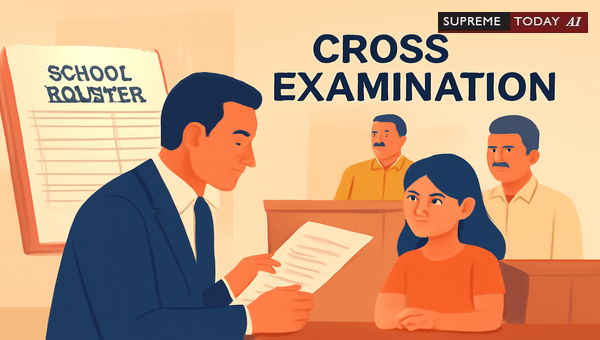
Cross-Examine Headmaster in POCSO: School Register Guide
In cases, proving the victim's age is often pivotal. School registers, particularly admission or attendance records, are frequently cited by the prosecution to establish minority status. However, these documents can be vulnerable during , especially when questioning the headmaster. A well-prepared can expose inconsistencies, procedural lapses, or lack of authenticity, potentially weakening the prosecution's case.
How to Cross Examine a Headmaster Regarding School Register Entry of Victim in Pocso Case? This question arises frequently in defense strategies, as courts have repeatedly emphasized that reliance on school records alone is insufficient without corroborative proof. Let's explore effective techniques, drawing from judicial precedents and practical questioning frameworks.
Why Target the School Register and Headmaster?
School registers are for age determination under POCSO. defines a 'child' as under 18 years, and prosecutions under Sections 4, 6, etc., hinge on this. Yet, courts demand . In multiple judgments, defenses have succeeded by highlighting defects in these records.
For instance, in one case, the prosecution relied on an entry in Ex.P-4/C Dakhil-Kharij register showing the 's date of birth as , but PW-2/Headmaster of the said school has admitted in his cross- examination that he did not record name of p.... 2024 Supreme(Online)(Chh) 17660. This admission undermined the register's reliability.
Similarly, PW8 Headmaster has admitted that there is practice of taking entry#HL_END.... 2024 Supreme(Online)(BOM) 6740, revealing customary practices that question contemporaneity.
Another ruling noted: the entry made in the School Admission Register in relation to her admission and date of birth has not been written by him on in front of him and the same has been partially written by Headmaster Rupram... 2024 Supreme(Online)(CG) 9896, leading to acquittal due to failure to prove age.
These examples illustrate how can reveal that entries were not made by the witness, lacked safeguards, or were based on assumptions, as in cases where age was stated about her age on assumption 2021 0 Supreme(Ori) 114.
Key Strategies for Effective
should systematically probe the register's authenticity, timing, authorship, and corroboration. Below is a structured list of 10 pivotal questions, expanded with rationale and tips for use. These are generally employed to cast doubt without being confrontational, maintaining judicial decorum.
Can you confirm the exact date and time when the victim's name was entered into the school register? Establish if the entry was . Delays suggest insertion, a common vulnerability. Link to protocols for daily entries.
Were there any other entries made in the register around the same time as the victim's entry? If so, can you provide the details of those entries? Compare ink, handwriting, or dates to detect anomalies. Inconsistencies here can imply tampering.
Who was responsible for making the entry of the victim's name in the register? What was their position and level of authority within the school? Pinpoint authorship. As seen in 2024 0 Supreme(Chh) 563, headmasters often admit others made entries, eroding credibility: PW-2/Headmaster... admitted in his that he did not record name of pr....
Is it possible that the entry of the victim's name could have been made at a later date, rather than on the date it purports to have been made? What procedures or safeguards are in place to ensure the accuracy and integrity of the register? Probe safeguards like locks, audits, or digital backups. Admissions of lax practices, as in 2024 Supreme(Online)(BOM) 6740, bolster defense.
Can you explain any discrepancies or inconsistencies between the information in the school register and other documentation or evidence related to the victim's attendance or enrollment at the school? Cross-reference with T.C.s, birth certificates, or . Disparities often lead to acquittals.
Are you aware of any instances where the school register has been altered or tampered with in the past? What measures are in place to prevent such tampering? Past incidents taint reliability. Even denials can highlight inadequate measures.
As the headmaster, do you have any personal or professional relationship with the victim or their family that could potentially influence your testimony or the information in the school register? Uncover bias subtly, avoiding accusations.
Can you confirm that the victim was actually present at the school on the date(s) indicated in the register, or is it possible that the entry was made without the victim's actual attendance? Differentiate enrollment from attendance. From the evidence of this witness it is quite vivid that he is not the author of the school register... 2025 0 Supreme(Chh) 90
What training or protocols do you and your staff follow to ensure the accurate and timely recording of student information in the school register? Lack of formal training exposes sloppiness.
Can you produce any corroborating evidence, such as attendance records, class schedules, or witness statements, to support the information contained in the school register regarding the victim's attendance? Demand backups. Courts note: The prosecution must provide conclusive evidence of a victim's age in POCSO cases; reliance on school records alone is insufficient without corroborative proof.
Lessons from Landmark POCSO Judgments
Judicial scrutiny is rigorous. In a key appeal, conviction was set aside because Prosecution failed to prove the age of the conclusively; reliance on school records was insufficient without corroborative evidence. The court stressed the necessity of credible evidence for age determination. Appeals allowed, appellants acquitted. 2024 0 Supreme(Chh) 563
Another upheld acquittal: Prosecution must prove a minor's age beyond reasonable doubt; acquittals maintain a high standard against appeal. 2024 Supreme(Online)(CG) 9896
In contrast, where registers held up, like Headmaster... proved the entry made in the school admission register... thoroughly crossexamined but could n.... 2020 0 Supreme(Cal) 438, convictions stood—but defenses failed to elicit doubts.
Cases like 2022 0 Supreme(Mad) 2989 show registers as supporting evidence alongside victim testimony, but remains crucial.
Even in convictions, such as under POCSO and , courts rely on consistent evidence, underscoring the need to challenge inconsistencies. 2020 0 Supreme(Bom) 779
Practical Tips for Defense Counsel
- Prepare Documents: Obtain the original register, seek forensic analysis for ink/dates.
- Sequence Questions: Start neutral, build to contradictions.
- Use Leading Questions: Yes/No format to control responses.
- Anticipate Objections: Focus on relevance to age proof.
- Follow Up: If admissions like non-authorship emerge, as in 2024 Supreme(Online)(Chh) 17660, press for details.
Key Takeaways
- School registers are not infallible; often reveals fatal flaws.
- Aim to prove lack of contemporaneity, authorship issues, or absence of corroboration.
- Success in cases like those cited has led to acquittals by shifting burden back to prosecution.
This article provides general insights based on judicial trends and is not legal advice. Consult a qualified lawyer for case-specific strategies. Always adhere to ethical standards under the .
#POCSO, #CrossExamination, #LegalDefense















