Searching Case Laws & Precedent on Legal Query..!
Scanned Judgements…!



Searching Case Laws & Precedent on Legal Query..!
Scanned Judgements…!
Release Deed Prior to Death of Father - Several cases involve daughters executing release deeds relinquishing their rights in family or ancestral properties, often prior to the father's death. Courts generally recognize such deeds as valid relinquishments of rights, but their implications on inheritance rights vary depending on context. For example, in one case, the court held that a release deed executed by a daughter before her father's death did not bar her claim to her share in self-earned or ancestral properties, especially after the father's demise and the application of the Hindu Succession Act (2023 0 Supreme(Mad) 967). Conversely, other cases clarify that a release deed may be considered a conveyance or relinquishment, affecting the daughter's inheritance rights, and that subsequent claims to property depend on the nature and timing of such deeds (2024 0 Supreme(Mad) 2465, 2024 0 Supreme(Guj) 2085).
Effect of Release Deed on Inheritance Rights - Courts have examined whether release deeds are valid relinquishments or mere conveyances. In some instances, if the deed is executed as a precaution during marriage or for registration benefits, it may be treated as a relinquishment of rights, but not necessarily as a bar to inheritance. For example, a daughter executing a release deed before her marriage was considered to have relinquished her rights, yet after her father's death, she was entitled to her share (2023 0 Supreme(Mad) 967). In other cases, courts have considered whether the release deed was executed voluntarily and whether it was supported by consideration, impacting its validity as a relinquishment (2024 0 Supreme(Mad) 961, 2023 0 Supreme(Kar) 103).
Legal Position on Daughter’s Rights - The landmark case of Rakesh Sharma (2020) SCC 1 confirms that a daughter, whether before or after the father's death, is a coparcener in ancestral property from birth, especially after the Hindu Succession (Amendment) Act, 2005, which grants daughters equal rights (2024 0 Supreme(Mad) 607). This legal position influences how courts interpret release deeds and inheritance claims, emphasizing that such deeds do not automatically extinguish a daughter's rights unless explicitly recognized as relinquishments.
Implications of Executing Release Deeds - Some cases highlight that release deeds executed to avoid registration charges or for other procedural reasons may not be valid relinquishments of rights, especially if not supported by clear intent or consideration. For example, a release deed mentioning properties as ancestral to reduce charges was deemed not to be a genuine relinquishment, leaving the daughter's claim intact (2023 0 Supreme(Mad) 1908). Additionally, deeds executed as conveyances rather than releases are treated differently in law.
Conclusion - Overall, the validity and effect of a daughter's release deed executed prior to her father's death depend on the deed's nature, intent, and compliance with legal requirements. Courts tend to uphold genuine relinquishments but recognize that such deeds do not necessarily bar inheritance rights, especially after the father's demise and in light of the daughter's coparcenary status post the Hindu Succession Act amendments. Proper documentation and clear intent are crucial to determine whether such deeds are effective relinquishments or conveyances.
References:- 2023 0 Supreme(Mad) 967- 2024 0 Supreme(Mad) 961- 2024 0 Supreme(Mad) 2465- 2023 0 Supreme(Kar) 103- 2024 0 Supreme(Guj) 2085- 2025 0 Supreme(Kar) 1501- 2023 0 Supreme(Mad) 2892- 2024 0 Supreme(Mad) 607
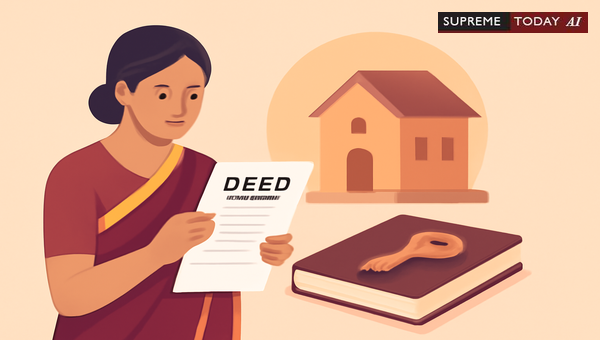
In family disputes over property, few issues spark as much contention as a daughter's pre-emptive relinquishment of rights. Imagine a scenario where a daughter signs a giving up her share in family property before her father's passing. Does this document forever close the door on her inheritance claims? This question lies at the heart of many succession battles under Indian Hindu law, balancing voluntary acts against evolving rights for daughters.
We'll dive into the legal nuances, drawing from key documents and court precedents. Note: This is general information, not legal advice. Consult a qualified attorney for your specific case.
The query revolves around a daughter who executed a registered relinquishing her rights in property in favor of her brothers prior to her father's death. Such deeds are common in setups to streamline succession or settle shares early. But their enforceability post-father's demise raises critical questions.
According to legal documents, the daughter received of Rs. 5,000/- for the deed. Crucially, she did not challenge it in subsequent suits on grounds like , , , or . 2020 2 Supreme 716 2020 1 Supreme 206
This setup triggers several legal principles:- Proof of Execution: Courts often uphold registered deeds as proven unless contested. For instance, The held that Ex.B.1 executed by the appellant was proved... 2023 0 Supreme(Mad) 967- 's Role: Payment strengthens validity, creating potential .
The daughter's acceptance of and execution of the deed may estop her from later claiming a share. prevents a party from denying facts they previously affirmed through conduct. Here, relinquishing rights for payment could bar future claims. 2023 1 Supreme 528
This section scrutinizes transactions by minors or guardians. If the daughter was a minor at execution, validity hinges on guardian consent and benefit to the minor. Courts evaluate: Was it fair? Did it safeguard her interests? 2023 1 Supreme 528
Recommendations for scrutiny include:- Reviewing deed terms meticulously.- Assessing conduct for .- Evaluating applicability.- Seeking specialist advice in Indian family and property law.
Indian courts have grappled with similar facts, offering nuanced views. Post- amendments, daughters gained coparcenary status equal to sons, retroactively in some rulings like and .
Properties labeled ancestral in deeds (sometimes to skirt registration fees) may not bind as relinquishments: ...to avoid huge registration charges... agreed to mention the properties as ancestral properties in the said . 2023 0 Supreme(Mad) 1908
Courts differentiate:- Ancestral/ Property: Daughters as coparceners from birth ( (2020) 9 SCC 1). Release may relinquish but not erase coparcenary birthright unless full . 2024 0 Supreme(Mad) 607- Self-Acquired: Easier to release, but post-death succession applies.
Deeds termed release but functioning as conveyances face scrutiny: ...cannot be treated as a Deed of release, rather would be termed to be a Deed of . 2024 0 Supreme(Guj) 2085
Voluntariness is key—no pleas of succeeded here. 2020 2 Supreme 716
| Factor | Potential Impact ||--------|------------------|| Paid | Strengthens 2020 2 Supreme 716 | | No / Claim | Upholds validity | | Ancestral vs. Self-Earned | May preserve rights 2023 0 Supreme(Mad) 967 | | Post- Amendments | Bolsters daughter rights 2024 0 Supreme(Mad) 607 |
The amendment equalized daughters in , applicable even if father died pre-amendment (). A pre-death release doesn't automatically nullify this, but courts weigh intent.
Examples:- Sisters' release to avoid charges didn't relinquish true rights. 2023 0 Supreme(Mad) 1908- Post-father's death releases reinforced titles. 2017 0 Supreme(Mad) 205
...a daughter, at birth, would become entitled to be treated as a coparcener in ancestral properties. 2024 0 Supreme(Mad) 607
Facing this? 1. Examine Documents: Verify registration, terms, . 2020 1 Supreme 2062. Trace Property Origin: Ancestral? Self-acquired? Partition history? (E.g., no dispute on grandfather/father death dates. 2024 0 Supreme(Mad) 2465)3. Check Challenges: Absence of claims bolsters deed. 2020 2 Supreme 7164. Analysis: Did conduct affirm relinquishment?5. Expert Consultation: Family law attorneys can assess , coparcenary.
Disclaimer: Laws evolve; precedents like shift sands. This overview (800+ words) synthesizes cases 2024 0 Supreme(Mad) 961 2024 0 Supreme(Mad) 2465 but isn't advice. Engage lawyers for tailored guidance.
References:- 2020 1 Supreme 206 2020 2 Supreme 716 2023 1 Supreme 528- 2023 0 Supreme(Mad) 967 2024 0 Supreme(Mad) 961 2024 0 Supreme(Mad) 2465 2023 0 Supreme(Mad) 1908 2024 0 Supreme(Mad) 607 2024 0 Supreme(Guj) 2085
Share your thoughts—have you faced a similar dispute?
#DaughtersInheritance, #ReleaseDeed, #HinduLaw


The trial Court held that Ex.B.1 release deed executed by the appellant was proved, but however, proceeded to hold that Ex.B.1 release deed executed by the appellant in respect of the ancestral properties would not bar her right to claim share in the self-earned properties of the father. ... making daughter as a member of Hindu coparcenary, came into f....

Thus, after the Release Deed executed by the plaintiff and after the death of the father in the year 1996, in terms of the ratio laid down by the Hon’ble Supreme Court in the case of Vineeta Sharma vs. ... According to the defendants, he had also executed a release deed dated 07.07.1983, on receiving a sum of Rs.6,500/- and on the same day, Nataraja Pa....

release deed (Ex.A14). ... With regard to the relationship, date of death of the grandfather and the father, there is no dispute between the parties. ... This Court finds that the properties mentioned in the suit schedule are not ancestral properties and after the death of the grandfather, there is a partition amongst the brothers of Madhava Mudaliar under the registered partition deed-E....
Moreover, in order to avoid huge registration charges for registering the release deed executed by his sisters, the 1st defendant agreed to mention the properties as ancestral properties in the said release deed. ... Therefore, according to D.W.1 the suit properties were jointly enjoyed till the death of their father i.e., on 03.10.2011 i.e., even after relinquishing hi....

Ex.D.1 indicates that the plaintiff’s father executed a release deed by receiving Rs.350/- and 21 guntas of land, Ex.D.2 shows that the first defendant, after the death of her husband, sold 21 guntas of land to her father-in-law on her behalf and on behalf of the plaintiff. ... Ex.D2 is the certified copy of the sale deed executed by the first defendan....

The result is that the release deed dated 27.12.2016 executed by the daughter, i.e. sister of the petitioner herein for relinquishment of her share in Survey no.11/1, which was purchased by father as Karta of HUF, cannot be treated as a Deed of release, rather would be termed to be a Deed of conveyance ... Anandrao, one Madhawrao executed#HL_....

The defendant acquired the suit property under the release deed executed by late Hayatbee, the daughter of Fatru Patel. ... The said Fatru Patel was the owner and possessor of the suit property and after his demise, his daughter has become the owner and possessor of the suit property and during her lifetime, she executed the registered release deed in ....
Sundhari again was a case in which the parents gifted their property to their daughter. The father expired and problems arose between the mother and the daughter. ... In the present case, as stated earlier, it is not even pleaded by respondent no. 1 that the release deed was executed subject to such a condition.” ... In the present case, as stated earlier, it is not even pleaded by respo....
If the Will (Ex.B3) was in existence and the suit property as per the Will belonged to the second defendant, then the release deed could not have been executed, as there was no necessity. The release deed is dated 26.04.2004, nearly 14 years from the death of Pethan. ... As seen from the registered release deed dated 26.04.2004, the existence of the pl....

Rakesh Sharma reported in (2020) 9 SCC 1, the legal position is now settled that either after the death of the father or when the father is alive, a daughter, at birth, would become entitled to be treated as a coparcener in ancestral properties. ... Further, according to him, the father died even in the year 1990, the plaintiff never sought to make a claim until the 1st defendant executed#HL_END....

According to her, she executed a Will dated 11.02.1987 in favour of plaintiff nos. It was also the case on behalf of the first defendant that, similarly, the first plaintiff’s husband is also entitled to 1/5th share, in which, first defendant and first plaintiff are entitled to half share in the suit properties. According to the first defendant, the first defendant’s daughter Nagabhushanam executed a Release Deed in respect of her own share. It was also the case on behalf of ....
Son not intimating tenants about becoming owner by virtue of release deed. Title to premises derived under release deed executed by father. Tenants were inducted prior to execution of release deed.
It had been stated that after the death of his father on 28.05.2008, and after the death of his mother, the sister of the defendant executed a release deed in favour of the defendant. Further the averment in the plaint that the defendant met the plaintiff and sought time to perform the agreement was also denied. It was also stated that the plaintiff had not filed any document to show that the Managing Director was authorised by the company to enter into an agreement of sale. ....
Similarly, the 1st plaintiff's husband is also entitled to 1/5th share in which, the 1st defendant and the 1st plaintiff are entitled to half share in the suit properties. The 1st defendant's daughter Naghabhushanam Ammal executed a release deed in respect of her own share. The 1st defendant executed a Will dated 11.2.1987 in favour of plaintiffs 1 and 2 and Naghabhushanam Ammal. (iv) According to the 1st defendant, she never acted as the Manager of the joint family.

After about 10 years of the death of the father, the sisters of the father had executed a release deed in favour of the mother and all the children and not in favour of the beneficiaries of the will, defendants 1 and 2. B7 and B8 were prepared and got signed and registered by the second defendant himself. Nothing has been stated about the provision for the welfare of the aunt Smt. Mary.


An indispensable Tool for Legal Professionals, Endorsed by Various High Court and Judicial Officers
Please visit our Training & Support
Center or Contact Us for assistance

Scan Me!
India’s Legal research and Law Firm App, Download now!


For Daily Legal Updates, Join us on :



 Back to top


