


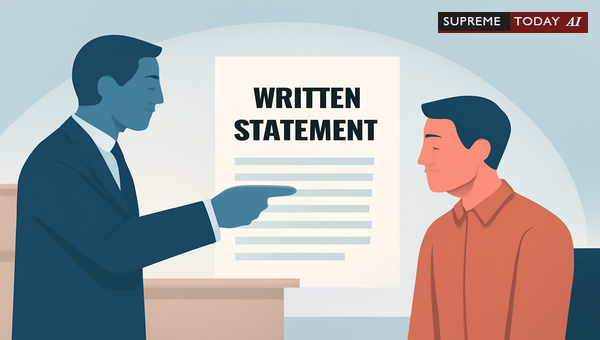
Cross-Examination Rights Despite No
In the of Indian courts, the right to witnesses stands as a cornerstone of . But what happens when a defendant misses the deadline to file a ? Can courts completely bar the defense counsel from cross-examining the plaintiff's witnesses? The legal question at hand is: right of defence council to cross cannot be curtailed because of non-filing of version/. This issue often arises in civil suits under the , particularly , where timelines for filing written statements are strict.
This blog post explores landmark judgments and legal principles affirming that cross-examination rights generally survive even without a timely . We'll delve into key cases, judicial reasoning, exceptions, and practical implications to help you understand this vital defense tool.
Main Legal Finding
Courts have consistently held that the right of a defense counsel to witnesses cannot be wholly curtailed solely because the defendant has failed to file a or version within the prescribed time1988 0 Supreme(SC) 628. This protection ensures the defendant's right to test the veracity of the plaintiff's evidence remains intact, upholding the essence of a fair trial.
As emphasized in Modulo India v. Kamakhya Singh Deo, the filing of a is not the sole means of defending a suit; cross-examination remains a fundamental aspect of the defense 1988 0 Supreme(SC) 628. Even if the right to file a is forfeited or barred, cross-examination persists 1988 0 Supreme(SC) 628.
Key Principles from Leading Cases
Preservation of Cross-Examination as a Fundamental Right
The in a judgment (INSC 724: (7) Supreme 536) ruled that even without filing of , the right to survives and not permitting the same has resulted in petitioner’s substantial rights being defeated without 2026 1 Supreme 174. The court stressed: The purpose of cross-examination is to elicit truth from witness and impeach its credibility – When was not allowed to be taken on record, denial of right to cannot be taken away by leaving defendant in lurch – Even when defendant has not filed , his right to plaintiff witnesses is not foreclosed 2026 1 Supreme 174.
This aligns with broader principles: – Object of procedural rules is to advance cause of justice and not to thwart it 2026 1 Supreme 174. Procedural technicalities must yield to .
Testing Witness Credibility
Judgments repeatedly underscore that the mere statement of the plaintiff’s witness cannot constitute the plaintiff’s evidence in the case unless and until it is tested by cross-examination 1988 0 Supreme(SC) 628. Further, no oral testimony can be considered satisfactory or valid unless it is tested by cross-examination 1988 0 Supreme(SC) 628. Without this opportunity, trials risk becoming one-sided.
cases reinforce this: Even if the has not been filed by the defendants, still they have a right to the witness examined on behalf of the plaintiffs
DEV CHANDER SOOD & ORS. vs H.L. SUD & ORS.
DEV CHANDER SOOD & ORS. vs H.L. SUD & ORS.-280_).Detailed Analysis: Scope and Judicial Discretion
Nature of the Right
Cross-examination is not a mere formality but an integral procedural safeguard to and elicit truth 1988 0 Supreme(SC) 628. Courts must exercise discretion judiciously, avoiding deprivation of this right due to procedural lapses like non-filing of written statements 1988 0 Supreme(SC) 628.
In Varun Singh proceedings, counsel argued: the entitlement and the right of the respondent/defendant, though the right to file was struck off, cannot be curtailed inasmuch as it is an indelible right available to the defendant to elicit truth from... 2023 0 Supreme(Del) 1099.
Limitations and Circumscribed Scope
While the right is preserved, it is not absolute. Courts may limit its scope to prevent abuse. For instance, when a is struck off, the right to summoned witnesses is circumscribed when the availability of defense is limited, and further cross-examination beyond the scope of the suit or record is impermissible 2023 0 Supreme(Del) 1099. In one case, the court set aside orders allowing excessive cross-examination, holding it impermissible beyond the suit's record 2023 0 Supreme(Del) 1099.
Defendants can only to demolish the version of the plaintiff and not introduce new evidence on
DEV CHANDER SOOD & ORS. vs H.L. SUD & ORS.
DEV CHANDER SOOD & ORS. vs H.L. SUD & ORS.-280_).Fair Trial Over Procedural Rigidity
The cautioned: Courts cannot countenance a situation where substantial justice is sacrificed at altar of procedural rigidity – Where substantial justice is at stake, technicalities must give way 2026 1 Supreme 174. In commercial suits, even mandatory 120-day timelines under do not foreclose cross-examination rights 2026 1 Supreme 174.
Other contexts echo this: In probate suits converted to civil suits, the right to cross-examination of petitioner was a material defence... and it cannot be curtailed 2021 0 Supreme(Guj) 1176. Similarly, under , courts must not curtail this essential right arbitrarily 2021 0 Supreme(Guj) 1176.
Practical Implications for Litigants
- For Defendants: Missing the deadline doesn't doom your defense. Focus on cross-examination to challenge evidence effectively. Seek court permission if needed, paying costs as in the remanded case (Rs. 1,00,000/-) 2026 1 Supreme 174.
- For Courts: Exercise discretion to balance efficiency and fairness. Absolute bars undermine justice.
- Strategic Tip: Even without a , cross-examination allows demolishing the opponent's case without introducing new pleas.
In labor disputes, non-filing doesn't validate weak defenses if distinctions (e.g., employee vs. non-employee) emerge in cross-examination 2017 0 Supreme(Bom) 1736.
Exceptions Where Rights May Be Limited
- : Prolonged or irrelevant questioning can be restricted.
- Struck-Off Defenses: Scope limited to plaint averments 2023 0 Supreme(Del) 1099.
- New Pleas: Cannot raise ; writ petitions won't entertain new defenses absent written statements 2019 0 Supreme(Raj) 954.
Recommendations for Courts and Parties
- Ensure cross-examination rights remain intact despite non-filing 1988 0 Supreme(SC) 628.
- Interpret procedural rules liberally to advance justice 2026 1 Supreme 174.
- Impose restrictions cautiously, only for compelling reasons like delay or misconduct.
Conclusion and Key Takeaways
The prevailing legal position in India is clear: the right of a defense counsel to witnesses cannot be completely taken away solely because the defendant has not filed a within the stipulated time1988 0 Supreme(SC) 628
Kaushik Narsinhbhai Patel VS S. J. R. Prime Corporation Private Limited - ()
. This safeguards the adversarial process and fair hearing principles.Key Takeaways:- Cross-examination survives forfeiture 2026 1 Supreme 174.- It's essential for testing evidence validity 1988 0 Supreme(SC) 628.- Scope may be limited but not extinguished.
Disclaimer: This post provides general information based on reported judgments and is not specific legal advice. Consult a qualified lawyer for your case. Laws and interpretations may vary by jurisdiction and facts.
References:- 1988 0 Supreme(SC) 628: Modulo India v. Kamakhya Singh Deo-
Kaushik Narsinhbhai Patel VS S. J. R. Prime Corporation Private Limited - ()
: Clarifies participation rights including cross-examination.- 2026 1 Supreme 174: on surviving rights.- Additional sources: 2023 0 Supreme(Del) 1099,DEV CHANDER SOOD & ORS. vs H.L. SUD & ORS.
, etc. #CrossExamination, #FairTrial, #LegalRights












