


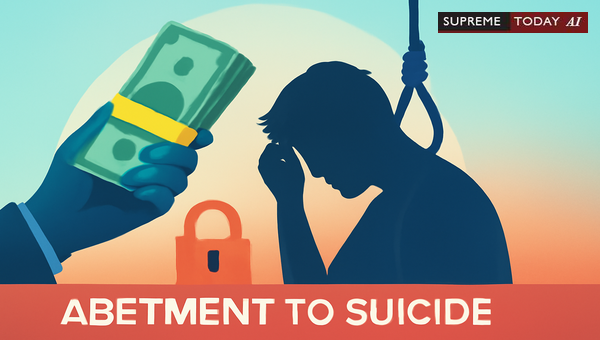
Demanding Bribe: Not ? IPC 306 Explained
In high-stakes scenarios involving corruption allegations or financial disputes, tragic outcomes like suicide can lead to serious criminal charges. One common question arises: Demand of Bribe is Not an —but why? This issue frequently surfaces in , where families or prosecutors seek to link a public servant's or individual's demand for money to a victim's desperate act.
This blog post delves into the legal nuances under , examining judicial precedents and why mere demands—whether for bribes or loan repayments—generally fall short of constituting abetment. We'll explore key principles, evidence requirements, and insights from related corruption cases. Note: This is general information based on judicial trends and not specific legal advice. Consult a qualified lawyer for your situation.
What Constitutes Under ?
punishes abetment of suicide, but courts have strictly interpreted it to require more than passive pressure. Abetment demands , , or that directly incites the suicide. Mere harassment, threats, or demands without a do not suffice. 2016 0 Supreme(MP) 1097 2007 0 Supreme(MP) 358 2018 0 Supreme(Ori) 819
As held in multiple rulings, Abetment requires , , or that reasonably incites or encourages the deceased to commit suicide. Words or acts in heat of moment, or acts that do not have a direct or proximate connection to inducing the suicide, are insufficient to establish abetment. 2016 0 Supreme(MP) 1097 1994 0 Supreme(MP) 377 2018 0 Supreme(MP) 703
The mental element is crucial: the accused must intend or knowingly aid the suicide. Without proof of such active encouragement, charges often fail. 1994 0 Supreme(MP) 377 2018 0 Supreme(MP) 703 2018 0 Supreme(Ori) 819
Why Demand of Bribe or Loan Repayment Alone Isn't Enough
Courts consistently rule that demanding a bribe or repayment, even with threats or abuse, does not automatically amount to abetment. There must be clear evidence of or a direct link to the suicide decision. 2007 0 Supreme(MP) 358 2017 0 Supreme(Guj) 896
For instance:- Demands in isolation lack the 'positive act' needed to induce suicide. 2016 0 Supreme(MP) 1097- Threats without encouragement to self-harm are insufficient. 2005 0 Supreme(Guj) 599 2022 0 Supreme(Jhk) 362- Suicide notes or witnesses must show direct incitement for charges to stick; otherwise, courts quash or discharge. 1984 0 Supreme(MP) 261 2005 0 Supreme(Guj) 599 2003 0 Supreme(P&H) 338
In one synthesis of precedents: Demand of bribe or loan repayment, in isolation, is generally not considered . Establishing abetment requires proof of , , or with a clear causal link. This aligns with statutory interpretations emphasizing intent. 2016 0 Supreme(MP) 1097
Judicial Precedents: Key Court Holdings
have clarified this boundary through landmark cases:
No Abetment Without Active Role
- Rulings stress that harassment alone doesn't cross the threshold. Mere harassment, demand, or threats without such intent or active encouragement do not amount to abetment. 1994 0 Supreme(MP) 377 2018 0 Supreme(MP) 703
- In cases with suicide notes implying coercion, abetment may arise—but absence of direct links leads to relief for the accused. 1984 0 Supreme(MP) 261
Demands vs. Instigation
- Acts like demanding repayment with abusive language fail unless tied to encouragement of suicide. Several judgments have clarified that acts like demanding repayment, even if accompanied by threats or abusive language, do not automatically amount to instigation or abetment unless there is clear evidence of active encouragement. 2007 0 Supreme(MP) 358 2017 0 Supreme(Guj) 896
These holdings prevent over-criminalization, ensuring only culpable conduct is punished.
Insights from Prevention of Corruption Act Cases
Related bribery prosecutions under the (PCA), offer context. Proving 'demand' itself is rigorous, mirroring abetment's evidentiary bar. Mere recovery of money isn't proof of demand, let alone instigation. 2018 0 Supreme(Kar) 434
Key examples:- In a Patwari case, the complainant alleged a Rs.800 bribe demand for land documents, but prior obtainment of copies and taped conversation lacking demand led to acquittal: Therefore, demand of bribe money is not established... possibility of false implication... due to previous enmity. 2018 0 Supreme(Chh) 438- Another VAT certificate case saw acquittal as demand wasn't proved: In his evidence, he has not stated anywhere that the accused asked for the bribe... Complainant had turned hostile. 2018 0 Supreme(Kar) 434- Contradictions in complainant statements doomed claims: But in his statement... the demand of the bribe was raised at his house. In view of this, material contradiction, the demand of bribe is not at all established. 2015 0 Supreme(P&H) 2305- Trap failures, like shadow witnesses turning hostile, reinforced: PW 1... has turned hostile... the complainant tried to put the currency notes in the pocket of the accused but he refused. 2014 0 Supreme(P&H) 1524- Unbelievable demands in front of unrelated parties raised doubts: It is unbelievable that a person would demand bribe in front of a person who has no connection. 2012 0 Supreme(Pat) 1200
These PCA cases highlight how courts demand consistent, for even basic bribe demands—far more for abetment's 'instigation' element. 2018 0 Supreme(Kar) 434 While some convictions occur with strong proof (e.g., trap recoveries proving demand and acceptance 2015 0 Supreme(P&H) 2305), they underscore the high bar, paralleling IPC 306 scrutiny. 2014 0 Supreme(P&H) 1524
Evidence Scrutiny: What Makes or Breaks a Case?
To establish abetment:1. : Direct words urging suicide.2. Causal Link: Proximate connection via notes, witnesses.3. Intent: Mental state beyond mere demand.
Recommendations for legal practitioners:- Focus on suicide notes and testimonies for direct accused links. 1984 0 Supreme(MP) 261- Avoid charging solely on threats; prove incitement.- In defenses, highlight lack of active role or enmity motives, as in PCA acquittals. 2018 0 Supreme(Chh) 438
Key Takeaways and Conclusion
Generally, demanding a bribe or loan repayment does not constitute under without or a clear . Courts protect against loose interpretations, requiring robust proof. 2016 0 Supreme(MP) 1097 2018 0 Supreme(Ori) 819
From IPC precedents to PCA parallels, the theme is evidentiary rigor: threats alone rarely suffice. This safeguards justice while holding true instigators accountable.
If facing such charges or advising on them, prioritize evidence analysis. For personalized guidance, seek expert legal counsel. Stay informed—corruption and tragedy intersect, but law demands precision.
This post synthesizes public judicial trends as of available data. Laws evolve; verify current status.
#AbetmentToSuicide #IPC306 #BribeLaw















