Searching Case Laws & Precedent on Legal Query.....!
Analysing the retrieved Case Laws
Scanned Judgements…!



Searching Case Laws & Precedent on Legal Query.....!
Analysing the retrieved Case Laws
Scanned Judgements…!
Demand for Property and Coercion - Section 498A IPC considers cruelty that includes harassment to meet unlawful demands for property, valuable security, or dowry. The term 'coercion' is not explicitly defined in the IPC but can be related to Section 15 of the Contract Act, involving threats or unlawful detention of property. A demand for dowry or property without accompanying cruelty does not constitute an offence under Section 498A; both elements must be present for liability 2024 0 Supreme(Ker) 381, 2023 Supreme(Online)(Ker) 62304.
Elements of Cruelty and Harassment - The offence requires proving that the accused subjected the woman to cruelty, which involves conduct likely to drive her to self-harm or cause grave injury, including mental harassment aimed at coercion. Ordinary quarrels or conflicts do not suffice unless they involve harassment for unlawful demands. The harassment must be of such a nature that it coerces the wife or her relatives to meet unlawful demands 2024 0 Supreme(Ker) 381, 2023 0 Supreme(Cal) 1225, 2023 Supreme(Online)(Ker) 61852.
Demand as an Ingredient - The demand for dowry or property is a critical element in establishing cruelty under Section 498A. The absence of a clear demand or vague allegations weaken the case. The law emphasizes that unlawful demand coupled with cruelty constitutes the offence; mere demands or quarrels without such elements are insufficient 2023 0 Supreme(Chh) 270, 2025 0 Supreme(Kar) 550, 2023 Supreme(Online)(KER) 8824.
Legal Interpretation and Case Law - Courts have clarified that 'cruelty' includes acts that threaten safety or cause mental or physical harm, particularly with intent to meet unlawful demands. The combined effect of demand and cruelty is necessary for conviction. The interpretation of 'coercion' and 'harassment' in relation to unlawful demands is crucial, and the presence of demand alone does not automatically attract liability unless it is linked with cruelty 2024 0 Supreme(Ker) 381, 2023 0 Supreme(Cal) 1225, 2023 Supreme(Online)(Ker) 61852.
Analysis and Conclusion:Demand for property or dowry under Section 498A IPC is considered an ingredient of cruelty only when it is accompanied by harassment or coercion that causes mental or physical harm. The law requires a combined demonstration of unlawful demand and cruelty, with 'coercion' being an implied concept related to threats or unlawful detention of property. Vague allegations or absence of a clear demand weaken the case. Therefore, for a conviction under Section 498A, it is essential to establish both the unlawful demand and the cruelty or harassment aimed at coercing the victim or her relatives to meet such demands.
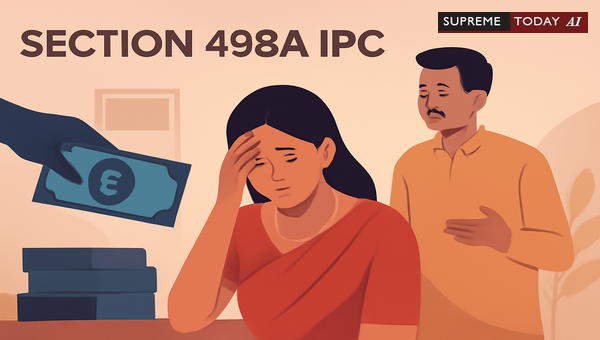
In the realm of matrimonial disputes in India, stands as a vital shield against inflicted on married women by their husbands or relatives. But a pressing question often arises: Is demand for property an essential ingredient under ? This query touches the heart of many cases involving allegations of harassment and coercion. While the law aims to protect women from abuse, courts meticulously scrutinize whether such demands constitute '' as defined. This post delves into the nuances, drawing from legal precedents and principles to provide clarity—note: this is general information, not specific legal advice; consult a qualified lawyer for your situation.
Enacted to combat , penalizes by a husband or his relatives towards a woman. It defines in two main forms:1. Wilful conduct likely to drive the woman to suicide or cause grave injury (Sub-section (a)).2. Harassment to coerce her or her relatives into meeting for property or (Sub-section (b)) 2023 0 Supreme(Del) 1146.
This provision intersects with the but extends beyond traditional dowry to any unlawful property demand linked to harassment. However, not every marital discord qualifies—mere disagreements over finances typically do not suffice.
Yes, demand for property can be a critical ingredient under Section 498A, but only if it is unlawful and tied to . Courts emphasize that the demand must intend to pressure the woman or her family, distinguishing it from routine requests for household support. For instance:- The demand must be unlawful, not just a plea for financial help post-marriage 2007 0 Supreme(MP) 674.- Evidence of harassment is mandatory, often supported by independent witnesses 2020 0 Supreme(Jhk) 3.
From judicial interpretations, From perusal of , it is very clear that for punishment under demand of any property or is also covered under but it is not mandatory2019 0 Supreme(All) 1363. Thus, while property demands fit within the section, they are not always required for a charge under clause (a).
Coercion is pivotal: Harassment must aim at coercing compliance. Harassment of the woman where such harassment is with a view to coercing her or any person related to her to meet any unlawful demand for any property2023 0 Supreme(Cal) 624. Without this link, allegations falter 2023 0 Supreme(UK) 593.
To succeed under Section 498A involving property demands, prosecutors must establish:- Unlawful nature: Demands like cash, vehicles, or gold, especially if disproportionate or timed suspiciously near marriage 2020 0 Supreme(Jhk) 3.- Proximity to marriage: Demands long after marriage may not qualify as dowry-related 2014 3 Supreme 387 2007 0 Supreme(MP) 674.- via harassment: driving the woman to despair. encompasses... and absence of dowry demand does not negate it entirely 2024 0 Supreme(SC) 1369.
Key from other rulings:- Now if one looks at , it is seen that the element of for unlawful demand is ingredient of the section, hence ingredients under still remains2017 0 Supreme(Jhk) 141.- Demands without evidence fail: Demand for dowry or property without accompanying does not constitute an offence under Section 498A from integrated analysis 2024 0 Supreme(Ker) 381.
Courts have shaped this area through precedents:1. Witness-backed demands: In a case, multiple testimonies confirmed a motorcycle demand, satisfying Section 498A 2020 0 Supreme(Jhk) 3.2. Coercion essential: Mere claims without proof of pressure quashed proceedings 2023 0 Supreme(UK) 593.3. Timing matters: Post-marriage delays weaken claims 2007 0 Supreme(MP) 674.4. Non-mandatory for all : Whether the absence of a dowry demand precludes charges of under ... High Court erred in holding that absence of dowry demand negates charge of 2024 0 Supreme(SC) 1369.
Further, In an offence under section 498a I. P. C. there is the ingredient of continuance of the offence2003 0 Supreme(All) 2044, allowing ongoing harassment to build the case.
Exceptions include:- No coercion: Cases lacking pressure elements may shift to laws 2019 0 Supreme(Pat) 1811 2010 0 Supreme(Pat) 216.- Missing dowry link: For related sections like 304B, ingredient for offence under ... in relation to demand of dowry is missing2016 0 Supreme(Pat) 1053.
Section 498A's scope is wide: includes mental harassment from quarrels if they coerce 2024 0 Supreme(Ker) 381. However, Ordinary quarrels or conflicts do not suffice unless they involve harassment for . Vague allegations undermine cases—clear proof of demand + is key 2023 0 Supreme(Chh) 270.
Coercion unpacked: Linked to threats or property detention (echoing ), it amplifies harassment into criminality 2023 Supreme(Online)(Ker) 62304.
If facing or alleging such issues:- Document everything: Collect witness statements, communications proving demands and harassment.- Timing assessment: Ensure demands align with marriage proximity.- Explore alternatives: If 498A elements lack, consider 2010 0 Supreme(Pat) 216.- Seek evidence strength: Courts demand more than accusations 2025 0 Supreme(Kar) 550.
Demand for property is indeed an ingredient under when unlawful, coercive, and harassment-linked, but not mandatory for all claims. Success hinges on robust evidence of both elements, as courts guard against misuse. The combined effect of demand and is necessary for conviction.
Takeaways:- Prove unlawful demand + coercion.- Use witnesses and timelines.- Absence of demand doesn't bar clause (a) .- Consult professionals—outcomes vary by facts.
References: 2020 0 Supreme(Jhk) 3 2023 0 Supreme(UK) 593 2023 0 Supreme(Del) 1146 2007 0 Supreme(MP) 674 2019 0 Supreme(Pat) 1811 2010 0 Supreme(Pat) 216 2024 0 Supreme(SC) 1369 2023 0 Supreme(Cal) 624 2019 0 Supreme(All) 1363 2017 0 Supreme(Jhk) 141 2014 3 Supreme 387
(Word count: 1028. This article synthesizes public legal insights for education; professional advice is essential.)
#Section498A, #IPC498A, #DowryDemand


Issues: Allegations of demanding dowry and assault under Section 498A IPC, lack of evidence of assault or injury, failure ... Ratio Decidendi: The court emphasized the need to establish the elements of cruelty as defined in Section 498A IPC, cautioned ... Final Decision: The accused No.1 was acquitted and set at liberty, and the finding of guilt and conviction under Section 498A ... T....

of Section 155(2) of the Code. ... It is not every type of harassment or cruelty that would attract Section 498A of the IPC. Explanation (b) to Section 498A of the IPC contemplates harassment of woman to coerce or any relation of her to meet any unlawful demand for any property or valuable security. ... Since an essential ingredient o....

... ... Issues: Whether the absence of a dowry demand precludes charges of cruelty under Section 498A IPC. ... (A) Indian Penal Code, 1860 - Section 498A - Criminal Procedure Code, 1973 - Section 482 - Appeal against quashing of proceedings ... under Section 498A IPC - High Court erred in holding that absence of dowry demand negates charge of cruelty - Cruelty encompasses ... The High C....

Indian Penal Code, 1860 – Section 498A, 406, 504, 506, 34 – Criminal Procedure Code, 1973 – Section 161 ... of Section 155(2) of the Code. ... The expression 'cruelty' in Section 498A covers conduct which may drive the woman to commit suicide or cause grave injury (mental or physical) or danger to life or harassment with a view to coerce her to meet unlawful demand. .......

Penal Code, 1860 – Section 498A – Dowry Prohibition Act, 1961 – Sections 3, 4 - Quash proceedings – Dowry ... Code. ... the woman; or (b) Harassment of the woman where such harassment is with a view to coercing her or any person related to her to meet any unlawful demand for any property or valuable security or is on account of failure by her or any person related to her to meet such demand#HL_....

The allegation is so vague that it does not narrate as to when, where and what became of the demand. Vaguely alleging the sister-in-law, who was admittedly a resident elsewhere demanded money would not mean that it would meet the ingredient of Section 498A or 304B of the IPC . ... To appreciate the arguments raised by the learned counsel for the parties, a perusal of Section 304B and 498A#HL_END....

The word 'coercion' is also not defined anywhere in the provision or in the Code, but can find a place under Section 15 of the Contract Act, which stands for “committing or threatening to commit, any act forbidden by the Code or an unlawful detaining or threatening to detain, any property, to the prejudice ... Like wise, a demand for dowry or any property or valuable security without th....
Like wise, a demand for dowry or any property or valuable security without the ingredient of “cruelty” as explained under clause (a) or (b) will not attract the said offence, but a combined effect of both these would bring home the liability under Section 498 A IPC. ... 498A, whatever be the legitimacy of the marriage itself for the limited purpose of Section 498A. ... ....

Section 304B IPC or Section 113B of the Indian Evidence Act. Even the ingredients of Section 498A Section 304B and 498A IPC and Section 113B of the Indian Evidence Act would be required. The same are extracted hereinbelow:- “304B. ... In the latter pronouncement, this Court propounded that one of the essential ingredients of dowry ....
The word 'coercion' is also not defined anywhere in the provision or in the Code, but can find a place under Section 15 of the Contract Act, which stands for “committing or threatening to commit, any act forbidden by the Code or an unlawful detaining or threatening to detain, any property, to the prejudice ... 498A, whatever be the legitimacy of the marriage itself for the limited purpose of Sec....

Therefore, the criminal prosecution of the petitioners would amount to abuse of the process of the Court. 9. Apparently, the demand alleged against the petitioners was for construction of a house which was not a dowry demand or unlawful demand. Hence, the basic ingredient for offence under Section 498A I.P.C. is missing in this case.

From perusal of Section 498A I.P.C., it is very clear that for punishment under Section 498A I.P.C. demand of any property or valuable security is also covered under Section 498A I.P.C. but it is not mandatory. In clause (a) of Explanation cruelty of other nature is covered under this Section.

Now if one looks at section 498A IPC, it is seen that the element of cruelty for unlawful demand is ingredient of the section, hence ingredients under section 498A IPC still remains and the appellants are liable for conviction. Having heard the learned counsel for both sides and having gone through the evidence I am not inclined to acquit the appellants under section 498A of the India Penal Code. However, if one looks at the ingredients of Section 304B IPC it is seen that the....

Hence, ingredient for offence under Section 304-B of Penal Code in relation to demand of dowry is missing. Moreover, the appellants are father-in-law and mother-in-law of the deceased. Further fact that most important ingredient for offence under Section 304-B of Penal Code that soon before the death the victim was subjecting to cruelty is also missing. Further, evidence of P.W. 5, the informant that the victim disclosed only with regard to demand and there is no evidence reg....
The case of Prem Singh etc. v. State of Haryana relied upon by the applicants counsel has also no application to the facts of this case because it relates to an offence under section 304b I. P. C. therefore, constitutes a fresh offence every time or occasion on which it continues. In an offence under section 498a I. P. C. there is the ingredient of continuance of the offence.


An indispensable Tool for Legal Professionals, Endorsed by Various High Court and Judicial Officers
Please visit our Training & Support
Center or Contact Us for assistance

Scan Me!
India’s Legal research and Law Firm App, Download now!


For Daily Legal Updates, Join us on :



 Back to top


