


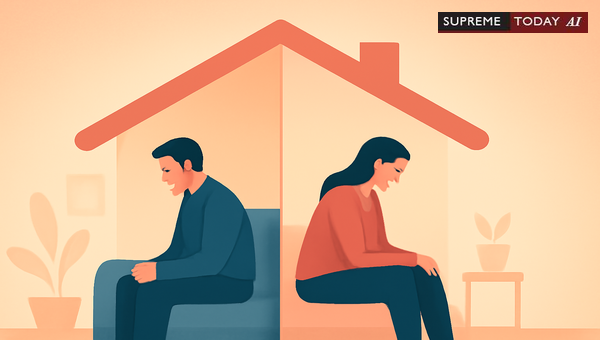
Living Separately in the Same House: Are You Eligible for Divorce?
In modern Indian families, doesn't always lead to physical separation into different homes. Many couples continue sharing the same roof while leading entirely separate lives—no shared meals, no intimacy, no . But does this count as living separately for divorce purposes? The question, Living Separately in the Same House Eligibility for Divorce, is increasingly common, especially under -B of the Hindu Marriage Act, 1955 (HMA).
This blog post dives into judicial interpretations, statutory requirements, and real-world case insights. We'll clarify if such arrangements qualify for , drawing from and rulings. Note: This is general information based on legal precedents and not personalized legal advice. Consult a qualified lawyer for your specific situation.
What Does Living Separately Mean Under -B HMA?
-B allows divorce by mutual consent if spouses have lived separately for at least one year immediately preceding the petition, cannot live together, and mutually agree to . But what constitutes living separately?
Courts have consistently held that it means , irrespective of shared residence. The focus is on the —a lack of desire to fulfill —rather than mere physical distance. As one ruling states: the expression 'living separately' refers to not living like husband & wife 2020 0 Supreme(All) 1396.
Key principles include:- Physical separation into different houses is not required2006 0 Supreme(Raj) 2628 2010 0 Supreme(Del) 9.- Spouses under the same roof can qualify if they lead separate lives, without cohabitation or 2006 0 Supreme(Raj) 2628 2010 0 Supreme(Del) 9 2001 0 Supreme(P&H) 639.
This interpretation prioritizes the breakdown of the marital bond over rooftops.
Court Rulings on Same-Roof Separation
Indian courts, particularly the , have clarified this in multiple cases. For instance:
The courts have consistently interpreted 'living separately' to mean , regardless of whether the spouses reside in the same or different houses 2006 0 Supreme(Raj) 2628 2010 0 Supreme(Del) 9 2001 0 Supreme(P&H) 639 2011 0 Supreme(Raj) 341.
In another case, parties stated they had been living separately for five years preceding the presentation of the petition, emphasizing the one-year requirement immediately before filing 2020 0 Supreme(All) 1396. Even shorter periods like ten months were noted, but courts stress the statutory one-year threshold 2017 0 Supreme(Raj) 2403.
Judges look beyond facades: sleeping in separate rooms, no shared household duties, or emotional detachment can suffice. The key aspect is the of the spouses—having no desire to perform —rather than physical separation alone 2006 0 Supreme(Raj) 2628 2010 0 Supreme(Del) 9 2001 0 Supreme(P&H) 639.
Living Under the Same Roof: Valid Grounds?
Yes, typically. Spouses sharing a home but not a marriage can be deemed living separately if:- They do not fulfill marital roles (e.g., no , separate finances, independent routines) 2006 0 Supreme(Raj) 2628 2010 0 Supreme(Del) 9 2011 0 Supreme(Raj) 341.- The separation reflects an , with no intent to reconcile.
Other sources affirm this: Courts recognize couples under the same roof but leading separate lives, such as sleeping separately or not sharing meals, as evidence of marital collapse 2022 0 Supreme(HP) 699 2024 0 Supreme(AP) 1534 2024 0 Supreme(P&H) 1374 2023 0 Supreme(Ker) 281. Physical proximity alone doesn't negate separation if the relationship is defunct.
However, proof matters. Affidavits, witness statements, or documented mutual consent help establish this in petitions.
Duration of Separation: The One-Year Rule
The separation must last at least one year immediately prior to filing the petition 2006 0 Supreme(Raj) 2628 2010 0 Supreme(Del) 9 2001 0 Supreme(P&H) 639 2011 0 Supreme(Raj) 341 2020 0 Supreme(All) 1396.
It is not disputed that the requirement of living separately for a period of one year or more is to be taken note of immediately preceding the presentation of the petition for divorce 2020 0 Supreme(All) 1396.
Courts may consider longer periods (e.g., 5-10 years) favorably, but the focus remains on recent, continuous separation and mental divorce 2017 0 Supreme(Raj) 2403. In mutual consent cases, this pairs with proof of failed reconciliation efforts.
: Essential Conditions
Under -B:1. Mutual agreement to 2006 0 Supreme(Raj) 2628 2020 0 Supreme(Bom) 1442
.2. Inability to live together.3. One-year separation.
Consent can be withdrawn unilaterally before the ends, but courts discourage delays if separation is prolonged. One judgment notes: The stand of the respondent wife that she wants to live separately from her husband but is not agreeable to a mutual divorce is not acceptable, since living separately is one of the grounds for grant of a mutual divorce and admittedly the parties are living separately for more than seven years 2009 0 Supreme(MP) 928 2009 0 Supreme(Raj) 1042.
Exceptions, Limitations, and Additional Insights
Not every same-house separation qualifies:- Prolonged separation alone isn't enough; intent and are crucial
.- If separation stems from coercion, threats, or force (not mutual), it may need separate grounds under (e.g., desertion) 2006 0 Supreme(Raj) 2628 2024 0 Supreme(Bom) 859
.- In one case, a wife withdrew consent after property transfer, prompting courts to consider alternative remedies like contested divorce 2012 0 Supreme(Raj) 623.
Extended separations (2-10 years) strengthen claims, especially with factors like extramarital issues or mutual agreements 2024 0 Supreme(AP) 1534 2023 0 Supreme(Ker) 281. Voluntary separation is viewed favorably over forced ones.
Practical Recommendations
- Document everything: Joint affidavits detailing separate lives, dates, and consent.
- File promptly: Ensure one-year separation precedes the petition.
- Seek mediation: Cooling-off periods allow reconciliation checks.
- Consult experts: assess on case merits.
Key Takeaways
- Living separately in the same house can qualify under -B if spouses aren't living as husband and wife, with requisite mental separation and one-year duration 2006 0 Supreme(Raj) 2628 2010 0 Supreme(Del) 9.
- Courts prioritize relationship breakdown over physical homes.
- Mutual consent is key, but withdrawals complicate matters—prolonged separations may invoke for justice 2009 0 Supreme(MP) 928.
Ultimately, eligibility hinges on facts, not roofs. If your marriage exists in name only, judicial precedents support dissolution.
Disclaimer: Laws evolve, and outcomes vary. This overview draws from cited cases like those under HMA but isn't advice. Contact a family law attorney for tailored guidance.
#DivorceIndia, #HMA13B, #LivingSeparately















