


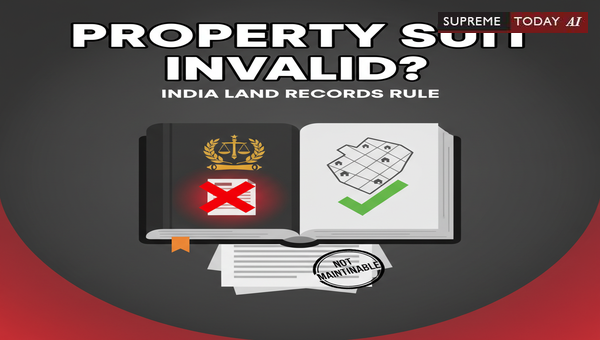
Partition Suit Barred by Revenue Record Entry?
In joint family property disputes, one common question arises: When Entry Made in Revenue Records then Suit for Partition is Not Maintainable? Imagine a family divided by an old partition deed, with entries already updated in the revenue records (like jamabandi or mutations). Can a co-owner still file a suit for partition, or does the revenue entry bar it? This issue hinges on the reliability of such entries and deeds under Indian law.
This blog explores the legal nuances, drawing from key judgments and statutory requirements. While revenue records play a role, they don't always confer conclusive title. We'll break down why an unincorporated or unregistered partition deed is often unreliable, yet incorporation in revenue records may signal in some cases. Note: This is general information, not legal advice. Consult a qualified lawyer for your specific situation.
Legal Requirements for Valid Partition Deeds
Under the , particularly , a affecting must be registered to be admissible as evidence of title, ownership, or interest. Unregistered deeds are generally inadmissible for proving transfer or extinguishment of rights, though they may show intention or . As one judgment notes: The law mandates that a affecting must be registered to be valid and admissible as evidence of title 1988 0 Supreme(SC) 166.
Courts consistently uphold this: unregistered documents cannot establish legal partition but might serve collateral purposes, like proving intent 1988 0 Supreme(SC) 166 2015 0 Supreme(SC) 971 1966 0 Supreme(SC) 265. For instance, informal records like Palupatti (partition memos) are often insufficient without registration 1988 0 Supreme(SC) 166 2026 1 Supreme 106.
Role of Revenue Records and Mutations
Revenue entries, such as mutations or jamabandi updates, are primarily for and do not confer legal title or prove valid partition. Courts emphasize: Revenue records and mutations, even if in the name of a party, do not confer legal title or establish a valid partition, as these records serve only 2020 4 Supreme 193
1969 0 Supreme(SC) 31.
However, once incorporated after due process, they gain a and . In one case: The plaintiff did not file any appeal against the said order, meaning thereby that the said proceedings had attained . Accordingly, the partition proceedings had been implemented and incorporated in the revenuerecord2025 Supreme(Online)(P&H) 5184. This suggests that unchallenged entries may bar fresh partition suits, as the partition is deemed implemented.
Yet, this presumption is . Discrepancies, lack of physical partition, or fraud can challenge it. For example: No effort was made by the parties to get the family settlement incorporated in the revenuerecord. ... There is also no document of alleged partition nor the alleged partition was got recorded in the revenuerecord
. Mere presence in records without registration doesn't make a suit non-maintainable if title is disputed.
When Does Revenue Entry Make Partition Suit Not Maintainable?
A suit for partition may not be maintainable if:- Partition proceedings are finalized, appeals exhausted, and fully incorporated in revenue records 2025 Supreme(Online)(P&H) 5184.- Entries reflect a registered deed or court decree, establishing
.
But it's maintainable if:- The deed is unregistered and unincorporated, lacking evidentiary value 1988 0 Supreme(SC) 166.- Revenue entries are fiscal only, without actual possession or legal transfer 2020 4 Supreme 193.- Evidence shows no effective partition, like inconsistent conduct or oral testimony favoring joint status
.
In , the Supreme Court reinforced: unregistered deeds are inadmissible for ownership transfer 1988 0 Supreme(SC) 166. Similarly: The partitiondeed does not bear the signatures and partition proceedings... had since been incorporated in the latest jamabandi
, highlighting scrutiny of documents.
Judicial Precedents and Exceptions
Key rulings clarify limits:- Unregistered deeds inadmissible for title: But usable for severance intent 1988 0 Supreme(SC) 166 2015 0 Supreme(SC) 971.- Revenue records not conclusive: Revenue entries do not determine title and that only a registered deed or decree can establish a valid partition
.- Incorporation adds weight: If no appeal, proceedings attain 2025 Supreme(Online)(P&H) 5184.
Exceptions include collateral use: Unregistered documents may be admissible to prove the intention or fact of , but not to establish title or ownership 1988 0 Supreme(SC) 166. Actual possession and oral evidence often prevail: courts in cases like
prioritized consistent conduct over disputed deeds.
Another example: The name of the appellant was recorded in sale deed and revenuerecord... but the partitiondeed Ex. D-1 is not admissible in evidence and no partition has taken place 2024 Supreme(Online)(MP) 37232. This underscores that records alone don't validate unregistered partitions.
Practical Implications from Case Law
From additional sources:- via incorporation: Unchallenged revenue updates post-partition proceedings suggest the suit may be barred 2025 Supreme(Online)(P&H) 5184.- Unreliability without registration: The settlement deed is of the year ... the defendant's version is notreliable
.- Oral evidence precedence: Courts weigh possession over unrecorded deeds
.
Under Hindu law, partition needn't always be registered, but for , it strengthens claims immensely 2023 Supreme(Online)(AP) 20690.
Key Takeaways and Recommendations
- Register partition deeds affecting to ensure admissibility 1988 0 Supreme(SC) 166.
- Incorporate in revenue records post-registration for presumption of 2025 Supreme(Online)(P&H) 5184.
- Revenue entries provide prima facie evidence but are ; they don't automatically bar suits if partition is ineffective 2020 4 Supreme 193.
- Rely on registered deeds, court decrees, or strong possession evidence in disputes.
- Seek incorporation early to avoid challenges; unchallenged entries may render suits non-maintainable.
In conclusion, while a partition deed not incorporated in revenue records is generally unreliable—especially if unregistered—proper entry after due process can make a fresh partition suit not maintainable, as it implies . However, courts scrutinize for validity, prioritizing registered documents and actual division. For tailored advice, consult a property law expert.
#PartitionLaw, #RevenueRecords, #PropertyDispute















