


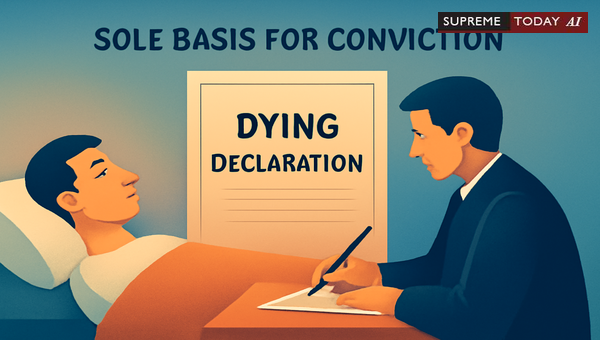
Can Conviction Rely Solely on a in Indian Law?
In high-stakes criminal cases, particularly those involving murder or , dying declarations often play a pivotal role. But can a court convict someone based solely on such a statement? The phrase Conviction only on is Bad in Law circulates widely, yet the reality is more nuanced. While Indian courts have held that a can form the sole basis for conviction under specific conditions, stringent safeguards ensure its reliability. This post delves into the legal principles, judicial scrutiny, and case insights to clarify when it's permissible and when it's risky.
Note: This article provides general information based on established case law and is not legal advice. Consult a qualified lawyer for case-specific guidance.
Understanding Dying Declarations Under Indian Law
A is a statement made by a person who is aware of their impending death, regarding the cause of their death or circumstances leading to it. Governed primarily by , it is an exception to the due to the presumption that a dying person speaks the truth.
The key question arises: Is conviction solely on a bad in law? Not inherently. Courts have repeatedly affirmed that if the declaration is trustworthy, voluntary, and inspires confidence, it can sustain a conviction without . However, courts exercise extreme caution to prevent miscarriages of justice. 2002 5 Supreme 466 2010 7 Supreme 8
Core Legal Principles for Relying on Dying Declarations
1. Trustworthiness and Reliability
For a to stand alone, the court must be fully satisfied about its truthfulness. This involves assessing:- Voluntariness: Was it made without coercion, tutoring, or prompting? External influences, such as relatives or police, can taint it. 2010 0 Supreme(SC) 695 2006 9 Supreme 331- Mental Fitness: The declarant must be in a fit state of mind. Medical evidence, like a doctor's certificate, is crucial to confirm this. 2006 9 Supreme 331 2016 8 Supreme 296
As held in judicial precedents, When the is trustworthy and reliable and it was given voluntarily and the same is proved, the settled law is that, it can be the sole basis for conviction without any . 2025 0 Supreme(Guj) 1414
2. Need for : Rule or Prudence?
is not mandatory but a . If the declaration is suspicious, inconsistent, or embellished, courts demand supporting evidence. For instance:- Multiple declarations with contradictions render them unreliable. 2018 0 Supreme(AP) 49 2018 0 Supreme(AP) 101- Oral dying declarations from witnesses, if doubtful, require backing. Now, it is well settled law that conviction can be awarded only on the basis of . If it is doubtful, then is necessary. 2018 0 Supreme(Bom) 1014
In cases of doubt, the accused benefits: As per settled law, unless the is reliable, it cannot form the sole basis for conviction. 2018 0 Supreme(AP) 49
3. Judicial Scrutiny and Caution
Courts meticulously examine:- Consistency: Internal coherence and alignment with other evidence.- Circumstances: Presence of relatives, police, or medical endorsement.- Embellishments: Any signs of exaggeration undermine it. However, before basing the conviction on the , the conscience of the Court must be satisfied that the maker of the statement was in a fit condition to give the statement, the statement is voluntary and truthful and the is free from embellishments and any other infirmity. 2018 0 Supreme(Bom) 738
If unreliable even in part, it cannot sustain conviction alone. 1964 0 Supreme(SC) 231
Landmark Case Law Insights
Affirmative Reliance
- : The ruled that if a inspires full confidence regarding truthfulness and voluntariness, conviction can proceed without . 2010 0 Supreme(SC) 695
- In a dowry death appeal, the court set aside , holding the wife's reliable despite hostile witnesses. It emphasized: Dying declarations can serve as the sole basis for conviction if found trustworthy. The accused failed to explain the burn injuries, leading to guilt under . 2025 0 Supreme(Guj) 1414
- Another case upheld conviction where the declaration was consistent and corroborated by circumstances, even recorded by a police head constable. 2012 0 Supreme(Bom) 1906
Rejections and Acquittals
- Where declarations showed inconsistencies (e.g., differing versions to police and magistrate), courts discarded them: In the case on hand, there is no material to corroborate the two versions of the deceased... the same are unreliable. 2018 0 Supreme(AP) 101
- In a burn injury case, doubts arose from lack of medical fitness certificate, presence of relatives, and contradictions: All this evidence create doubt about statement made by deceased. Appeal dismissed, upholding 's caution. 2018 0 Supreme(Bom) 1014
- Multiple declarations with material inconsistencies touching core facts made conviction unsafe: Court have no hesitation in holding that... it would be unsafe to base conviction on dying declarations. 2018 0 Supreme(Bom) 738
These cases illustrate that while possible, sole reliance is exceptional and demands rigorous testing. 1994 0 Supreme(SC) 934 1994 0 Supreme(SC) 935
Practical Recommendations for Stakeholders
For prosecutors, defense lawyers, and investigators:- Secure Medical Endorsement: Always obtain a doctor's certificate on the declarant's fitness. 2016 8 Supreme 296- Minimize Influences: Record in neutral settings, avoiding relatives or prompts.- Seek Proactively: Especially in suspicious cases, bolster with forensics, witnesses, or circumstantial evidence.- Scrutinize for Inconsistencies: Cross-check multiple statements or with post-mortem reports.
Defendants should highlight any lapses, such as missing endorsements or tutoring, to claim benefit of doubt. 2011 3 Supreme 278
Conclusion: Balancing Justice and Caution
Conviction solely on a is not bad in law if it passes the litmus test of reliability, voluntariness, and confidence-inspiring scrutiny. Courts prioritize prudence, often preferring amid doubts. As settled law affirms, a credible carries immense weight, but unreliability invites . 2012 0 Supreme(SC) 913 1994 0 Supreme(SC) 935
Key Takeaways
- Permissible with Safeguards: Yes, if trustworthy—no absolute rule.
- Red Flags: Inconsistencies, no medical proof, external influence.
- Judicial Role: Thorough examination to prevent errors.
Stay informed on evolving precedents, as rulings continue shaping this vital evidentiary tool. For personalized advice, reach out to legal experts.
References: 2002 5 Supreme 466 1964 0 Supreme(SC) 231 2010 0 Supreme(SC) 695 2011 3 Supreme 278 2012 0 Supreme(SC) 913 1994 0 Supreme(SC) 934 1994 0 Supreme(SC) 935 2006 9 Supreme 331 2016 8 Supreme 296 2025 0 Supreme(Guj) 1414 2018 0 Supreme(Bom) 1014 2018 0 Supreme(AP) 49 2018 0 Supreme(AP) 101 2018 0 Supreme(Bom) 738 2012 0 Supreme(Bom) 1906
#DyingDeclaration #CriminalLawIndia #LegalInsights















