


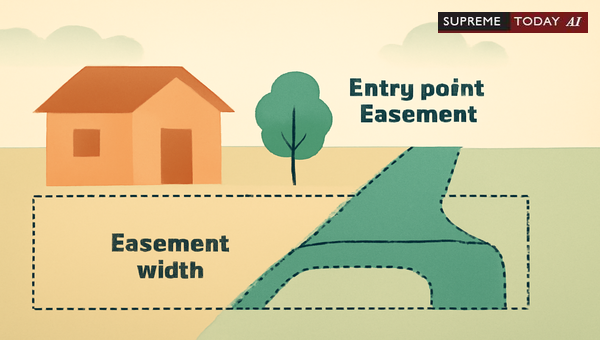
Easement Width & Entry Points: Essential Rules in Indian Property Law
Property disputes in India often revolve around —the right to use another's land for specific purposes like pathways. A common question arises: Easement Width Entry Point Middle Portion—how are the width of an easement, its entry points, and even the middle portions regulated? Under the , these aspects aren't arbitrary but hinge on evidence of use, , and precise documentation. This guide breaks down the legal principles, key court rulings, and practical insights to help property owners navigate these issues.
Note: This is general information based on case law and should not be considered specific legal advice. Consult a qualified lawyer for your situation.
Main Legal Finding
In property law under the Indian Act, the regulation of easement width and entry points is primarily determined by the nature of the easement—whether by prescription, , or implied—and the evidence of long-term use, , or natural boundaries. Courts emphasize that specifics must be established through clear, continuous use, long-standing practice, or , and cannot be arbitrarily defined without proper evidence or legal basis. 2025 0 Supreme(Ker) 545 1990 0 Supreme(Ker) 476
Key Points on Easement Dimensions
- Width Determination: The width of an easement is often set by and long-standing practice, not unilateral decisions. For instance, courts have recognized widths like three feet or 2½ meters based on proven historical use. 2025 0 Supreme(Ker) 545 1990 0 Supreme(Ker) 476
- Entry Points and Pathways: These must stem from continuous, uninterrupted use or , with dimensions backed by evidence. 2012 0 Supreme(Ker) 3
- Precise Required: Claims for specific widths and entry points need detailed and proof, especially in contested cases. 1992 0 Supreme(Ker) 227
Detailed Analysis: Nature of Easement and Evidence
Governs Extent
depend heavily on proven, long-term use or . In one case, a pathway used for over 50 years was recognized with a three-foot width based on evidence, where the existence of an alternative pathway does not negate the claim if the essentials are proven (para 21). 2025 0 Supreme(Ker) 545
Similarly, vehicular access over a gravelled and metalled road, with a uniform width of 2½ metres was upheld as a , tied directly to the nature of continuous use. 1990 0 Supreme(Ker) 476
Width and Entry Point Specifics
Courts reject arbitrary claims. In another ruling, a three-foot-wide pathway was upheld, though the plaintiff failed to prove the existence of the pathway for the , limiting rights to presented evidence. 2012 0 Supreme(Ker) 3
Precise are crucial: the judgments and decrees should be based on the of the parties, ensuring widths and entry points are clearly specified and proved. 1992 0 Supreme(Ker) 227
Role of and Boundaries
Accurate are vital, depicting the easement's length, width, starting point (entry), and termination. Without them, boundary discrepancies undermine claims. Pathways may start from specific points like the northwestern end, with widths varying (e.g., 8 links, 6 feet, or 3.45-4.72 meters). 2025 Supreme(Online)(Ker) 24062 2025 Supreme(Online)(KER) 5905 2025 Supreme(Online)(Ker) 14231
Entry points are critical; for example, an 8-links-wide way on the western side shifted to 5 links in the middle of 2002, with courts noting entry to major roads only through certain schedules. 2025 Supreme(Online)(Ker) 22433
Discrepancies between survey reports and plaints—such as varying widths across survey numbers—can weaken cases. 2025 Supreme(Online)(Ker) 14231 2024 Supreme(Online)(Ker) 85773
Entry Points, Usage, and Judicial Scrutiny
Physical evidence like fencing or pillar distances supports actual entry points. Widths (e.g., 6 or 8 feet) and usage type matter: pedestrian-only paths don't extend to vehicles. When use is only for walking, the plaintiff cannot claim easement for taking vehicular traffic. 2025 Supreme(Online)(KER) 10780 2022 Supreme(Online)(KER) 40357 2022 Supreme(Online)(KER) 62905 2025 Supreme(Online)(Ker) 29933 2025 Supreme(Online)(Ker) 55471
Permissive use doesn't ripen into prescription: when the right of way is by way of permission, the same could not ripen into an easement by prescription. 2025 Supreme(Online)(KER) 10780
Courts demand showing precise location and measurements for success. The extent of user at claim time defines scope, especially for prescriptive . 2025 Supreme(Online)(Ker) 24062 2025 Supreme(Online)(KER) 5905 2025 Supreme(Online)(Ker) 14231 2025 Supreme(Online)(Ker) 55471
Exceptions and Limitations
- Prescription Requirements: over the (typically 20 years) is key; occasional or permissive use fails. Narrower paths (e.g., 5 links) or foot-only traffic limit scope. 2025 Supreme(Online)(Ker) 55471 2022 Supreme(Online)(KER) 62905
- -Based : Width and entry points follow land's physical needs, not owner preference. 2025 0 Supreme(Ker) 545
- Court Modifications: Evidence may lead to narrower widths than claimed. 2025 0 Supreme(Ker) 545 1990 0 Supreme(Ker) 476
Practical Recommendations
- Document Thoroughly: Specify exact widths, entry points, and middle portions in , backed by surveys and use history.
- Prove Continuous Use: Maintain records of pathway usage to build prescriptive claims.
- Focus on Evidence: Use physical boundaries, commission reports, and over vague assertions.
- Address Usage Type: Distinguish foot from vehicular to avoid rejected expansions.
Key References
- 1992 0 Supreme(Ker) 227: Stresses precise for widths and entry points.
- 2012 0 Supreme(Ker) 3: Recognizes rights via long-term use; orders removal of infringing structures.
- 2025 0 Supreme(Ker) 545: Width by continuous use; alternatives don't negate claims.
- 1990 0 Supreme(Ker) 476: Vehicular pathway width from actual metalled road use.
- 2025 Supreme(Online)(Ker) 24062, 2025 Supreme(Online)(KER) 5905, 2025 Supreme(Online)(Ker) 14231: Survey plan .
- 2025 Supreme(Online)(KER) 10780: Limits to proven usage type.
- 2025 Supreme(Online)(Ker) 22433: Width variations and entry specifics.
Conclusion and Key Takeaways
Easement width, entry points, and middle portions in Indian law rest on , evidence, and surveys—not assumptions. Courts favor clear, documented claims, often limiting rights to what's proven. Property owners should prioritize and historical use to strengthen positions in disputes.
Takeaways:- Always plead specifics with evidence.- Match claims to usage (foot vs. vehicle).- Use surveys to resolve boundary issues.
By understanding these principles, you can better protect easement rights. For tailored advice, seek professional legal counsel.
#EasementLaw, #PropertyRightsIndia, #IndianPropertyLaw












