Searching Case Laws & Precedent on Legal Query!
Scanned Judgements…!



Searching Case Laws & Precedent on Legal Query!
Scanned Judgements…!
Court-Ordered Access to Children - Courts can order a party to see children when necessary, but if a party is not complying or is uncooperative, the proper legal action involves seeking enforcement through the court. This typically includes filing a motion for contempt or enforcement of the existing order, or requesting the court to hold the non-compliant party in contempt if they refuse or neglect to facilitate access ["
MENCHINAHAMY v. MUNIWEERA et al.
"].Legal Steps to Enforce Access - To take legal action, the concerned party should file a formal application or motion before the court, requesting enforcement of the visitation or access order. The court can then issue directives or sanctions to ensure compliance. If the party is deliberately obstructing access, the court may hold them in contempt or impose penalties to compel adherence ["
MENCHINAHAMY v. MUNIWEERA et al.
"].Importance of Proper Legal Procedure - It is essential to follow the correct legal process, which includes providing notice to the opposing party, presenting evidence of non-compliance, and requesting the court's intervention. Courts have the authority to enforce access orders and address violations appropriately ["
MENCHINAHAMY v. MUNIWEERA et al.
"].Summary - When a court has ordered access to children but a party is not showing or cooperating, the appropriate legal action is to file a motion for enforcement or contempt. This ensures the court can compel compliance and address any obstruction legally ["
MENCHINAHAMY v. MUNIWEERA et al.
"].References:["
MENCHINAHAMY v. MUNIWEERA et al.
"]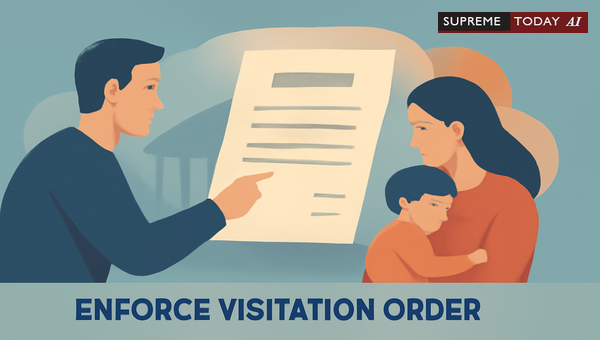
Imagine a court has ordered visitation when necessary, but the other parent refuses to show the children, leaving you frustrated and disconnected from your kids. This common family law issue—court ordered to see children when necessary but party is not showing how to take legal action to show the children—raises serious concerns about compliance with . Withholding children violates and can harm the child's , which courts universally prioritize. 2025 0 Supreme(Telangana) 1378
Courts stress both parents' involvement, often favoring structured schedules unless negligence exists, such as for young children typically staying with the mother. 2025 0 Supreme(Telangana) 1378 Violations like denial of access or unauthorized moves may lead to . 2022 0 Supreme(SC) 615 This guide outlines practical, general steps to demonstrate withholding and seek enforcement, drawing from legal precedents. Note: This is informational only; consult a local family law attorney for personalized advice.
Start by solidifying your foundation. Obtain certified copies of the visitation order from the issuing court. These detail schedules (e.g., every second Saturday), conditions (supervised vs. unsupervised), and any parenting plans. 2025 0 Supreme(Telangana) 1378 2022 0 Supreme(SC) 615
In one case, courts affirmed no variation without , placing the on the seeking party: The court affirmed that the welfare of children is paramount and the lies on the party seeking variations to custody and maintenance orders.
Evidence is your strongest ally. Courts require proof of .
Precedents highlight child welfare: It is now well settled law that while deciding the issue of visitation of the children, the court will take into consideration the welfare and interest of children. 2015 0 Supreme(Del) 4091 Children's reluctance due to parental discord doesn't excuse violations if settlement terms bind parents. 2015 0 Supreme(Del) 4091
Move to formal action once documented.
Access must serve welfare: The court emphasizes the importance of allowing both parents access to children for their welfare while assuring interim orders to adapt during ongoing divorce proceedings.
Prepare meticulously for hearings.
In custody disputes, courts consider children's views but prioritize welfare: The behavior of the children towards their mother/respondent is clearly evident that they are not at all interested to go along with their mother/respondent. Yet, parents must comply unless welfare demands otherwise. 2021 0 Supreme(Mad) 368
Seek local counsel.
Syariah contexts bind parties to original courts: Parties to a divorce must resolve in the following a decree.
Enforcing visitation demands documentation, evidence, filings, and welfare-focused arguments. Courts uphold orders prioritizing child stability over unilateral actions. 2025 0 Supreme(Telangana) 1378 2022 0 Supreme(SC) 615 Act promptly to preserve bonds—start with records, then motions.
Key Takeaways:- Document everything meticulously.- Child welfare trumps parental disputes.- File contempt with strong proof.- Consult professionals immediately.
This approach, backed by precedents, helps restore access. Always verify with jurisdiction-specific advice, as laws vary.
#VisitationRights #FamilyLaw #ChildCustody



Id. at 176; see also Crowley, 38 F.4th at 1109 (“Because a plaintiff could not bring this type of tort action in [the Court of Federal Claims] in the first place, that Court would not have exclusive jurisdiction of them.”). ... The district court found that the Government elected to withhold all congressionally authorized funding for direct legal representation, even though such funding was necessary to ensure all unaccompanied #HL_....
Attapattu be ordered to issue notices on the parties disclosed by Wattuhamy. Mr. Attapattu, however, refused to do so stating that " notices are not necessary if the intervenient does not want them ". ... The Court issued an order nisi on N's son S and four other children of N to show cause why they should not be added. The order nisi was reported served and on the returnable date, they being absent, the Court made the order ni....
On that date the children were with the PW and has remained with her until today. There is nothing to even suggest that the PW did not take care of the children was indifferent to their welfare. ... The court should not condone such action when there was no effort to make any payments at all as a sign of good faith but a total stoppage of payments. ... She was given custody, care and control of the children and had been taking care of the c....
In any case, the Petitioner Wife did not justify this claim to the Court. It is also not proper for this Court to grant such lump sum payment when the Court has not conducted the full trial and ascertained which party has been responsible for the breakdown of the marriage. ... , but not legal guardianship, is granted to the Petitioner Wife. ... (g) Any other Order and/or relief which is deemed proper and necessary#HL_EN....
It is also not proper for this Court to grant such lump sum payment when the Court has not conducted the full trial and ascertained which party has been responsible for the breakdown of the marriage. ... (g) Any other Order and/or relief which is deemed proper and necessary by this Honourable Court. ... Prayer (a) : regarding access only When the Petitioner Wife applied for legal guardianship and custody of the 3 children, ....
It is also not proper for this Court to grant such lump sum payment when the Court has not conducted the full trial and ascertained which party has been responsible for the breakdown ... the degree of responsibility which the Court apportions to each party for the breakdown of the marriage. ... (g) Any other Order and/or relief which is deemed proper and necessary by this Honourable Court. ... Prayer (a) : regarding access only....
It is also not proper for this Court to grant such lump sum payment when the Court has not conducted the full trial and ascertained which party has been responsible for the breakdown of the marriage. ... (g) Any other Order and/or relief which is deemed proper and necessary by this Honourable Court. ... Prayer (a) : regarding access only When the Petitioner Wife applied for legal guardianship and custody of the 3 children, she did....

We see no merit in this petition and the same is, accordingly, dismissed. We expect all the State Governments to take appropriate action in preventing such encroachments and illegalities wherever they come up. ... Ext.P-5 the family membership certificate issued by the Village Officer concerned would show that, the widow and children of the deceased John Mathew are his legal representatives and his children including the petitioner are his legal representatives etc. 6. ... along with a....
There should be more of a "give and take" attitude from each party. More importantly, the parties should strive to minimise their difference on the access issue so that the children will not be adversely affected. ... If that was in reference to what the Senior President had told the children, that would not be contradicting the access order as there is no breach if the children themselves refuse to see or be with the father. ... Section 52(6) AMLA p....

Being a party to such resolution, he cannot take a decision to keep it in abeyance; (2) making such a provision of adding weigh tage of 10 marks is not at all discriminatory in nature. ... Section 13 (6) of the act states the vice-chancellor may, subject to the control of the chancellor, take action on any emergency which in his opinion calls for immediate action. ... In addition to this even in the absence of such a challenge by a person, when such matters come to the notice of this #....

The behavior of the children towards their mother/respondent is clearly evident that they are not at all interested to go along with their mother/respondent. When the respondent/mother requested the Court to grant permission to speak with the children, this Court, in order to provide an opportunity to the mother of the minor children, asked the minor boy and girl, whether they are willing to talk with their mother. When the minor children and the respondent/mother of the minor children are present, this Court made clear observations and for about one hour, the children had not even....

Further, he made admission that he did not give any money to the respondent for family expenses. He has also made admission that he did not take any legal steps to see his children. At the same time, in contradiction, he has deposed that there is no chance for reunion with the respondent and children.

Master Shravan aged 5 years, was so attached to the mother that he kept on visiting his mother after short intervals during interaction in the chamber. It is now well settled law that while deciding the issue of visitation of the children, the court will take into consideration the welfare and interest of children because it is not the rights of the parties to meet the children but the interest and welfare of the minor children. Though, it is desirable that for proper development of personality of the children of warring parents, both parents should have equal access to the....

Unless absolutely necessary for the purposes of interaction with the Judges, parties should not be required to bring children to the Court. The adversarial nature of child custody proceedings, and the environment in which they are conducted, have the potential of traumatising children. When she answered in the affirmative the Court observed that the children need not have been brought to the Court when there was no order requiring their presence. Accordingly as far as the present appeal is concerned, the children were requested to remain outside the court room.

Looking at the role of mother in past towards children and taking primary responsibility for their health, safety, education and overall welfare; which parents deal with mundane but necessary arrangements of their lives – clothing, haircuts, extracurricular activities, gifts for friends, doctors’ and dentists’ appointments, contact with their extended family; and mother has the best perception of the emotional needs of the children specifically female child. How this Court approached the child custody issue when the children were produced in Court and thereafter:


An indispensable Tool for Legal Professionals, Endorsed by Various High Court and Judicial Officers
Please visit our Training & Support
Center or Contact Us for assistance

Scan Me!
India’s Legal research and Law Firm App, Download now!


For Daily Legal Updates, Join us on :



 Back to top


