Searching Case Laws & Precedent on Legal Query!
Scanned Judgements…!



Searching Case Laws & Precedent on Legal Query!
Scanned Judgements…!
MEIS SINGHO v. JOSIE PERERA
"], ["TIRUGNASAMBANTHAPILLIA v. NAMASIVAYAMPILLAI
"], ["Sobhag Narain Mathur vs Pragya Agrawal & Ors. - Delhi"], ["Sobhag Narain Mathur vs Pragya Agrawal & Ors. - Delhi"]-176_2007), ["Sobhag Narain Mathur vs Pragya Agrawal & Ors. - Delhi"].MEIS SINGHO v. JOSIE PERERA
"], ["TIRUGNASAMBANTHAPILLIA v. NAMASIVAYAMPILLAI
"], ["Sobhag Narain Mathur vs Pragya Agrawal & Ors. - Delhi"], ["Sobhag Narain Mathur vs Pragya Agrawal & Ors. - Delhi"], ["Sobhag Narain Mathur vs Pragya Agrawal & Ors. - Delhi"]-176_2007).MEIS SINGHO v. JOSIE PERERA
"].The legal principle is that an agreement to agree or to negotiate in future does not amount to a binding contract unless it is finalized and contains all essential terms ["2023 0 Supreme(Cal) 460"], ["
MEIS SINGHO v. JOSIE PERERA
"].Analysis and Conclusion:
MEIS SINGHO v. JOSIE PERERA
"].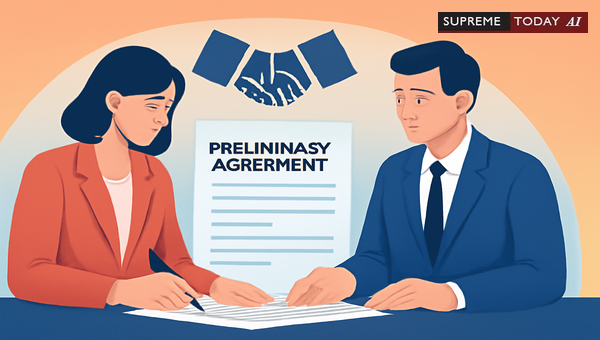
In the world of business and real estate deals, parties often sign preliminary documents outlining their intent to hammer out a full contract later. But a common question arises: can there be an agreement to enter into a future agreement? These agreements to agree or are tricky. They promise future negotiations or execution but may not hold up in court. This post dives into the legal principles, enforceability challenges, and real-world examples to help you navigate this nuanced area of contract law.
Note: This is general information, not legal advice. Consult a qualified attorney for your specific situation.
Agreements to enter into future contracts are typically preliminary or inchoate agreements. They act as a framework for later negotiations or a definitive deal, but they're often not binding right away. Instead, they signal the parties' intention to be bound once conditions are met. 2017 0 Supreme(AP) 231
These fall under , where obligations are to be performed in the future—unlike , which are fully performed. involve ongoing promises not yet fulfilled. 2017 0 Supreme(AP) 231
Classically termed , as in Von Hatzfeld-Wilden Burg v. Alexander (1912), they don't create immediate enforceable rights until the future contract materializes. Similarly, in principle agreements, like those in Western Broadcasting Services v. Seaga (2007 UKPC 19), agree on core terms but leave details for later—enforceable only if certain enough. 2017 0 Supreme(AP) 231
For any agreement to stick, courts look at several pillars:
Preliminary docs like () often lack clear intent to be legally binding unless stated explicitly. Without this, they're just negotiations.
Agreements must have sufficiently certain terms. Vague agreements to agree on material points fail here. Courts won't enforce incomplete deals. 2017 0 Supreme(AP) 231
In one case, a document was deemed at the best; an agreement to enter into an agreement in future by accepting in future the before sub-Registrar. Since was never paid, no binding sale agreement formed, and was denied under , as it depended on parties' volition. 2020 0 Supreme(P&H) 943
English law (influential in many jurisdictions) requires consideration. These agreements often feature —future promises. 2017 0 Supreme(AP) 231
are generally non-binding absent explicit language or action upon them. However, if terms are clear and intent shown, courts may enforce parts.
Von Hatzfeld-Wilden Burg v. Alexander: Affirms these as non-immediately binding . 2017 0 Supreme(AP) 231
Western Broadcasting Services v. Seaga: In principle deals can bind if intent and certainty exist, despite open details. 2017 0 Supreme(AP) 231
Indian courts often scrutinize these in property disputes:
A 'bayana' receipt was seen as a concluded contract despite missing details, as intent and material terms (like price) were clear. Absence of covenants like unearned increase didn't invalidate it. 2009 0 Supreme(Del) 1237
Conversely, another document was merely an agreement to enter into an agreement to sell by receiving the on a future date. No enforcement since money wasn't received. 2020 0 Supreme(P&H) 943
In a shipping dispute, an agreement was upheld as binding—not a mere MoU—due to detailed terms on quantity, rate, and procedures. 2019 0 Supreme(Del) 1340 Other terms of the Agreement also clearly show that the above Agreement is a binding Contract between the parties and cannot be termed as a Memorandum of Understanding or Agreement to enter into an Agreement in future.
Lease renewals failed if terms were uncertain: The terms of the renewed lease are to be decided afresh by the parties at the time of renewal and no guideline or indication is given. 2016 0 Supreme(Ker) 628
views in injunction suits reject relief: the said writing dated thus can at the most be considered as an agreement to enter into an agreement in future. 2014 0 Supreme(Bom) 1875
These cases highlight that courts demand concluded terms; future-dependent deals risk unenforceability.
In land deals, statutes complicate matters. Section 2 of certain acts prohibits contracts for future sale or purchase of land, distinguishing present promises from future ones.
The dealings referred to in (b) and (c) are clearly distinguishable; (b) does not refer to- future transactions but (c) does refer to future dealings.
For :- Prove readiness and willingness (e.g., funds). Failure sinks claims, as in a Karnataka land case post-Section 79B omission. 2024 0 Supreme(Kar) 473- Uncertain terms bar relief: Courts can't supervise vague contracts. 2014 0 Supreme(Bom) 1875
Recommendations to Strengthen Your Agreement:- Explicitly state binding vs. non-binding clauses.- Define essential terms (price, timeline, conditions).- Include consideration and clear intent language.- Avoid volitional escapes (e.g., optional payments).- Use detailed with fallback enforcement mechanisms.
Agreements to enter future contracts exist but straddle a fine line. Generally classified as executory and preliminary, their enforceability turns on intent, certainty, and completeness. While they facilitate deals, courts typically view pure agreements to agree as non-binding, especially for in property cases. 2017 0 Supreme(AP) 231
Key Takeaways:- Draft carefully: Spell out binding elements to avoid disputes.- Document intent: Use words like binding on signature for key parts.- Act promptly: Fulfill conditions to solidify the deal.- Seek specifics: In jurisdictions like India, watch statutes on land futures.
By understanding these principles, you can better protect your interests. Always tailor to your context with professional advice.
References:- 2017 0 Supreme(AP) 231 (Core principles on and case law)- 2020 0 Supreme(P&H) 943, 2009 0 Supreme(Del) 1237,
, 2024 0 Supreme(Kar) 473, 2019 0 Supreme(Del) 1340, 2016 0 Supreme(Ker) 628, 2014 0 Supreme(Bom) 1875 #ContractLaw, #AgreementToAgree, #LegalInsights


Any agreement or clause in an agreement requiring or contemplating a further consent or consensus before a reference to arbitration, is not an arbitration agreement, but an agreement to enter into an arbitration agreement in future.’ ... It is only an agreement to enter into an Arbitration Agreement in future.’ Emphasis Added 9. Similarly, the Bombay High Court in Nagreeka Indcon Products Pvt. Lt....

Now the question arises as to whether the defendant was competent to enter into such an agreement with the plaintiff ? ... Learned counsel for the appellant argued that since the nature of the property was joint, the defendant alone was not entitled to enter into any such agreement. ... Now it has to be seen as to whether in case on hand, the agreement is proved, with all its certainty and even otherwise, it was independently enforceable, leaving the question of right of vendee to enter#HL_END....

In my opinion this is the right view of section 408, and it cannot be said that the agreement, embodied in " A " is one which was stated to Court by both parties as an agreement on which the Court was to act, and the Court is not obliged to enter decree in accordance with it. ... Where an agreement, entered into between parties to testamentary proceedings, was filed of record but was not notified to Court in the presence of the parties as required by section 408 of the Civil Procedure Code,- Held, that the Cour....
Section 2 prohibits 3 things : (a) sale, purchase, etc., of land ; (b) promise, bargain, etc. for effecting any of the objects enumerated in (a) ; (c) any contract or agreement for future sale or purchase of land. ... The dealings referred to in (b) and (c) are clearly distinguishable ; (b) does not refer to- future transactions but (c) does refer to future dealings and covers contracts or .agreements for future sale or purchase only. The word "for" with the present participle means "for the purpo....

The alleged document, being relied upon by the plaintiff/appellant, was at the best; an agreement to enter into an agreement in future by accepting in future the earnest money before sub-Registrar. ... Even if the same is taken as correct, then also; at the best; it was an agreement to enter into an agreement to sell by receiving the earnest money on a future date. However, undisputedly, that earnest money was never received by the ....

of the parties to enter into a future contract. ... He also submitted that absence of covenant regarding unearned increase is agreement to enter into a future formal contract, does not make the existing contract invalid. ... 5. ... The contract relied upon by the plaintiff was merely a contract for entering into a further agreement and the Court could not compel the parties to enter into an agreement to sell. ... 2. ... Thus, the ‘bayana’ receipt w....

It is urged that Section 79B of the Act of 1961 is omitted with retrospective effect, as such, it is to be presumed that Section 79B was never in the statute and there was no bar for the plaintiffs to enter into an agreement to purchase agricultural land. 13. ... Defendants No.1 and 2, referring to Section 79B of the Karnataka Land Reforms Act, 1961 (‘the Act of 1961’ for short) had also taken a stand that plaintiffs No.1 to 3 not being the members of the ‘same family’ could not enter into an agreement to purchase agricu....

The alleged document, being relied upon by the plaintiff/appellant, was at the best; an agreement to enter into an agreement in future by accepting in future the earnest money before sub-Registrar. ... Even if the same is taken as correct, then also; at the best; it was an agreement to enter into an agreement to sell by receiving the earnest money on a future date. ... However, the father is not even a defendant in the sui....
was only an intention of the parties to enter into a future contract. ... He also submitted that absence of covenant regarding unearned increase is agreement to enter into a future formal contract, does not make the itself where parties had agreed to enter into a sale agreement after payment of 10% earnest money by the plaintiff. ... The contract relied upon by the plaintiff was merely a contract for entering into a further agreement and the ....

was only an intention of the parties to enter into a future contract. ... He also submitted that absence of covenant regarding unearned increase is agreement to enter into a future formal contract, does not make the itself where parties had agreed to enter into a sale agreement after payment of 10% earnest money by the plaintiff. ... The contract relied upon by the plaintiff was merely a contract for entering into a further agreement and the ....

At the best, it can be reckoned as an agreement to enter into an agreement to sell in future. As already observed, from the recitals in the document, neither any intention of the purchaser to enter into a legally enforceable contract nor, the terms so certain so as to give rise to a presumption of existence of any valid agreement, are reflected. In these circumstances also, the agreement dated 27.8.1981 cannot be held to be a valid agreement to sell.
Other terms of the Agreement also clearly show that the above Agreement is a binding Contract between the parties and cannot be termed as a Memorandum of Understanding or Agreement to enter into an Agreement in future. The Arbitral Tribunal has also considered this issue in its Impugned Award dated 20.08.2014 and I do not find any reason to interfere with the said finding. Clauses 3 and 4 give the details of the vessels to be used, while Clause 5 gives the procedure of nomination of vessel and Clause 6 the loading and unloading parameters.

The learned single Judge in the above decision has also held that a tenant would be entitled to the benefit of part performance of the contract and resist eviction if he has exercised the option for renewal. The terms of the renewed lease are to be decided afresh by the parties at the time of renewal and no guideline or indication is given in Ext.A1 as to the manner in which the terms have to be settled between the parties." (emphasis supplied) It is completely left to be decided by the parties at the time of entering into a renewed lease. In other words, there is only an agreement....

In my prima facie view the said writing dated 22nd November 2007 thus can at the most be considered as an agreement to enter into an agreement in future which would have been executed after conclusion of the negotiations, finalization of all the terms and conditions etc. In my view these are some of the material terms and conditions of the contract which were not decided between the parties and were not incorporated in the said writing dated 22nd November 2007. In my prima facie view such agreement to enter into an agreement cannot be specifically performed.
In my prima facie view the said writing dated 22nd November 2007 thus can at the most be considered as an agreement to enter into an agreement in future which would have been executed after conclusion of the negotiations, finalization of all the terms and conditions etc. In my view these are some of the material terms and conditions of the contract which were not decided between the parties and were not incorporated in the said writing dated 22nd November 2007. In my prima facie view such agreement to enter into an agreement cannot be specifically performed.


An indispensable Tool for Legal Professionals, Endorsed by Various High Court and Judicial Officers
Please visit our Training & Support
Center or Contact Us for assistance

Scan Me!
India’s Legal research and Law Firm App, Download now!


For Daily Legal Updates, Join us on :



 Back to top


