


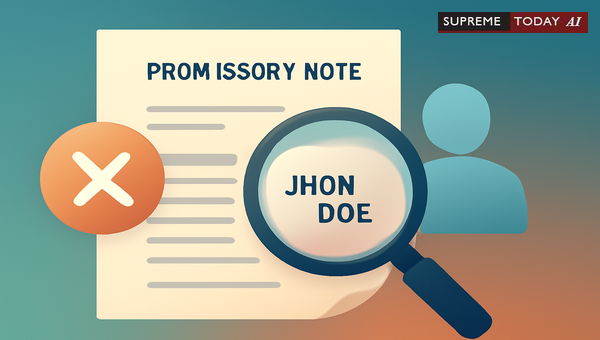
Typo in Name: Is It Unenforceable?
Imagine signing a to secure a loan, only to realize later there's a minor misspelling in the 's name. Does this small typographical error doom the document to invalidity? Many borrowers and lenders worry about the effect of typographical small mistake in writing names on enforceability. The good news? Courts generally take a practical approach, prioritizing substance over perfection.
In this post, we'll break down the legal principles under the (NI Act), key court interpretations, and practical advice. While this provides general insights, consult a legal professional for your specific situation.
Understanding Promissory Notes Under the NI Act
A is a written promise to pay a certain sum to a specified person or bearer. outlines the essentials:
- It must be in writing.
- Contain an to pay.
- Be signed by the maker.
- Payable to a certain person or bearer.
2024 0 Supreme(AP) 767 2024 0 Supreme(AP) 566 2023 0 Supreme(AP) 765
These requirements focus on form and intent, not flawless spelling. As one ruling notes, In order to make a document a , the following requisites are indicated in Section 4... Name precision is not listed as disqualifying if intent to create a is evident. 2024 0 Supreme(AP) 767
Main Legal Finding: Small Typos Don't Invalidate
A small typographical mistake in names typically does not render the unenforceable, provided it meets Section 4 essentials. Courts interpret this alongside Sections 20 and 42, which address incomplete or fictitious instruments.
- Section 20 (): Validates notes signed and delivered even if blank or incomplete, like missing names at execution. Section 20 states that when a person signs and delivers... it becomes a negotiable instrument even if it is wholly blank or written with incomplete particulars. 2023 0 Supreme(AP) 765
- Section 42 (Fictitious Names): Protects holders in due course from defenses based on fictitious payees. Section 42 of N.I. Act lays down: '42. Acceptance of bill drawn in a ... is not, by reason that such name is fictitious, relieved from liability to any ...' This applies analogously to promissory notes. 2023 0 Supreme(AP) 765
Even a note without the plaintiff's name at execution remains valid. Even where the ... did not bear the plaintiff's name at the time of execution, it remains valid. 2023 0 Supreme(AP) 765
Reading these together: When one reads Section 4 in conjunction with Sections 20 and 42 this is the only interpretation that can be placed on the meaning of '' under Section 4 of the Act. 2023 0 Supreme(AP) 765
Detailed Analysis: Why Name Errors Are Forgiven
Validity Despite Defects
Minor name variations—like typos or slight misspellings—fall under 'incompleteness.' Courts uphold enforceability if the maker's intent is clear and under apply (e.g., presumed unless rebutted).
Supporting cases emphasize flexibility: A note lacking details at execution is still enforceable by a . This logic extends to typos, as they don't obscure the 'certain person' requirement if context identifies them.
Interplay of Sections 20 and 42
These provisions ensure minor errors don't defeat liability. For instance, a fictitious or erroneous name doesn't relieve the maker when sued by a bona fide holder. This protects commerce, avoiding technical defeats over trivial mistakes.
Insights from Related Cases and Sources
Other rulings reinforce tolerance for small errors but distinguish them from :
- In one case, a with a later-added signature on the back was scrutinized, but liability held if intent was clear—echoing that post-execution fixes don't always invalidate.
- Inadvertent oversights or mistakes from negligence don't bar enforcement for . Inadvertence is stated to be the effect of inattention... preserves the rights of for value who have not had any notice.
However, are different. Changing dates or amounts post-execution can invalidate under . It is found that the had committed a serious error in not applying the principles laid down u/s.87... the suit had been materially altered both date wise and month wise. 2018 0 Supreme(Mad) 828
A small typo in a name is not material—it's clerical. Courts allow corrections in complaints for such errors: Correction of a typographical error or in the complaint can normally be permitted. 2020 0 Supreme(Ker) 18 But for the note itself, rely on Sections 20/42 rather than amending. 2015 0 Supreme(Raj) 1913
In another instance, a scribe's testimony confirmed execution despite disputes, upholding the note. 2025 Supreme(Online)(Tel) 74148
Exceptions and Limitations
Not all errors are harmless:- Obscuring intent: If the typo makes identification impossible (e.g., total fabrication), it may shift the burden under Section 118.- Material changes: Date, amount, or signature alterations invalidate without consent.
- Complaint amendments: Factual errors in plaints must be corrected via evidence, not amendment if they alter the transaction's nature. The court below has gone wrong in finding that the amendment sought... is only to correct typographical error... It is really a mistake in making correct statement of facts. 2020 0 Supreme(Ker) 18
Enforceability presumes the error is minor and doesn't violate core elements. 2024 0 Supreme(AP) 767
Practical Recommendations
To strengthen your case:- Prove essentials: Use attestors, scribes, or witnesses to confirm execution and .- Signature comparison: Courts can compare under the if disputed.- Holder status: As a , leverage Sections 20/42 without needing amendments—avoid late corrections that raise due diligence flags.- Avoid alterations: Any post-execution changes require party consent per Section 87. 2018 0 Supreme(Mad) 828
Key Takeaways
- Small name typos on promissory notes generally do not affect enforceability under NI Act Sections 4, 20, and 42.
- Focus on intent and essentials; courts favor holders in due course.
- Distinguish typos from to avoid pitfalls.
This analysis draws from established rulings, but laws evolve, and outcomes depend on facts. This is not legal advice—seek tailored counsel from a qualified attorney.
References:1. 2023 0 Supreme(AP) 765: Core on missing/fictitious names.2. 2024 0 Supreme(AP) 767: Section 4 essentials.3. 2024 0 Supreme(AP) 566: Confirms core elements.
#PromissoryNote #NILaw #LegalEnforceability















