


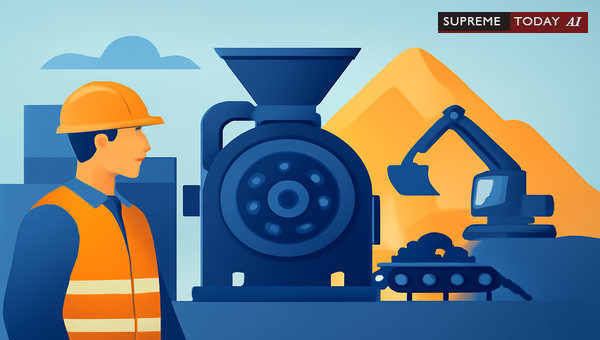
ESI Not Applicable: Crushing Mills in Areas
Introduction
In the complex world of mining operations, business owners and HR professionals often grapple with overlapping labor laws. A common query arises: Is the Employees' State Insurance (ESI) Act applicable when executed material is crushed and ground in a mill situated in a area? This question is critical for compliance, as misapplying regulations can lead to penalties or missed benefits.
This post delves into the legal nuances, drawing from key statutes like the , and recent consolidations under new labor codes. We'll explore why such operations are generally exempt from ESI, supported by regulatory insights and case references. Note: This is general information, not legal advice—always consult a labor law expert for your specific situation.
Overview of ESI Applicability in Mining Contexts
The , provides social security benefits like medical care and maternity support to workers in covered establishments. It typically applies to factories or shops employing 10 or more workers (20 in some states), focusing on industrial and commercial sectors.
However, mining operations introduce exceptions. Activities like crushing and grinding of executed material (raw minerals post-extraction) in a mill within a area often fall outside ESI's scope. Instead, they are governed by specialized laws prioritizing mine safety and health. The , takes precedence, regulating working conditions in opencast and underground mines, including ancillary processes like processing plants. 2023 2 Supreme 698
Key Legal Principles Determining Exemption
Several principles guide this determination:
: ESI covers 'factories' under the , but mining leases create distinct 'mines.' Even if a mill is nearby, if integral to mining, it's not a standalone factory. For instance, processing plants like crushers and ball mills situated away from the pit but on leased land are often registered separately—yet mining oversight prevails. The primary crusher, the secondary crusher, the ball mill, the Concentrator Plant... are situated away from the mine... and are registered separately as a 'factory' under the provisions of the . 2016 8 Supreme 129
: Crushing and grinding transform raw minerals. Courts have held that once the mineral is crushed, it loses its character of a mineral and, therefore, the said Rules would not be applicable.
This shift impacts regulatory applicability, aligning processed material with non-ESI frameworks.
: The , and , consolidate laws but carve out mining specifics. The consolidation of labor laws under various codes... indicates that mining operations may have distinct regulations that could exempt them from ESI provisions. 2023 2 Supreme 698 The Mines Act addresses health, safety, and welfare uniquely for mine workers.
Insights from Regulations and Case Law
Mining leases demand strict compliance, including approved plans and boundary demarcations. Non-compliance, like operations without plans, can invalidate exemptions—but lawful crushing within bounds supports ESI non-applicability.
: Leases require submitted mining plans. But as on date, the lease holder does not submitted the approved mining plan to the subject area . 2024 0 Supreme(AP) 1510 Valid leases enable processing like crushing quarried stones: It is projected that the petitioner purchases stones from the stone quarry/ holders and then it is crushed in its unit. 2024 0 Supreme(Gau) 837
: Processed material like M-sand or gravel differs from raw minerals. Quarried stones of different sizes are crushed and, thereafter, the crushed material is transported.
Sand is excluded from mineral definitions, easing transport rules post-crushing. 2022 Supreme(Online)(Mad) 84006
: Even distant plants on lease land remain mining-linked. This reinforces Mines Act dominance over ESI, especially for ancillary activities. 2016 8 Supreme 129
Illegal Practices to Avoid: Operations must stay within boundaries. - The has clarified that illegal mining includes activities... outside the designated lease area. 2024 0 Supreme(Raj) 395 Only quarried waste material is available in the area. 2014 0 Supreme(Mad) 2704
Authorities like the oversee clearances, ensuring mills near layouts comply. 'stone' shall mean rough stones including khandas, boulders, size-reduced (broken or crushed) materials including metal jelly...
Practical Compliance Recommendations
To confirm ESI exemption:
- Review Classification: Assess if your mill qualifies as a 'mine' under .
- Check Employee Thresholds: ESI thresholds don't apply if mining rules govern.
- Ensure Documentation: Maintain approved mining plans, lease deeds, and boundary proofs. The executed is nothing but a contract to undertake mining operations in the leased mining area. 2017 0 Supreme(Raj) 1760
- Separate Registrations: If processing is factory-like, dual compliance may arise—but mining typically prevails. 2016 8 Supreme 129
Post-consolidation codes, focus shifts to unified compliance portals, but mining retains autonomy. 2023 2 Supreme 698
Conclusion and Key Takeaways
Generally, ESI is not applicable to crushing and grinding in mills within areas, as the , and related codes provide tailored protections. The transformative nature of crushing further distances operations from standard ESI-covered factories.
2023 2 Supreme 698
Key Takeaways:- Prioritize Mines Act adherence for safety and welfare.- Crushing alters material status, influencing regulations.
- Valid leases and plans are essential to avoid illegality. 2024 0 Supreme(Raj) 395- Consult labor experts or authorities for site-specific rulings.
This framework helps mining stakeholders navigate compliance efficiently. For tailored advice, engage a legal professional—regulations evolve, and facts vary.
References
- 2023 2 Supreme 698 - Labor law consolidations and Mines Act.
- 2016 8 Supreme 129 - Processing plants in mining leases.
- Mineral character post-crushing.
- 2024 0 Supreme(Raj) 395 - Illegal mining definitions.
- 2024 0 Supreme(AP) 1510, 2024 0 Supreme(Gau) 837, 2017 0 Supreme(Raj) 1760, 2014 0 Supreme(Mad) 2704












