SupremeToday Landscape Ad
AI Thinking

AI Thinking...

Searching Case Laws & Precedent on Legal Query.....!

Scanned Judgements…!

Checking relevance for Sree Swayam Prakash Ashramam VS G. Anandavally Amma...

2010 1 Supreme 23 : An easement of necessity is a right of way that is implied when a dominant piece of land is land‑locked and there is no other reasonable access to it; the necessity must be absolute and must exist at the time the claim is made. Only the owner (or lawful occupier) of the landlocked dominant property can claim such an easement.Checking relevance for Ramkanya Bai VS Jagdish...

2011 0 Supreme(SC) 594 : An easement of necessity is an easement that arises by implication at the time a servient land is transferred or partitioned, where the dominant land would be left without reasonable access to its premises unless a right of way (or similar use) is impliedly reserved by the owner of the servient land. It can be claimed by the owner of the dominant land (or his successors) when, at the time of the disposition of the servient land, the necessity of the easement was apparent and the grant or reservation was implied.Checking relevance for Hero Vinoth (Minor) VS Seshammal...

2006 4 Supreme 131 : An easement of necessity under the Indian Easement Act, 1882, is a legal right that arises by implication of law when the dominant tenement cannot be used at all without the easement – i.e., the land would be completely inaccessible without it. It is not merely a convenience but an absolute necessity for the use of the dominant land. The right can be claimed by the owner of the dominant tenement (the land that would be land‑locked) who is unable to access his property without the easement. Such an easement is extinguished when an alternative reasonable access becomes available, and it does not arise from a grant or contract between parties.Checking relevance for S. KUMAR VS S. RAMALINGAM...

Checking relevance for Madai Lakshmi Alias M. Rajalakshmi VS P. M. Partha Kumar...

Checking relevance for Bachhaj Nahar VS Nilima Mandal...

2008 0 Supreme(SC) 1421 : An easement of necessity arises when the dominant and servient tenements were originally a single parcel owned by the same person, and after a severance of ownership the dominant tenement would be unusable without the easement. The claimant must be the owner (or occupier) of the dominant tenement who can show that the two parcels were once one and that the easement is essential for the use of the dominant property.Checking relevance for Rajkumar VS Academy of Maritime Education and Training...

2024 0 Supreme(Mad) 1033 : An easement of necessity is a right that arises when a dominant and servient tenement were formerly under common ownership and, after that ownership is divided, the dominant tenement cannot be reasonably enjoyed without using the servient land. To claim an easement of necessity, a claimant must prove (1) that there was common ownership of the two parcels and (2) that the necessity for the easement stems from the disintegration of that common ownership, making the easement essential for the enjoyment of the dominant property.


AI Overview

AI Overview...

  • Easement of Necessity - A right claimed when a property is landlocked or lacks access, established by showing that such access is absolutely necessary for the use of the property. It can be claimed by the owner of a landlocked property when there is no alternative route, and the necessity arises from the nature of the property itself or from the circumstances of its ownership ["2025 Supreme(Online)(Guj) 12487"], ["

    GODAMUNE vs MAGILINNONA

    "], ["2024 0 Supreme(Ker) 433"].
  • Who Can Claim It - Primarily, the owner of a landlocked property or a person who has no other means of access to their property can claim easement of necessity. The claim requires proof of actual necessity, such as the absence of alternative pathways, and that the property was not accessible otherwise. The claim cannot be based solely on convenience or preference ["2022 Supreme(Online)(Mad) 98444"], ["

    GODAMUNE vs MAGILINNONA

    "], ["2024 0 Supreme(Ker) 433"].
  • Main Points & Insights:

  • The claim of easement of necessity is limited to actual and absolute necessity; mere convenience is insufficient ["

    GODAMUNE vs MAGILINNONA

    "], ["2024 0 Supreme(Ker) 433"].
  • The existence of alternative pathways negates the claim for easement of necessity, especially if such routes are accessible and sufficient ["2022 Supreme(Online)(Mad) 98444"], ["2024 0 Supreme(Ker) 433"]].
  • The ownership history and ownership continuity are relevant; if the property was originally owned by the same person or there was no landlocked situation, the claim may not hold ["Shankar Bandu Koli vs Sitaram Ganu Koli, since deceased by his heirs and legal representatives - Bombay"], ["

    GODAMUNE vs MAGILINNONA

    "].
  • The claim can also be made by persons claiming rights through grant or prescription, but the burden of proof lies on the claimant to establish the necessity and lack of alternative routes ["2022 0 Supreme(Mad) 116"], ["2025 Supreme(Online)(Guj) 12487"].

  • Analysis and Conclusion:

  • Easement of necessity is a limited right that arises only when the property owner has no other means of access, and the necessity is immediate and unavoidable ["

    GODAMUNE vs MAGILINNONA

    "], ["2024 0 Supreme(Ker) 433"].
  • Claimants must substantiate their case with evidence of actual necessity and absence of alternative routes; mere assertions are insufficient ["2022 Supreme(Online)(Mad) 98444"], ["2025 Supreme(Online)(Guj) 12487"].
  • Courts tend to reject claims if there are reasonable alternative pathways or if the property owner has, through their own acts, deprived themselves of access ["Shankar Bandu Koli vs Sitaram Ganu Koli, since deceased by his heirs and legal representatives - Bombay"], ["

    GODAMUNE vs MAGILINNONA

    "].
  • Therefore, only the owner of the land, or someone with a recognized legal right, who can prove the absence of other means of access, can successfully claim easement of necessity ["2025 Supreme(Online)(Guj) 12487"], ["

    GODAMUNE vs MAGILINNONA

    "].

References:- ["Shankar Bandu Koli vs Sitaram Ganu Koli, since deceased by his heirs and legal representatives - Bombay"]- ["2022 0 Supreme(Mad) 116"]- ["2022 Supreme(Online)(Mad) 98444"]- ["2024 0 Supreme(Ker) 433"]- ["

GODAMUNE vs MAGILINNONA

"]
Establishing Easement of Necessity Claims Under Section 13 of the Indian Easements Act 1882

Easement of Necessity in India: Who Can Claim It?

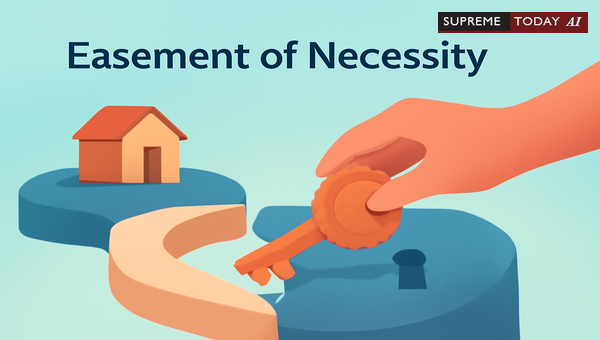
Imagine owning a plot of land that's completely landlocked, with no way to access it except through your neighbor's property. This is where the concept of easement of necessity becomes crucial. But what exactly is it, and who can claim it? In this comprehensive guide, we break down the legal principles under the Indian Easements Act, 1882, particularly Section 13, to help property owners understand their rights.

What is an Easement of Necessity?

An easement of necessity arises when two parcels of land—known as the dominant tenement (the land needing access) and the servient tenement (the land providing access)—were once under common ownership. This unity is severed, say through sale or partition, leaving the dominant tenement unusable without crossing the servient one. It's not about convenience; it demands absolute necessity, meaning no other access exists at all. 2006 4 Supreme 131

As per Section 13 of the Indian Easements Act, 1882, this easement is implied by law upon severance of common ownership. Easements of necessity are based on implied grants or reservations made by the owner of a servient heritage, at the time of disposition such as transfers and partitions. 2011 0 Supreme(SC) 594 Without it, the dominant tenement cannot be used at all. 2006 4 Supreme 131

Who Can Claim an Easement of Necessity?

Typically, the owner or occupier of the dominant tenement can claim it. To succeed, they must plead and prove three key elements:

  • Prior common ownership: Both tenements were once owned by the same person.
  • Severance: Ownership was divided (e.g., by sale, inheritance, or partition).
  • Absolute necessity: Subsisting at the time of the claim, with no alternative access. 2008 0 Supreme(SC) 1421

The claimant must specifically aver in their suit: his dominant tenement and defendant's servient tenement originally constituted a single tenement and the ownership thereof vested in the same person and that there has been a severance of such ownership and that without the easementary right claimed, the dominant tenement cannot be used. 2008 0 Supreme(SC) 1421 Courts won't infer it without these pleadings. 2006 4 Supreme 131

Failure to prove any element dooms the claim. For instance, if an alternative path exists—even if inconvenient—the easement fails. 2010 1 Supreme 23 In one case, the trial court dismissed a suit because a commissioner confirmed an alternative pathway, holding the plaintiff not entitled despite claims of inconvenience. 2019 Supreme(Online)(Mad) 1918

Key Requirements and Proof

  • Proof of common ownership and severance: Documentary evidence like title deeds showing a common ancestor or prior unity is essential. Lack of this led to dismissal in several matters. 2024 0 Supreme(Mad) 1033
  • Absolute vs. reasonable necessity: It must be impossible to use the property without the easement. Absolute necessity means no other access exists; even an inconvenient alternative defeats the claim. 2010 1 Supreme 23
  • Subsisting necessity: Must exist when claiming; past necessity isn't enough. 2010 1 Supreme 23

Courts require a suit for declaration and injunction against obstruction, often with local inquiries to verify access.

Distinction from Other Easements

Don't confuse easement of necessity with easement by grant or prescription:

  • Easement by grant: Contractual (express or implied), permanent unless specified, and not dependent on necessity. Easement of grant is a matter of contract between the parties... The grant may be express or even by necessary implication. In either case it will not amount to an easement of necessity under Section 13 of the Act even though it may also be an absolute necessity. 2006 4 Supreme 131 Its scope is limited by contract terms, as upheld where courts protected a pathway per an express grant via interim injunction. 2021 0 Supreme(Ker) 733

    Aneesh VS Aneena

  • Easement by prescription: Requires 20 years of open, continuous use under Section 15. Mere reference without proof fails, as in a case quashing a decree for air, light, and water rights due to deficient pleadings post-1954 construction.

    Shankar Bandu Koli vs Sitaram Ganu Koli, since deceased by his heirs and legal representatives

Amendments changing a suit's nature from easement to title dispute are impermissible. 2024 Supreme(Online)(GUJ) 4220

When Does It Extinguish?

Unlike grants, necessity easements end when need ceases. Section 41 provides: if alternate access becomes available, it's legally withdrawn or extinguished. 2006 4 Supreme 131 Such an easement will last only as long as the absolute necessity exists. 2006 4 Supreme 131 An inconvenient alternate pathway defeats and extinguishes the claim. 2010 1 Supreme 23

Exceptions and Limitations

In property disputes, clear identification via title documents is prerequisite before easement adjudication.

KOCHU NADAR Vs KUNJAN NADAR GABRIEL - 2011 Supreme(Online)(KER) 7220

Practical Recommendations

To claim:1. File a suit with precise pleadings on unity, severance, and absolute necessity.2. Support with deeds, surveys, and evidence of no alternatives.3. Plead easement by grant alternatively if applicable.4. Seek declaration, injunction, and damages.

Trial courts often use commissioners; appeals focus on law, not facts.

Key Takeaways

  • Easement of necessity protects landlocked properties from common ownership severance but demands strict proof of absolute need. 2024 0 Supreme(Mad) 1033
  • Only dominant tenement owners/occupiers qualify, with rigorous evidentiary hurdles.
  • It differs fundamentally from permanent grants or prescriptive rights.

Disclaimer: This article provides general information based on the Indian Easements Act, 1882, and cited cases. It is not legal advice. Consult a qualified lawyer for your specific situation, as outcomes depend on facts and jurisdiction.

For more on property rights, explore our guides on easements by grant or prescriptive rights.

#EasementOfNecessity, #PropertyLawIndia, #EasementsAct
Chat Download
Chat Print
Chat R ALL
Landmark
Strategy
Argument
Risk
Chat Voice Bottom Icon
Chat Sent Bottom Icon
SupremeToday Portrait Ad
logo-black

An indispensable Tool for Legal Professionals, Endorsed by Various High Court and Judicial Officers

Please visit our Training & Support
Center or Contact Us for assistance

qr

Scan Me!

India’s Legal research and Law Firm App, Download now!

For Daily Legal Updates, Join us on :

whatsapp-icon Back to top