


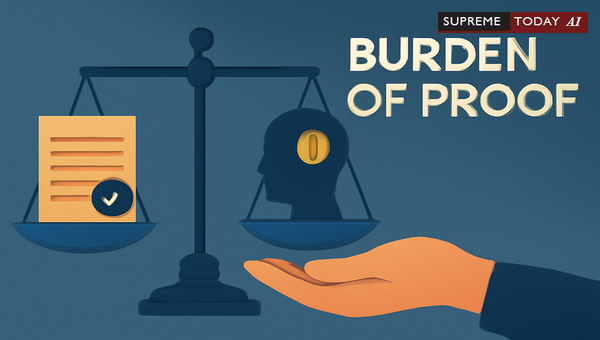
Plaintiff's Burden: Proving Suits with in India
In the Indian legal system, initiating a lawsuit comes with a fundamental responsibility: the plaintiff must substantiate their claims with . But what does Plaiintiff to Proof Suit with truly mean? This principle underscores that mere allegations or suspicions aren't enough—plaintiffs need clear, logical, and convincing proof to succeed. Whether in , , or specialized claims like medical negligence or fraud, courts demand robust evidence to establish facts. This blog dives into the key legal principles, standards of proof, and practical tips, drawing from established case law and statutory provisions.
Understanding this burden is crucial for litigants, businesses, and anyone navigating India's courts. Failure to meet it can lead to case dismissal, emphasizing the need for strategic evidence gathering from the outset.
Overview of the
The foundation of this requirement lies in , which states that whoever desires any court to give judgment as to any legal right or liability dependent on the existence of facts must prove that those facts exist 2006 4 Supreme 62 2000 0 Supreme(Bom) 319. The initial onus rests squarely on the plaintiff (or prosecution in criminal matters). As courts have reiterated, There should be cogent material evidence to constitute legal proof 2018 0 Supreme(Jhk) 1131.
This burden may shift once a is established, placing the onus on the defendant to rebut it 2006 4 Supreme 62
P. K. Shinu Rep. by Power of Attorney Holder Sheela VS Dhanya Madhavan - Current Civil Cases (2013)
. However, plaintiffs cannot rely on weak links; evidence must form a complete chain of circumstances that points unequivocally to the truth of the allegations 2021 0 Supreme(Bom) 1369.Standards of Proof in Civil and Criminal Cases
:
In civil proceedings, the standard is the —meaning the evidence must make the plaintiff's version more likely than not 2021 0 Supreme(Bom) 1369 2021 0 Supreme(UK) 597. For instance:- Proving execution of documents, like promissory notes, requires credible witnesses attesting to signatures and consideration. Consistent testimonies from PW1-PW3, coupled with presumptions under , strengthen such claims 2023 0 Supreme(AP) 1032 2022 0 Supreme(AP) 625.- Mere assertions of loss for (e.g., photocopies) are insufficient; courts demand cogent reasons and authentication under 2022 0 Supreme(HP) 610
.
Criminal Cases:
demand proof . The prosecution must prove the charge beyond a reasonable doubt 2021 0 Supreme(Bom) 1369 2021 0 Supreme(UK) 597. Courts give the benefit of doubt if evidence has gaps: If the evidence is found to be lacking or if there are significant gaps in the narrative, the benefit of the doubt must be given to the accused 2021 0 Supreme(UK) 597 2022 0 Supreme(All) 1112.
In presumption-heavy cases, like those under statutory provisions, the burden now shifts on the accused... Failure to give an explanation or giving false explanation can be taken as an additional circumstance against him 2017 0 Supreme(Jhk) 1932. Yet, convictions cannot rest solely on presumptions without corroboration, especially with inconsistent 2008 0 Supreme(Guj) 398.
What Constitutes ?
is clear, logical, and convincing—not mere suspicion. Mere suspicion or weak evidence is insufficient for a conviction or to support a claim 2022 0 Supreme(All) 1112
. Key elements include:- Documentary Proof: is preferred. requires strict foundation, such as proof of original loss. Certified copies suffice for public documents 2022 0 Supreme(HP) 610 2024 0 Supreme(Ker) 731. After 23 years, late bids are often rejected for lack of bona fides 2005 0 Supreme(Raj) 2780.- Witness Credibility: Testimonies must be reliable and corroborated. Courts scrutinize consistency and reject unless excepted 2012 0 Supreme(P&H) 788 2020 0 Supreme(MP) 1283
Lembaga Kemajuan Tanah Persekutuan (FELDA) & Anor vs Awang Soh bin Mamat & Ors
.- Expert Reports: Valuable but not conclusive. Forensic or commissioner reports need substantive corroboration; courts may reject unsupported opinions 2023 0 Supreme(Gau) 567.In fraud or medical negligence, the plaintiff must provide hard evidence to substantiate their claims, as mere assertions are not adequate
Pritam Singh VS Moorti Devi - Current Civil Cases (2010)
. There must be cogent and convincing evidence with strict standards of proof 2008 0 Supreme(Guj) 398.Evaluation of Evidence by Courts
Judges holistically assess evidence, weighing credibility, reliability, and gaps. In territorial jurisdiction issues, even if raids occur without local police, courts focus on whether there's cogent and reliable evidence against accused 2016 0 Supreme(Guj) 1059.
The plaintiff's burden persists unless shifted: The plaintiff must prove their case with cogent and convincing evidence, especially when asserting facts like execution of documents or consideration 2025 Supreme(Online)(Mad) 41095 2022 0 Supreme(HP) 610 2023 0 Supreme(P&H) 1919 2024 Supreme(SRI)(SC) 12743. Denials by defendants without counter-proof weaken defenses, but plaintiffs bear the initial load.
Practical Recommendations for Plaintiffs
To discharge this burden effectively:- Document Thoroughly: Gather early; authenticate secondary copies properly.- Corroborate Witnesses: Ensure testimonies align and are supported by documents.- Anticipate Shifts: Build a to force rebuttals.- Address Gaps: Prepare for cross-examination; use experts judiciously.- Avoid Delays: Timely evidence production prevents rejection, as seen in long-pending suits 2005 0 Supreme(Raj) 2780.
Conclusion and Key Takeaways
Ultimately, plaintiffs must present that convincingly supports claims, or risk failure. Indian courts prioritize clear, credible proof across civil and criminal realms, from document execution to serious allegations like fraud. Courts emphasize the importance of , proper foundation for , and the credibility of witnesses 2025 Supreme(Online)(Mad) 41095 2023 0 Supreme(AP) 1032 2022 0 Supreme(HP) 610
2023 0 Supreme(P&H) 1919 2024 Supreme(SRI)(SC) 12743 2022 0 Supreme(AP) 625
Lembaga Kemajuan Tanah Persekutuan (FELDA) & Anor vs Awang Soh bin Mamat & Ors
.Key Takeaways:- Burden starts with plaintiff under Evidence Act Section 101.- Civil: Preponderance; Criminal: Beyond doubt.- Cogent = Clear + Logical + Convincing; no room for suspicion.- Integrate documents, witnesses, and experts holistically.
This post provides general information based on legal precedents and is not specific legal advice. Consult a qualified lawyer for your case.
References:2021 0 Supreme(Bom) 1369 2021 0 Supreme(UK) 597 2006 4 Supreme 62
2022 0 Supreme(All) 1112
Pritam Singh VS Moorti Devi - Current Civil Cases (2010)
2012 0 Supreme(P&H) 788 2020 0 Supreme(MP) 1283 1961 0 Supreme(SC) 156P. K. Shinu Rep. by Power of Attorney Holder Sheela VS Dhanya Madhavan - Current Civil Cases (2013)
2018 0 Supreme(Jhk) 1131 2017 0 Supreme(Jhk) 1932 2016 0 Supreme(Guj) 1059 2008 0 Supreme(Guj) 398 2005 0 Supreme(Raj) 2780 2025 Supreme(Online)(Mad) 41095 2022 0 Supreme(HP) 610 2023 0 Supreme(P&H) 1919 2024 Supreme(SRI)(SC) 127432024 0 Supreme(Ker) 731 2023 0 Supreme(AP) 1032 2022 0 Supreme(AP) 625 2023 0 Supreme(Gau) 567
Lembaga Kemajuan Tanah Persekutuan (FELDA) & Anor vs Awang Soh bin Mamat & Ors
#BurdenOfProof, #CogentEvidence, #IndianLaw















