Searching Case Laws & Precedent on Legal Query.....!
Analysing the retrieved Case Laws
Scanned Judgements…!



Searching Case Laws & Precedent on Legal Query.....!
Analysing the retrieved Case Laws
Scanned Judgements…!
RAVINDRA MANKAR vs STATE OF CHHATTISGARH - Chhattisgarh
andSAROJ SHRIVAS vs STATE OF CHHATTISGARH - Chhattisgarh
, it refers to an informal or voluntary agreement among family members, such as truck drivers arranging their work or schedules.Typically not a formal legal partition but an understanding or arrangement among family members regarding their responsibilities or assets.
Partition - Main points and insights:
LAKSHITA D/O. MANOJKUMAR JAIN @ MEHATA vs MANOJKUMAR S/O. MANGILAL JAIN @ MEHATA - Karnataka
, 2023 Supreme(Online)(KAR) 6537,INDHODHC010053602018
,P.SARAVANAN vs M.SIVASUBRAMANAIAN - Madras
, 2021 Supreme(Online)(MAD) 10197, and 2024 Supreme(Online)(KER) 17955.Key distinctions include:
LAKSHITA D/O. MANOJKUMAR JAIN @ MEHATA vs MANOJKUMAR S/O. MANGILAL JAIN @ MEHATA - Karnataka
).Analysis and Conclusion:
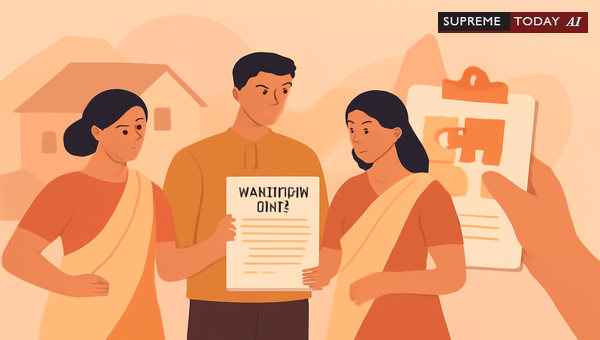
In the realm of family property disputes, understanding the nuances between a and a can save time, money, and relationships. Families often face conflicts over joint property inheritance, leading to questions like: What is the difference between a and a ? This blog post breaks down these concepts, drawing from legal precedents and principles, to help you navigate property division effectively.
Disclaimer: This article provides general information based on legal discussions and is not a substitute for professional legal advice. Consult a qualified lawyer for your specific situation.
A is essentially a mutual, honest settlement among family members to resolve disputes over property. It recognizes existing rights without the need for formal court proceedings. Courts uphold these arrangements on , provided they are made in good faith. As noted in key judgments, a has a twofold character—acting as both a settlement and a 2014 0 Supreme(Ker) 548.
The has emphasized that such arrangements are as good as a , and courts are duty-bound to recognize them when satisfied of their honesty 2014 0 Supreme(Ker) 548. For instance, it can preclude subsequent claims for or inheritance if parties have benefited from it 2015 0 Supreme(Ker) 595.
From additional case insights, family arrangements sometimes appear in non-property contexts, like informal understandings among family-related workers (e.g., truck drivers' schedules)
, highlighting their flexible, practical application in family dynamics.
In contrast, a is a structured legal mechanism to divide , resulting in individual ownership rights. It typically culminates in a court decree—either preliminary or final—that severs the 2014 0 Supreme(Ker) 548.
Partitions can be informal agreements if they meet legal criteria, but they often involve court intervention, especially in disputes 1974 0 Supreme(Ker) 47. Sources confirm as the act of dividing or assets among members, often formalized through a deed or court decree across multiple cases
,
.
Disputes frequently arise over whether property is joint or self-acquired, leading to suits for and
.
While both aim at property division, their processes, effects, and enforceability differ significantly:
| Aspect | | ||---------------------|---------------------------------------------|--------------------------------------------|| Nature | Equitable, consensual settlement 2014 0 Supreme(Ker) 548 | Legal adjudication via court decree 2014 0 Supreme(Ker) 548 || Formality | Informal, often oral; no mandatory court 2015 0 Supreme(Ker) 595 | Formal deed or suit; court-ordered 1974 0 Supreme(Ker) 47 || Effect | ; binds on equity | Creates distinct titles and possession || Enforceability | Good faith required; precludes further claims 2015 0 Supreme(Ker) 595 | Statutory rights; conclusive || When Used | To avoid litigation, preserve harmony | Disputes or need for legal certainty |
A can substitute for if longstanding and accepted, having the same legal effect as a 2014 0 Supreme(Ker) 548, 2015 0 Supreme(Ker) 595. However, it won't replace a formal if parties seek court-enforced titles.
Courts refuse prayers if a valid exists, viewing it as a final settlement 2014 0 Supreme(Ker) 548. Beneficiaries cannot later claim shares allotted to others 2015 0 Supreme(Ker) 595. Conversely, partitions resolve ownership definitively, as in cases where joint family properties are divided between father and sons
.
In one analysis, if there's a difference of opinion among , directions may issue for share ascertainment before
. This underscores 's role in contentious scenarios.
Additional sources note partitions involving all or some family members, including legal heirs, amid disputes over demarcation
.
Family arrangements offer a harmonious, equitable path to property settlement, often as effective as partitions without court hassles 2014 0 Supreme(Ker) 548. Partitions provide formal certainty through legal processes. Understanding vs : Key Differences empowers families to choose wisely.
Key Takeaways:- Opt for for amicable resolutions in good faith.- Use for disputed or formalized divisions.- Both recognize rights but differ in process and formality.
Stay informed on property laws to protect your legacy. Share your thoughts below!
#FamilyArrangement #PartitionSuit #PropertyLaw


drivers of the trucks, the Supervisor came to know that the truck drivers had an arrangerment

drivers of the trucks, the Supervisor came to know that the truck drivers had an arrangerment

After the amendment, it states “where the partition is among all or any of the members of the family and legal heirs of the family member, if any”. The only difference is “all or some of the family members” is changed to “all or any of the family members and legal heirs of the family members”. ... A comparison of the unamended Sl.No. 42(a) and the amended Sl.No. 42(a), ....

The revision petitioners herein submitted that the mortgaged property is joint family property and partition suit is pending. ... It is seen that the joint family property in S.No.514/9 in 0.25 cents, on the eastern side 8-7/8 cents with Door No. 8,11,19,20 which was prevailing as in the year 1985, since the partition suit was filed on 26.06.1984. Thereafter there was no partition among the fami....

or not would not make much of the difference. ... 7.2 once the properties are joint family properties, upon a partition having been effected between father, and sons being allotted a portion of the joint family ... - 3 - O.S.No.129/2016 has been filed by the plaintiffs seeking for partition and separate possession of the joint family properties. ... schedule properties are avail....
It was stated since difference arose between family members and a demand for partition was made and the same was refused and hence the suit was filed. ... He stated that he and his brothers had orally partitioned his joint family properties about 50 years ago and in the said partition Sy.16 had fallen to the share of - 5 - p style="text-align ... He therefore contended that all the suit propert....

(8) If there is any difference of opinion among the co- direction to enquire and ascertain the share of the Petitioner, if any, back to the Tahasildar, Bargarh to determine the share of the Petitioner from the joint family ... applied for and if there is any difference of partition can be made under Clause (c) of Section 19(1) of the Act.

The difference in the subsequent suit is the “C” schedule property. ... the joint family property. ... In this partition deed, the properties held by Manickam Chettiar family were divided into 8 lots under Schedule “A” to “H”. ... This is subsequent partition suit between the family members of Sivasubramanian, who is the son of K.N.T.Manickam Chettiar. ... The statutory fictio....
the deeming fiction and notional partition brought an end to the joint family or coparcenary. ... The statutory fiction of partition is far short of actual partition, it does not bring about the disruption of the joint family or that of coparcenary is a settled proposition of law. ... This is subsequent partition suit between the family members of Sivasubramanian, who i....

No.528 of 2016 arose some difference of opinion about giving the entire property where the house is situated, to the 1st defendant. ... At any rate it could be considered that for maintaining peace in the family they had given up their share. Either way the document is valid. Regarding the allegation of absence of denial, the written statement supports the partition deed. In sum and substance the allegations levelled are denied. ... Ext.A2 ....


An indispensable Tool for Legal Professionals, Endorsed by Various High Court and Judicial Officers
Please visit our Training & Support
Center or Contact Us for assistance

Scan Me!
India’s Legal research and Law Firm App, Download now!


For Daily Legal Updates, Join us on :



 Back to top


