


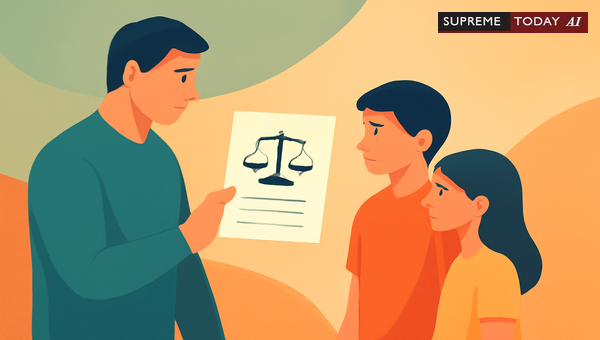
Can a Father Present Evidence for Children Without ?
In family disputes or civil proceedings involving minors, parents often step in to represent their children's interests. But what happens when a father wants to on behalf of his children without a formal () or explicit authorization? This is a common question in : whether a father can on behalf of children without and authorisation.
The short answer, based on legal principles and case law, is generally no—proper authority is typically required to ensure the evidence's and validity. This blog post dives into the analysis, drawing from key judgments like 2025 0 Supreme(Ker) 211, and integrates insights from related cases to provide a comprehensive overview. Note: This is general information, not specific legal advice. Consult a qualified lawyer for your situation.
Understanding the Core Legal Principles
emphasize procedural correctness, especially when vulnerable parties like minors or persons of unsound mind are involved. In or representation matters, acting without authority can lead to evidence being challenged or disregarded.
A pivotal judgment highlights this: The Court stressed that a preliminary enquiry is essential before appointing a guardian to assess the person's capacity to protect their interests 2025 0 Supreme(Ker) 211. While this case focuses on for persons of unsound mind under the , it underscores broader principles: any action on behalf of another requires proper legal standing.
Key implications for fathers representing children:- Without or court-appointed , a father's evidence may lack legal backing.- Courts prioritize procedural legality and proper authorization, implying that unauthorized evidence could be deemed inadmissible 2025 0 Supreme(Ker) 211.
Detailed Analysis from the Primary Case
In 2025 0 Supreme(Ker) 211, the ruling centered on the necessity of a preliminary enquiry before guardian appointments. The Court ruled that any appointment or action must follow legal procedures2025 0 Supreme(Ker) 211. Though not directly about fathers and evidence for children, it illustrates that third-party actions (like presenting evidence) demand authority.
Why this matters:- Fathers, as under the , have some inherent rights, but these don't automatically extend to adducing evidence in court without formal steps.- Evidence without may be considered legally improper or could lead to the evidence being challenged or disregarded2025 0 Supreme(Ker) 211.
Insights from Related Case Law
Several judgments reinforce the need for explicit authorization when presenting evidence or acting on behalf of others:
In a case, the Court held that The filing of the suit by the holder is a specific act which cannot be performed without appropriate authorisation... It is only on the basis of such specific authorisation that the holder can sign the plaint, the affidavit...
. This extends to evidence, as unauthorized actions undermine proceedings.
A Supreme Court ruling clarified limitations of : It is now well settled that a can sign and verify the , sign affidavits, instruct advocates... A cannot even give evidence on behalf of the party...2011 0 Supreme(AP) 15. Even with , giving evidence is restricted—without it, a father faces steeper hurdles.
In disciplinary proceedings, courts mandated sequence and proof: It is for the employer to prove the charges, they have to examine the witnesses... It is only after the evidence on behalf of the employer is completed, that the employee can be required to ...2014 0 Supreme(AP) 1444. This procedural rigor applies analogously to family representations.
Further, in sales tax matters, Nobody can act for and on behalf of the concern without authorisation or ...2009 0 Supreme(Ker) 662, highlighting that proprietary or representative actions need documentation.
These cases collectively show courts' scrutiny: acting without risks invalidity, whether filing suits
, adducing evidence 2011 0 Supreme(AP) 15, or other representations.
Exceptions and Special Circumstances
While proper authority is the norm, exceptions exist:- Natural : Under Section 6 of the Hindu Minority and Act, fathers are , potentially allowing limited actions without . However, courts may still require proof or authorization for evidence.- : Courts can appoint one under for minors in suits, granting authority to act.- : In urgent family matters, courts might accept evidence if no challenge arises, but this is risky 2023 0 Supreme(Telangana) 555.- Additional Evidence Stages: allow further evidence sparingly, not to fill gaps: The power to admit additional evidence under is discretionary and cannot be utilized to fill up gaps...2023 0 Supreme(Telangana) 555.
Absent these, unauthorized evidence may compromise the 2025 0 Supreme(Ker) 211.
Practical Recommendations for Parents
To safeguard your children's interests:1. Secure : Obtain a notarized specifically authorizing evidence presentation.2. Seek Court Appointment: Apply for or status under CPC Order 32.3. Document Authority: Always file authorization with to avoid challenges
.4. Consult Advocates: They can verify standing and instruct properly 2011 0 Supreme(AP) 15.5. Anticipate Scrutiny: Courts examine whether the proposed additional evidence... would be of any help2023 0 Supreme(Telangana) 555.
Pro Tip: Early formalization prevents delays—courts dismiss lax representations.
Conclusion and Key Takeaways
Based on precedents like 2025 0 Supreme(Ker) 211, a father typically cannot reliably for children without or authorization. Principles of procedural fairness demand it, as seen in cases stressing specific powers
2011 0 Supreme(AP) 15.
Key Takeaways:- Authority Essential: or ensures validity.- Risks of Non-Compliance: Evidence may be inadmissible or challenged.- Best Practice: Formalize representation upfront.- Seek Professional Help: Laws vary by context—tailored advice is crucial.
This analysis draws solely from cited documents; evolving jurisprudence may apply. Stay informed and proactive in legal matters involving minors.
#FamilyLaw #POAIndia #LegalEvidence















