


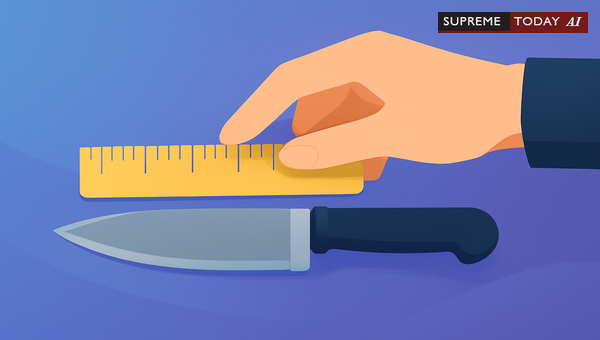
Knife Measured by Fingers: Key Court Citations in Indian Judgments
In criminal trials, especially those involving violent crimes like murder or assault, the recovery and description of weapons such as knives play a pivotal role. Precise measurements and consistent descriptions can make or break the prosecution's case. But what happens when knives are measured informally—using fingers? This unconventional method has appeared in several Indian court judgments, raising questions about evidence reliability.
If you've ever wondered, Please Find Citations where Knife Recovered was Measured with Fingers, this post dives deep into relevant cases. We'll examine key findings, discrepancies, and lessons for legal practitioners. Note: This is general information based on public judgments and not specific legal advice. Consult a qualified attorney for your situation.
Why Finger Measurements Matter in Knife Recovery Evidence
Under Indian criminal law, particularly , , and provisions of the , the recovery of a weapon must be proven . Recovery memos (under ) often describe seized items, but subjective measures like fingers can lead to challenges during cross-examination.
Courts scrutinize such descriptions for consistency. Discrepancies—whether between witnesses, sketches, or forensic reports—can undermine the , leading to acquittals. Let's explore documented cases.
Key Cases: Knives Measured in Fingers
Case 1: Precise Finger Dimensions in Assault
In a fatal assault case, the recovered knife was meticulously described: the blade size was noted as eight fingers and the handle was ten fingers in length. This knife was allegedly used in the crime and recovered during the accused's custodial interrogation. 2022 0 Supreme(All) 1194
Such detailed yet subjective measurements highlight how investigators sometimes rely on hand spans when precise tools aren't immediately available.
Case 2: Blade Thickness as Finger Equivalent
Another judgment referenced a knife with a blade length equivalent to the thickness of 5 fingers, which the court deemed not large enough to raise suspicion about its possession. 2022 0 Supreme(All) 1462
This non-suspicious size worked in favor of the defense, illustrating how finger-based descriptions can normalize everyday carry items.
Case 3: Multiple Finger Measurements in Robbery
A notable robbery case detailed: This knife was about 5 fingers in length with a six fingers handle with button system... Additionally, a country-made pistol was described as having an iron barrel about 7 fingers long.2017 0 Supreme(All) 724
These measurements from a recovery involving public seizure and police involvement underscore the prevalence of finger units in rural or hasty documentations.
Measurement Discrepancies and Their Impact
Inconsistencies often erode credibility. Consider this example:
- The investigating officer's sketch showed the knife's total length as 23.9 cm (blade 11.2 cm, handle 12.7 cm).
- A doctor's sketch measured it at 22.5 cm total, creating evidentiary gaps.
Courts have noted: no suggestion was put to any witness... with regard to the dimensions of the knife as measured by the Investigating Officer and as measured by the forensic expert. Not much importance can be attached to... a slight variation of 0.5 cms. to 1 cm.2013 0 Supreme(Del) 586
However, larger discrepancies prove fatal. In one murder trial, the knife recovery was questioned because the dimensions of the knife were not consistently reported by witnesses, and the knife was not produced in court for verification.1990 0 Supreme(Raj) 95
Forensic and Bloodstain Issues
Even with finger or cm measures, lack of forensic links weakens cases:- A recovered knife had no bloodstains and was not forensically connected to the crime.2016 0 Supreme(Raj) 145- In another, the recovered knife was sent for chemical examination... contained human blood, but the blood group could not be decided.2012 0 Supreme(UK) 457
These gaps emphasize the need for corroboration.
Broader Context from Related Judgments
Finger measurements aren't isolated. Other cases show evolving standards:
- Recovery Process Scrutiny: In a murder appeal, the knife recovery from bushes raises more questions than it answers, lacking independent witnesses. 2024 0 Supreme(All) 697
- Witness Reliability: The knife was measured and its sketch was prepared by the I.O. but recoveries from drains or bushes needed better attestation. 2011 0 Supreme(Del) 334
- Police Testimony Caution: Courts urge corroboration when relying on police witnesses alone, as in a robbery where a buttondar knife... measured 13.25 was recovered, yet contradictions led to acquittal. 2012 0 Supreme(Del) 2780
In conspiracy cases, even bloodstained recoveries fail without a complete chain: Once it is found that the evidence relating to... recovery... cannot be safely relied upon...2023 0 Supreme(P&H) 1166
Legal Implications and Defense Strategies
Finger measurements, while practical, invite challenges:- Subjectivity: One person's finger varies (typically 7-8 cm per hand span).- Cross-Examination Opportunities: Probe inconsistencies between memos, sketches, and court productions.- Forensic Imperative: Always push for blood group matching and expert verification.
Recommendations (general best practices):- Prosecution: Standardize with rulers; include photos in memos.- Defense: Highlight variances, demand physical production (as missing in 1990 0 Supreme(Raj) 95).- Courts: Weigh against , per principles in murder appeals. 2023 0 Supreme(Chh) 244
Summary of Key Findings
- Knives are measured subjectively (fingers) or objectively (cm), but consistency is key. 2022 0 Supreme(All) 1194
- Discrepancies undermine recovery validity. 1990 0 Supreme(Raj) 95
- Forensic absence questions links to crime scenes. 2016 0 Supreme(Raj) 145
Conclusion: Strengthening Weapon Evidence
Finger-measured knives reveal the gritty reality of Indian investigations—practical but perilous for proof. Cases like those cited show courts demand rigor: complete chains, independent witnesses, and science-backed links. For legal professionals, these precedents guide challenges or bolstering of evidence.
Key Takeaways:- Use finger measures cautiously; corroborate with metrics.- Cross-examine on variances to exploit doubts.- Prioritize FSL reports for blood/weapon matches.
Stay informed on evolving evidentiary standards. For case-specific guidance, seek expert counsel.
Citations: 2022 0 Supreme(All) 1194 2022 0 Supreme(All) 1462 2016 0 Supreme(Raj) 145 1990 0 Supreme(Raj) 95 2017 0 Supreme(All) 724 2013 0 Supreme(Del) 586 2024 0 Supreme(All) 697 2023 0 Supreme(P&H) 1166 2011 0 Supreme(Del) 334 2012 0 Supreme(Del) 2780 2012 0 Supreme(UK) 457 2023 0 Supreme(Chh) 244












