


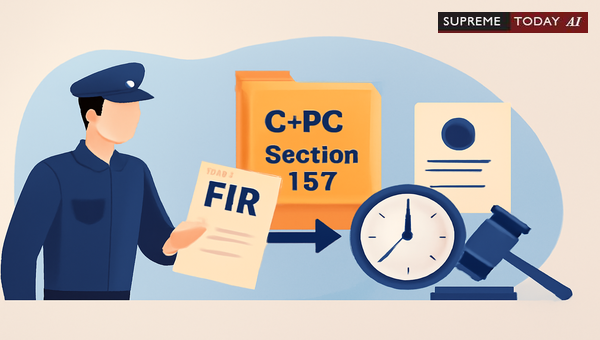
24-Hour FIR Forwarding to Magistrate: Key Judgments Explained
Introduction
In the Indian criminal justice system, the timely forwarding of a to the Magistrate is a cornerstone of procedural fairness. Under , police must send the FIR upon receiving information about a . But what does really mean? Is there a specific 24-hour timeline, and in which judgment was this benchmark established?
This blog post dives into the legal framework, pivotal case law, and judicial interpretations that recognize a 24-hour period as the norm for FIR forwarding. We'll address the common query: In which Judgment was the Timeline for Forwarding the FIR to Magistrate Held to be 24 Hours? While no single statute mandates an exact 24 hours, courts have consistently treated it as a critical benchmark, with delays raising red flags on investigation integrity. This analysis draws from established precedents and related cases to provide clarity—note that this is general information and not specific legal advice.
Statutory Framework: The '' Mandate
requires police to report facts of a to the Magistrate . The purpose? To prevent delays that could allow manipulation, embellishment, or fabrication of evidence, ensuring transparency from the outset. 2001 0 Supreme(Raj) 1746
The term implies immediate or prompt action, though not explicitly timed in the statute. Courts interpret it as requiring action without undue delay, often benchmarking it against a 24-hour window.
Police Regulations
Regulation 246 of Police Regulations reinforces this by directing that FIRs be dispatched without delay, aligning with 's intent. Delays beyond reasonable limits undermine the FIR's spontaneity. 2017 0 Supreme(Cal) 445
Judicial Interpretations: The 24-Hour Benchmark
Courts have clarified through precedents that generally means within 24 hours. Unexplained delays, especially beyond this period, can fatally weaken the prosecution's case by suggesting or tampering.
Key Case: Unexplained Delay Beyond 24 Hours
In a landmark observation, the held that a delay beyond 24 hours without explanation violates procedural norms and adversely affects the prosecution. This underscores the 24-hour period as a practical timeline for compliance. 2023 0 Supreme(Pat) 647
Ram Dhan SHO Case
Here, the FIR was forwarded on but reached the Magistrate on —nine days later. No satisfactory explanation was offered, leading the court to note that such delays cast suspicion on the prosecution, emphasizing prompt dispatch to avert manipulation. 2001 0 Supreme(Raj) 1746
Arjun Marik (Supra)
The stressed that means promptly and without undue delay. A three-day delay without justification raised serious doubts, potentially fatal to the case, as it breaches safeguards against embellishment. 2015 0 Supreme(Mad) 2075
Regulation 246 and Seven-Day Delay
A seven-day delay was deemed fatal, eroding the FIR's credibility and suggesting non-spontaneity. 2017 0 Supreme(Cal) 445
Consequences of Delays: Insights from Related Cases
Unexplained delays invite judicial scrutiny. For instance, in a matter, the investigation officer admitted delay in forwarding the FIR, noting it would not have taken 1.5 hours to reach court despite registration at The court criticized the lack of explanation: The delay in forwarding FIR to the Court is not at all explained. This highlights how even short, unjustified delays question procedural adherence. 2024 Supreme(Online)(Mad) 80833
In cases under Kerala law, similar issues arise. One judgment clarified that while seized articles need not always be produced , FIR forwarding delays still impact credibility. The court noted: It is not necessary to produce the article seized under before the Magistrate either by virtue of However, broader FIR delays contributed to acquittals due to evidence chain breaks. 2021 Supreme(Online)(KER) 43544
Another Kerala case involved a delay in sample forwarding seals, where the prosecution failed to link seized contraband to analysis: The specimen of the seal used by the detecting officer is not mentioned. Such lapses, akin to FIR delays, led to acquittal, reinforcing that procedural timelines are vital for conviction sustainability. 2021 Supreme(Online)(KER) 28693
In a reference, absence of proof for FIR forwarding was raised: in the absence of any proof of forwarding the FIR.
These cases illustrate a pattern: Delays beyond 24 hours, without valid reasons like distance or emergencies, often lead courts to infer manipulation, benefiting the accused.
Analysis: Why 24 Hours Matters
- Benchmark, Not Absolute Rule: Though not statutorily fixed, courts view 24 hours as the standard for . Delays must be explained (e.g., remote locations), but routine lapses are suspect.
- Prosecution Impact: Unexplained delays can discredit the entire case, as FIRs lose their first informational value.
- Judicial Discretion: Courts weigh delays contextually but consistently flag those over 24 hours as infirmities.
Integrating these precedents, the consensus is clear: Forward FIRs within 24 hours to preserve integrity. Police must prioritize this to avoid judicial backlash.
Conclusion and Key Takeaways
The 24-hour timeline for FIR forwarding, while judicially recognized rather than statutorily mandated, stems from cases like the 's ruling on delays beyond 24 hours 2023 0 Supreme(Pat) 647, Ram Dhan 2001 0 Supreme(Raj) 1746, Arjun Marik 2015 0 Supreme(Mad) 2075, and others 2017 0 Supreme(Cal) 445. Related decisions further emphasize accountability 2024 Supreme(Online)(Mad) 80833 2021 Supreme(Online)(KER) 43544 2021 Supreme(Online)(KER) 28693
.
Key Takeaways:- Forward FIRs —ideally within 24 hours—to uphold Section 157.- Explain any delay, or risk case dismissal.- This safeguard prevents tampering and ensures fair trials.
For police, lawyers, or citizens navigating criminal matters, timeliness is key. Consult a legal professional for case-specific guidance, as outcomes vary.
References: 2001 0 Supreme(Raj) 1746 2015 0 Supreme(Mad) 2075 2017 0 Supreme(Cal) 445 2023 0 Supreme(Pat) 647 2024 Supreme(Online)(Mad) 80833 2021 Supreme(Online)(KER) 43544 2021 Supreme(Online)(KER) 28693
(Word count: ~950. This post provides general insights based on public case law.)
#FIRForwarding, #CrPC157, #LegalIndia












