


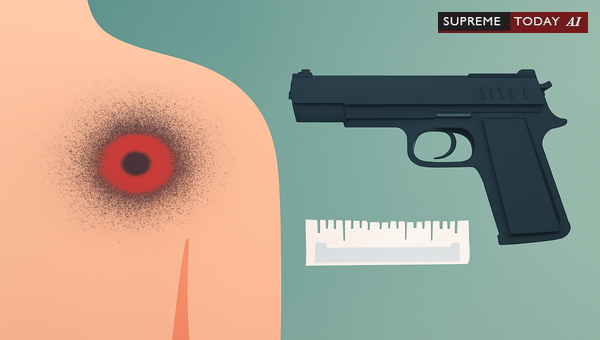
Gunshot Blackening & Tattooing: At What Distance Do They Occur?
In forensic investigations and criminal trials involving firearm injuries, determining the distance from which a shot was fired is crucial. A key question often arises: from which distance by fire blackening and tattooing will occur? These telltale signs—blackening (soot deposition) and tattooing (embedded gunpowder particles)—provide vital clues about whether a shooting was at close range, potentially indicating intent, self-defense, or accident. Understanding these markers can make or break a case in court.
This article draws from legal judgments and forensic principles to explain when and why blackening and tattooing appear, typically within approximately 18 inches (1.5 feet). We'll explore court findings, variations by firearm type, and exceptions, while emphasizing that this is general information, not specific legal advice. Always consult forensic experts and legal professionals for case-specific analysis.
What Are Blackening and Tattooing in Firearm Injuries?
Blackening refers to the deposit of soot or carbonaceous material from the gun's muzzle around the entry wound, caused by hot gases and smoke. Tattooing occurs when unburnt or partially burnt gunpowder particles strike the skin at high velocity, embedding like small tattoos.
These signs are hallmarks of . Their presence strongly suggests the firearm was fired from a short distance, while their absence points to a greater range, generally beyond 18 inches. As noted in forensic literature cited in courts, The effect of flame, blackening, scorching, and tattooing depends on the distance of firing. Generally, blackening and tattooing are observed when the firearm is fired within a few inches (generally within 18 inches or 1.5 feet) 2022 0 Supreme(J&K) 722.
Typical Distances for Blackening and Tattooing
Legal documents consistently highlight a benchmark of about 18 inches for these effects:
- Within 18 inches (1.5 feet): Blackening and tattooing are typically present. For instance, Absence of such carbonaceous tattooing proves that the firearm responsible was at a distance of more than 18 2016 0 Supreme(All) 642.
- Shotguns: Blackening may extend up to 3 feet, while pistols or revolvers show it within about 2 feet 2023 0 Supreme(SC) 536.
- Beyond 18 inches: These signs usually disappear, indicating a distant shot. One case states, the fire-arm from which bullet was fired, could not have caused scorching, blackening and tattooing if fired from a distance of more than 4 feet 2022 0 Supreme(J&K) 722.
In practice, courts use this to challenge prosecution narratives. The absence of these marks can undermine claims of close-range firing, as in cases where medical evidence contradicted eyewitness accounts.
Variations by Firearm and Ammunition
The extent depends on factors like firearm type, gunpowder quantity, and barrel length:- Pistols/Revolvers: Effects visible up to 2 feet 2023 0 Supreme(SC) 536.- Shotguns: Broader spread, up to 3 feet for blackening.- Country-made pistols: Often show blackening, charring, and tattooing from a near place around vital areas like the neck 2003 0 Supreme(All) 393 2003 0 Supreme(All) 395.
One judgment notes, tatooing and blackening was present in the wound, it means the fire arm shot was inflicted from a very close range, i.e., within 4 to 6 feet 2016 0 Supreme(All) 1090. This slightly broader range (4-6 feet) appears in some contexts, but the 18-inch rule remains the forensic standard.
Court Cases Illustrating These Principles
Indian courts frequently reference these signs in murder trials under :
- In a case with lacerated wounds showing blackening and tatooing, the court inferred a very very near place firing 1984 0 Supreme(Raj) 28.
- Conversely, No blackening or tatooing of wound margin present in multiple entry wounds did not raise doubt when clothing or blankets were involved, as Person injured putting on clothes at time of being shot at—Blackening and tatooing would not be found 2006 0 Supreme(UK) 348.
- Detailed injury descriptions, like lacerated wound over left loboute partially imputed with blackening and tatooing, traced tattooing into body cavities, confirming close range 2019 0 Supreme(Pat) 731
.
These examples show how courts weigh forensic evidence. In one acquittal, discrepancies between FIR claims of close-range shots (expecting blackening) and medical findings led to doubts, as if caused by fire arm should have shown similar features of blackening or tatooing at 25 yards 2006 0 Supreme(Pat) 1212.
Eyewitness reliability is scrutinized alongside: unnatural conduct or omissions about injuries, combined with missing blackening, can be fatal to the prosecution case 1984 0 Supreme(Raj) 28.
Exceptions and Limitations
While the 18-inch guideline is reliable, exceptions exist:- Clothing or coverings: Thick clothes or blankets can prevent visible blackening/tattooing, even at close range 2006 0 Supreme(UK) 348.- Contact shots: When the muzzle is pressed against skin, signs may be minimal or absent due to gas entry into the wound, but other evidence like muzzle abrasion distinguishes them.- Environmental factors: Angle of shot, wind, or wiping of the wound can alter appearance.- Firearm specifics: Smoothbore vs. rifled barrels affect particle spread.
Courts advise holistic analysis: Forensic experts should consider all signs, including blackening, tattooing, gunshot residue, and wound characteristics, to estimate firing distance accurately 2022 0 Supreme(J&K) 722.
Forensic and Legal Recommendations
- Rely on experts: Ballistics reports linking pellets to recovered guns are essential; their absence can be fatal 1984 0 Supreme(Raj) 28.
- Corroborate evidence: texts like Lyons and Raju-Jhala are cited for principles 2022 0 Supreme(J&K) 722.
- : Must prove ; inconsistencies in distance evidence lead to acquittals 2006 0 Supreme(Pat) 1212.
In trials, these signs help differentiate suicide, homicide, or accident. For example, fouling over face and nose with tattooing confirmed firearm death alongside incised wounds 2000 0 Supreme(Jhk) 10.
Key Takeaways
- Typically within 18 inches: Blackening and tattooing indicate close-range fire 2016 0 Supreme(All) 642 2022 0 Supreme(J&K) 722.
- Absence suggests >18 inches: But check for clothing or other mitigators.
- Case-specific: Varies by weapon; always integrate with full evidence.
In conclusion, blackening and tattooing are powerful forensic tools in firearm cases, generally appearing within 1.5 feet of discharge. Courts use them to test narratives, but interpretations require expert input. This overview from legal precedents provides context, but forensic and legal advice should be sought for individual matters.
References:- 2022 0 Supreme(J&K) 722, 2016 0 Supreme(All) 642, 2023 0 Supreme(SC) 536, 1984 0 Supreme(Raj) 28, 2006 0 Supreme(UK) 348, 2019 0 Supreme(Pat) 731, 2016 0 Supreme(All) 1090, 2006 0 Supreme(Pat) 1212, 2003 0 Supreme(All) 393, 2003 0 Supreme(All) 395, 2000 0 Supreme(Jhk) 10.
#FirearmForensics #GunshotWounds #LegalEvidence















