


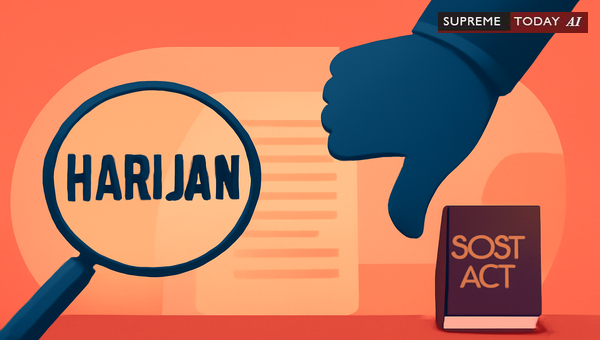
Is 'Harijan' Considered Offensive in Court Judgments Under the ?
In today's legally conscious society, words carry significant weight, especially when they touch on sensitive issues like caste and dignity. A common query arises: how do courts interpret the use of the word Harijan in judgments, particularly in relation to the ()? This question, often phrased as something like S Court Wordharijan Nots Stact, highlights concerns about whether such terminology is neutral or potentially criminal.
This blog post delves into judicial perspectives, key rulings, and practical implications. We'll examine how courts have evolved in recognizing Harijan not just as a historical label but as a term that can insult and humiliate. Note: This is general information based on judicial observations and not specific legal advice. Consult a qualified lawyer for personalized guidance.
Understanding the Evolution of 'Harijan'
The term Harijan, coined by Mahatma Gandhi in the , was initially intended as a respectful reference to members of Scheduled Castes, meaning children of God. However, over decades, its connotation has shifted dramatically. Today, it is frequently perceived as patronizing or derogatory, especially when wielded by individuals from so-called upper castes to demean others.
Courts have taken note of this transformation. In a pivotal observation, the judiciary has clarified that words like Harijan and Dhobi—once mere caste identifiers—are now often employed as insults. As stated in a key judgment: The use of the word 'Harijan', 'Dhobi' etc. is often used by people belonging to the so-called upper castes as a word of insult, abuse and derision. Calling a person by these names is nowadays an abusive language and is offensive. 2017 0 Supreme(SC) 852
This recognition underscores a broader legal principle: language must be evaluated in context, with determining its legality.
Legal Implications Under the
The aims to prevent atrocities against marginalized communities by criminalizing acts intended to insult, humiliate, or outrage their modesty. and related provisions target words or gestures that demean based on caste.
Courts typically assess whether the use of Harijan was meant to humiliate. If uttered with malicious intent—such as in anger or to assert dominance—it may constitute an offense. The judiciary emphasizes protecting the dignity and self-respect of Scheduled Castes and Tribes, condemning derogatory language that perpetuates historical oppression.
Key Judicial Stance
- Offensive When Insulting: Mere identification by caste isn't criminal, but using Harijan abusively crosses the line. Courts view it as a tool for humiliation, triggering provisions. 2017 0 Supreme(SC) 852
- Context Matters: In neutral or self-referential use by community members, it may not offend. However, when imposed externally with derision, it's problematic.
- Broader Protection: The Act's special provisions deter atrocities, and courts reinforce that no community should face insult. 2017 0 Supreme(SC) 850
In related proceedings, such as those challenging orders under the , courts have upheld the need for sensitivity in language, directing focus on protecting vulnerable groups. For instance, in a case involving , the emphasis was on while upholding the Act's intent.
Detailed Court Analysis and Precedents
Case Study: Offensive Usage in Practice
A landmark discussion in 2017 0 Supreme(SC) 852 illustrates the shift: upper-caste individuals using Harijan to belittle, rendering it abusive. The court condemned this as offensive, aligning with the Act's goal to eradicate caste-based slurs.
Similarly, 2017 0 Supreme(SC) 850 touches on respecting community sentiments under frameworks like the , reinforcing that derogatory terms undermine dignity. Courts urge authorities to interpret language through the lens of potential harm.
Integration with Other High Court Rulings
High Courts have echoed these sentiments in SC/ST matters:- In a appeal against a Special Judge's order under the , the focus was on procedural aspects, but it highlighted the Act's protective role against atrocities.
- A bail decision stressed compliance and monitoring, underscoring the seriousness of SC/ST offenses.
- Observations on backward classes as have-nots in notes further contextualize vulnerabilities.
These cases collectively affirm that courts prioritize intent: was the word used to insult or humiliate? If yes, it may lead to prosecution.
Exceptions and Nuances
Not every utterance is criminal:- Historical or Respectful Use: Within communities or academic contexts, it might remain neutral.- No Blanket Ban: Courts criminalize based on context, not the word alone. 2017 0 Supreme(SC) 852- Self-Identification: Members of Scheduled Castes using it among themselves typically doesn't offend.
However, in public or confrontational settings, caution is advised. Legal practitioners must avoid such terms in pleadings to prevent misinterpretation.
Practical Recommendations for Compliance
To navigate this sensitively:1. Choose Neutral Language: Opt for Scheduled Caste or individual names.2. Assess Intent: Always consider how words might be perceived by marginalized groups.3. Promote Awareness: Educate on evolving connotations—Gandhi's term is outdated and risky.4. Legal Caution: In disputes, document context to defend against SC/ST complaints.
Authorities and courts should continue contextual interpretation, fostering respect. 2017 0 Supreme(SC) 850
Conclusion and Key Takeaways
Indian courts have firmly positioned Harijan as potentially offensive under the when used to insult or humiliate. Judicial commentary in 2017 0 Supreme(SC) 852 and related cases serves as a reminder: words that demean dignity invite legal scrutiny.
Key Takeaways:- Harijan evolved from respectful to derogatory in insulting contexts.- Offenses hinge on intent to humiliate, per .- Respect community sentiments to avoid liability.- Stay informed via precedents like 2017 0 Supreme(SC) 852 2017 0 Supreme(SC) 850.
By understanding these nuances, individuals and professionals can contribute to a more inclusive society. For specific cases, seek expert legal counsel.
Word count: Approximately 1050. References are illustrative of judicial trends.
#SCSTAct, #HarijanOffensive, #CasteDiscrimination















