


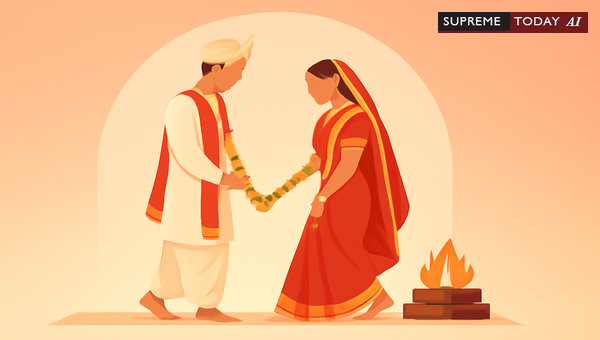
Is Hindu Marriage Valid with Rites of One Party Only?
In today's diverse society, inter-community or inter-custom marriages are increasingly common. But what happens when two individuals from different backgrounds marry according to the rites and ceremonies of just one person? Is such a union legally valid under Hindu law? This question often arises in disputes over inheritance, maintenance, divorce, or claims.
We'll dive into the legal framework, essential ceremonies, landmark cases, and insights from related judgments to clarify. Note: This is general information based on precedents and statutes. Consult a qualified lawyer for advice specific to your situation.
Legal Requirements for a Valid Hindu Marriage
Under , a Hindu marriage is valid only if according to the and ceremonies of either party. This provision accommodates diversity but sets clear benchmarks.
Essential Ceremonies
For a marriage to be typically considered valid, two key ceremonies are generally required:- Invocation before the sacred fire ( or ).- – the bride and groom taking seven steps together around the fire, symbolizing vows 1970 0 Supreme(Kar) 4.
The in emphasized: a marriage must be celebrated with proper ceremonies to be 1970 0 Supreme(Kar) 4. Similarly, held that essential ceremonies must be proven, especially in cases 2009 0 Supreme(Ori) 272.
Absence of these can render the marriage invalid. As noted, The absence of these ceremonies generally renders the marriage invalid under Hindu law 2009 0 Supreme(Ori) 272.
Role of
Flexibility exists if the customs of either party do not mandate . In such cases, other community-recognized ceremonies may suffice 1976 0 Supreme(Raj) 290. The court in Sunder Kaur v. Guman Singh ruled that if do not require , the marriage can still be valid based on performed ceremonies 1976 0 Supreme(Raj) 290.
This underscores: even if rites follow one party's customs, validity hinges on adherence to those customs or orthodox essentials.
Proving Marriage Validity: Evidence Matters
Courts demand concrete proof. Mere , exchange of garlands, or a few steps won't do. In one case, mere exchange of garlands or taking one or two steps alone are not sufficient for solemnization of a valid marriage
T. Rema VS A. K. Radhamani
.To establish validity:1. Witnesses testifying to ceremonies.2. Photographs, videos, or invitations showing rites.3. Community elders confirming customs.
The evidence regarding the performance of marriage according to Hindu Law must be brought on record to show that there had been a valid marriage. To prove a valid marriage under the Hindu Law, it has to be established that marriage was performed in accordance with the and ceremonies, as required under Section 7 of the Act 2007 0 Supreme(P&H) 97 2007 0 Supreme(P&H) 101.
Two essential ceremonies are reiterated: Firstly, invocation before the sacred fire and secondly Saptadi i.e. taking of seven steps by the bridegroom and the bride jointly before the sacred fire 2013 0 Supreme(MP) 116.
Case Law Insights on Partial Rites and Validity
Landmark Precedents
- (1965): Marriage invalid without ; mere living as husband-wife insufficient 1970 0 Supreme(Kar) 4.
- (1966): Burden on claimant to prove ceremonies in trials 2009 0 Supreme(Ori) 272.
- Sunder Kaur v. Guman Singh: Customs overriding orthodox rites if proven 1976 0 Supreme(Raj) 290.
and
Second marriages during a are void under . between a man and woman, however long it may be, same will not acquire character of a valid marriage, if it is during subsistence of another marriage
T. Rema VS A. K. Radhamani
. Continuous may presume marriage, but not if bigamousT. Rema VS A. K. Radhamani
.In a , a second 'wife' (per Sikh rites, prior marriage hidden) was granted maintenance despite invalidity, treated as 'wife' for equity 2007 0 Supreme(Del) 2077.
and Children's Rights
affect legitimacy. protects children of from decrees impacting inheritance. In one appeal, a decree of was set aside for failure to prove prior marriage validity 2007 0 Supreme(P&H) 97. The legal effects of a decree of on the legitimacy and inheritance rights of children from were central 2007 0 Supreme(P&H) 97.
When Rites of One Party Suffice – Or Fail
If Party A (e.g., from a community without ) and Party B marry per Party A's rites, and those are proven, validity may hold. But if rites are incomplete even per one custom – e.g., no invocation – courts lean invalid.
Example: A man suppressing prior marriage weds per new rites; second union void, but maintenance possible 2007 0 Supreme(Del) 2077. In property disputes, unproven second widow marriage failed succession claim 2013 0 Supreme(MP) 116.
Other cases reinforce: Failed cruelty proofs in divorce didn't question base validity but assumed ceremonies 2009 0 Supreme(Del) 180.
Key Takeaways and Recommendations
- Validity possible if rites match customs of either party, especially essentials like 1970 0 Supreme(Kar) 4 2009 0 Supreme(Ori) 272 1976 0 Supreme(Raj) 290.
- Proof critical: No presumption from alone in /void claims
T. Rema VS A. K. Radhamani
. - Disputes? Gather evidence early – photos, witnesses.
Recommendations:- Document ceremonies thoroughly.- In inter-custom unions, align with at least one party's full rites.- For disputes, handle validity declarations under
T. Rema VS A. K. Radhamani
.In conclusion, a marriage per one party's rites may be valid if those rites fulfill Section 7 – but courts scrutinize rigorously. Essential ceremonies provide the safest path. This overview draws from precedents; professional legal counsel is essential for your case.
#HinduMarriage #MarriageValidity #FamilyLawIndia















