


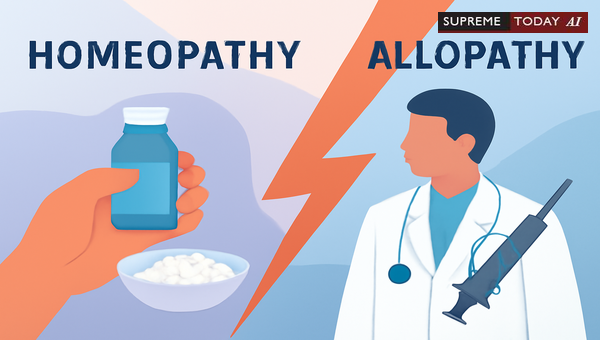
Can Homeopathy Doctors Prescribe Allopathy Medicines? Legal Risks in India
In the diverse landscape of Indian healthcare, where systems like homeopathy, Ayurveda, and allopathy coexist, a critical question often arises: Can a homeopathy doctor treat patients using allopathy medicines? This query, frequently phrased as Homoeopathy Doctor Treat Allopathy Offence, touches on statutory boundaries, public safety, and potential criminal liability. With rising awareness of medical qualifications, understanding these limits is essential for practitioners, patients, and regulators alike.
This article delves into Indian legal principles, court judgments, and implications, drawing from key statutes and case law. Note that this is general information based on precedents and should not be considered specific legal advice—consult a qualified lawyer for personalized guidance.
Legal Framework Governing Medical Practice in India
Under Indian law, medical practitioners are strictly regulated by their qualifications and registration. The (IMCA) and related statutes define the scope of practice for each system. Homeopathy doctors, registered under the , are authorized solely for homeopathic treatments. 1996 4 Supreme 328 1996 4 Supreme 328
Practitioners of homeopathy are statutorily restricted to practicing within the scope of Homoeopathy only. They lack qualification or authorization for allopathy (modern medicine). The IMCA explicitly prohibits cross-practice without proper allopathy qualifications, such as an MBBS degree. 1996 4 Supreme 328 1996 4 Supreme 328 2015 0 Supreme(Mad) 2727
As courts have ruled, Practicing Allopathy without the requisite qualifications is considered an act of into a prohibited field, amounting to negligence and actionable misconduct. 1996 4 Supreme 328 1996 4 Supreme 328
Is It an Offence? Key Court Findings
Indian courts have consistently upheld these boundaries. Engaging in allopathy without qualification breaches statutory duties and invites prosecution.
Landmark Case on Criminal Charges
In a notable instance detailed in document 2018 0 Supreme(MP) 138, a homeopathy doctor faced criminal charges under (causing death by negligence) and provisions of the . The court deemed the practice unlawful, stressing adherence to prescribed norms and expert committee procedures for appointments and practice. 2018 0 Supreme(MP) 138
The ruling emphasized: His imparting of Allopathic Medicines was an actionable negligence. Since the law under which a Homoeopathic Doctor was registered as a Medical Practitioner required him to practise in Homoeopathy only, he was under not to enter the field of any other System of Medicines. 2010 0 Supreme(MP) 620
Negligence and Public Safety Risks
Unauthorized allopathy practice not only violates law but endangers lives. Courts recognize it as potential negligence leading to harm. 2018 0 Supreme(MP) 138 2010 0 Supreme(Mad) 528
In a consumer protection case, a (unqualified practitioner) was held liable for wrong diagnosis and treatment of malaria (actually Japanese Encephalitis). The court applied , stating: Respondent had no authority to prescribe allopathic medicine—He is at liberty to give his own ayurvedic medicine as per Book—He has no authority to trespass into allopathy.
It further noted: Whenever an Allopathic medicine is to be given, it must be sanctioned, verified and seconded by Allopathic Doctor.
Exceptions: Are There Any?
While homeopathy practitioners retain rights within their domain—such as issuing prescriptions or certificates incidental to treatment—exceptions for allopathy are rare. 2013 0 Supreme(Bom) 829 The court in that case affirmed: The appellants are validly holding the right to treat certain diseases. So their right to issue prescriptions or certificates cannot be detached from their right to treat.
However, emergencies do not broadly permit allopathy use. In 2010 0 Supreme(MP) 620, a plea for homeopaths to prescribe life-saving allopathic drugs in emergencies was dismissed as baseless, highlighting distinctions between systems like Ayurveda and homeopathy.
Some alternative systems, like Electropathy, have protections if certified, but police harassment is barred absent statutory violations.
Yet, this does not extend to homeopaths encroaching on allopathy.
Related Issues: Selection, Pay, and Recognition
Courts also address tangential matters reinforcing specialization:
Selection Processes: For homeopathy roles, committees must include experts. Lack thereof vitiates selections, as in 2003 0 Supreme(Cal) 538, where: The selection process for part-time Homoeopathy Doctor and Compounder must be conducted... with the inclusion of an expert in Homoeopathy medicine.
Pay Parity: doctors (e.g., BAMS) are not entitled to equal pay as MBBS allopathy doctors, as they do not perform equal work. 2023 0 Supreme(SC) 415
Certificates and Leave: Homeopathy medical certificates may suffice for general ailments but not specialized fitness tests, upholding branch distinctions. 2014 0 Supreme(AP) 132
These rulings underscore that no system can arrogate to itself sole privilege of exclusive expertise. 2014 0 Supreme(AP) 132
Implications for Practitioners and Patients
- For Homeopathy Doctors: Stick to homeopathy to avoid prosecution under , IPC 304-A, or state acts. Dual qualifications are the only safe path.
- Defenses: Lack of intent, emergencies, or no harm proven may mitigate, but practice remains impermissible. 2021 Supreme(Online)(KER) 12456
- Patients: Seek qualified allopathy care for conditions requiring modern drugs; unauthorized treatment risks health and legal recourse.
Public safety drives these laws—choosing the wrong practitioner might be cause of public injury. 2003 0 Supreme(Cal) 538
Key Takeaways and Recommendations
- Homeopathy doctors cannot legally prescribe or use allopathy medicines without MBBS-equivalent qualifications; it constitutes an offence. 1996 4 Supreme 328 1996 4 Supreme 328
- Violations lead to criminal charges, negligence suits, and disciplinary action.
- Always verify practitioner credentials via councils like the .
- For accused practitioners, defenses hinge on evidence absence, but prevention is best.
In summary, while India's pluralistic medicine honors each system, boundaries protect patients. Courts prioritize expertise: Merit is required to qualify as a doctor in both Allopathy and Homoeopathy. 2018 0 Supreme(Bom) 1694
Disclaimer: This overview draws from precedents like those in 2018 0 Supreme(MP) 138 and IMCA. Laws evolve; seek professional advice for cases.
#HomeopathyLaw















