


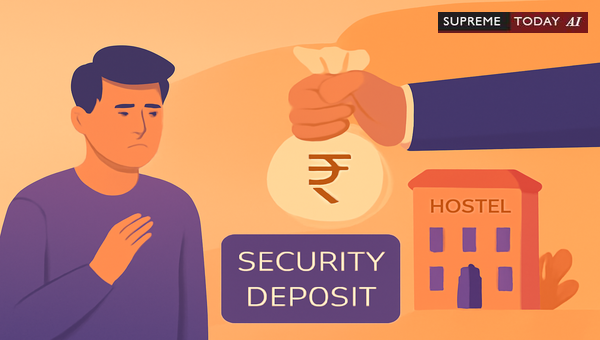
Hostel Security Deposit: or Misappropriation?
Depositing security money with a hostel is a common practice for students and tenants seeking accommodation. But what happens when the hostel refuses to return it after checkout? Does this amount to of money, and is non-return a ? The question arises: Whether Security Money Deposited in a Hostel is of Money and Not Returning such Money is Misappropriation of Money.
This blog post dives into Indian legal principles, drawing from key judgments and statutes like and 409 of the (). We'll examine when such deposits qualify as , the role of dishonest intent, and real-world case insights. Note: This is general information, not legal advice. Consult a lawyer for your specific situation.
Understanding Under Indian Law
is a cornerstone of offenses under (punishment for ) and 409 (for public servants, etc.). It occurs when property or money is transferred to someone with the expectation of lawful handling, accounting, or return. As clarified in legal precedents, involves the transfer or placing of money in a position of trust, with an expectation of its return or proper application 2009 0 Supreme(SC) 1417.
Key ingredients include:- : The depositor hands over control to the recipient (hostel owner).- Obligation to return: Typically upon fulfillment of conditions like vacating without damage.- : The recipient holds it in trust, not as their own 2009 0 Supreme(SC) 1417 2024 0 Supreme(Cal) 461.
Without , mere retention doesn't trigger criminal liability—it's often a civil dispute.
Does Hostel Security Money Qualify as ?
In a hostel context, security money is paid to cover potential damages or unpaid dues, with an implicit promise of refund if conditions are met. This can resemble : the act of paying money to the hostel can be viewed as an —an amount paid with the understanding that it will be kept safely and returned when the contractual obligation terminates or upon request 2009 0 Supreme(SC) 1417. The hostel assumes a custodian role, creating a trust-like position.
However, courts scrutinize the relationship. Several judgments emphasize that not all deposits are . For instance, in banking or deposit scenarios, it's often a , not , unless specified otherwise. In such circumstances, the essential ingredients of Section 406 or of the , which require proof of of property and its dishonest misappropriation, are not attracted 2025 Supreme(Online)(Bom) 6129 2025 Supreme(Online)(Bom) 5930. Mere deposit without proof of specific terms doesn't suffice.
In one case, the court noted: He has admitted that he did not have any proof that the Respondent No.1 had deposited the money... Suffice it to conclude here that besides = there is no proof of dishonest misappropriation
. Thus, documentation like receipts specifying refund conditions strengthens an claim.
When Does Non-Return Become Misappropriation?
Failure to return security money without lawful justification can signal misappropriation. Not returning entrusted money, without lawful justification, can be regarded as dishonest misappropriation, fulfilling the ingredients of 2009 0 Supreme(SC) 1417 2024 0 Supreme(Cal) 461. The act of withholding after the return condition arises infers ().
Courts infer dishonesty from:- Retention post-vacation without damage claims.- No accounting for deductions.- Conversion to personal use.
The law emphasizes the importance of () for establishing , but the act of withholding entrusted property without lawful excuse can be sufficient to infer dishonesty 2009 0 Supreme(SC) 1417 2024 0 Supreme(Cal) 461.
Yet, counterexamples abound. In partnership or agency cases, dominion over funds isn't automatic without agreement: dominion of partner over partnership asset is not an unless there is special agreement 2021 Supreme(Online)(KER) 1313. Similarly, for hostel deposits: unless there is evidence of dishonest misappropriation, the deposit remains a contractual or civil relationship from analyses of 2025 Supreme(Online)(Jhk) 4210.
Case Studies: Proven or Absent?
Proven and Misappropriation
Some scenarios mirror hostels:- The averments in Annexure A2 complaint would clearly show that the 2nd respondent entrusted the money to the petitioners and it has not been returned, rather it was misappropriated 2025 Supreme(Online)(Ker) 25013. Here, investment-like deposits led to charges.- Investor funds: /dominion of investors’ money, agency/business capacity satisfied 2025 Supreme(Online)(Bom) 6003.
No Despite Deposits
- Cashier roles: Lack of proof that money of the was deposited or not dismissed charges 2023 Supreme(Online)(HC) 767.
- Contractor delays: no allegation of of any money to the petitioner despite payments 2025 Supreme(Online)(Jhk) 4210.
- Fixed deposits: no proof of for conviction 2022 Supreme(Online)(MAD) 12057.
These highlight: Evidence is key. Oral claims fail; receipts, agreements, and witness accounts prevail.
Exceptions and Lawful Withholding
Not every non-refund is criminal:- Contractual terms: If agreement allows deductions for damages, compliance negates offense 2009 0 Supreme(SC) 1417.- Disputes: Withhold during legal proceedings or damage claims 2009 0 Supreme(SC) 1417.- No : Innocent delays or errors aren't dishonest 2024 0 Supreme(Cal) 461.
If the retention of money is lawful—such as in cases where the period for return has not yet expired, or where the money is legitimately withheld due to dispute or legal proceedings—the act may not amount to misappropriation 2009 0 Supreme(SC) 1417.
Practical Recommendations for Tenants and Hostel Owners
For Tenants:
- Get written receipts specifying amount, purpose, and refund conditions.
- Document room condition with photos on check-in/out.
- Demand refund in writing; escalate to if needed.
For Owners:
- Maintain records: Clearly document the terms of deposit and conditions for return to establish lawful retention 2009 0 Supreme(SC) 1417.
- Account for deductions transparently.
- Return promptly: Ensure prompt and lawful return of security deposits upon termination 2009 0 Supreme(SC) 1417.
- In disputes, seek legal resolution first.
Conclusion: Civil vs. Criminal – A Fine Line
Depositing security money in a hostel may constitute if terms imply a trust obligation, and non-return can amount to misappropriation with proof of dishonesty 2009 0 Supreme(SC) 1417 2024 0 Supreme(Cal) 461. However, courts often view it as a civil debtor-creditor matter absent clear evidence, as seen in multiple precedents 2025 Supreme(Online)(Bom) 6129 2021 Supreme(Online)(KER) 1313.
Key Takeaways:- Prove via documentation.- Dishonesty inferred from unjustified retention.- Prefer civil remedies (e.g., rent control acts) unless criminal intent evident.- Always consult a legal expert.
Stay informed, document diligently, and resolve amicably to avoid escalation. For more on offenses, explore our legal resources.
References
- 2009 0 Supreme(SC) 1417: Principles of and .
- 2024 0 Supreme(Cal) 461: Ingredients of .
- Additional cases: 2025 Supreme(Online)(Bom) 6129,
, etc.












