


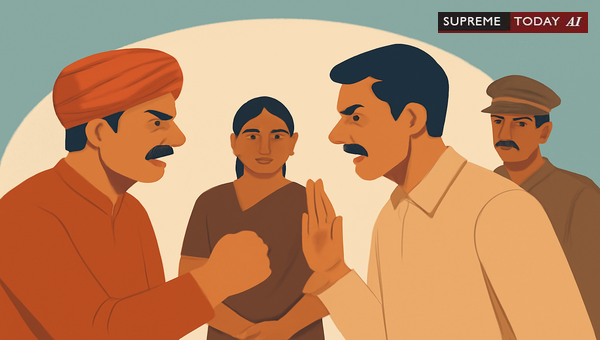
Balagounda vs Bala Saheb: Analyzing Assault Allegations and in Indian Law
Introduction
In the realm of Indian criminal law, cases involving by public officials often highlight critical issues like and . The case of Balagounda vs Bala Saheb—more precisely involving Bala Saheb Ingole, a school teacher assaulted by Haribhau (the Sarpanch) and Babarao (a member)—serves as a stark example. Occurring on , this incident raises questions about accountability in rural governance and the challenges prosecutions face when key witnesses turn hostile. 2019 1 Supreme 257
This blog delves into the Balagounda vs Bala Saheb case, examining its background, key findings, legal principles, and broader implications. While providing general insights, note that this is not legal advice; consult a qualified attorney for specific matters.
Background of the Case
The confrontation stemmed from Bala Saheb's late arrival at school. Haribhau and Babarao allegedly accosted him, using abusive language and physically assaulting him over a missing school record book. 2019 1 Supreme 257 This event unfolded in a setting, underscoring tensions between local authorities and public servants.
Under Indian law, such assaults typically fall under provisions of the (), including sections related to hurt, criminal force, and intimidation. However, proving these is paramount, especially when relying on witness accounts. 2007 0 Supreme(MP) 871
Key Findings: The Assault and Its Challenges
Nature of the Assault
Reports detail Haribhau threatening Bala Saheb with further violence while demanding the record book 2019 1 Supreme 257. This not only involved physical blows but also verbal abuse, potentially invoking (), (), or ()—though specific charges depend on the complaint.
Witness Testimonies and Hostile Turns
The prosecution called 24 witnesses, a substantial number, yet many turned hostile or failed to corroborate the claims. Critically, PW6—Bala Saheb himself—did not support the prosecution's narrative. 2007 0 Supreme(MP) 871 As courts often note, 'The testimony of can significantly weaken the prosecution's case.' 2007 0 Supreme(MP) 871
This mirrors broader judicial trends where undermine credibility. In similar matters, like murder under , courts emphasize reliable eyewitnesses. For instance, in a case involving the murder of Md. Sirajul Islam, the victim's daughter's consistent testimony proved pivotal, leading to conviction—but altered to due to circumstances. 2020 0 Supreme(Gau) 197
Legal Precedents and Principles
Related Case Law
A connected precedent, , clarified that circumstances like consent or voluntary actions may negate charges under or . 2009 0 Supreme(Del) 1194
This underscores how context influences charge interpretation, generally applicable in assault scenarios.
Courts consistently stress reliable testimonies. The failure of key witnesses here echoes rulings where hostile evidence led to acquittals or reduced charges. 2007 0 Supreme(MP) 871
Core Legal Principles
- Assault and Battery under : Physical assaults require prosecution to prove occurrence . Mere allegations suffice not; evidence is key.
- : When witnesses resile, the case weakens substantially. provisions allow , but conviction hinges on remaining credible proof. 2007 0 Supreme(MP) 871
- Burden of Proof: Lies squarely with prosecution; defense need not disprove unless evidence demands.
Drawing from other contexts, Transfer Petitions like highlight procedural transfers in criminal matters, potentially relevant for venue challenges in assault cases.
SHASHANK BALA SAHEB BHAPKAR vs THE STATE OF CHHATTISGARH
In vehicular accident compensations under —analogous in evidence scrutiny—courts award based on reliable proof, enhancing claims with interest. 2015 0 Supreme(Bom) 1301 Similarly, pension disputes under stress document authenticity, paralleling witness credibility. 2017 0 Supreme(Cal) 365
Broader Implications from Comparable Cases
Other judgments reinforce these themes. In , observations on evidence reliability (paragraphs 14-15) align with hostile witness handling. 2020 0 Supreme(Gau) 197
Fraud and gift deed cases under and discuss , relevant if coercion claims arise in assaults. 2014 0 Supreme(Gau) 985 For instance, 'Acceptance of deeds of gift by a minor has been correctly taken care of... A minor donee... is however competent to accept a non-onerous gift.' 2014 0 Supreme(Gau) 985 This illustrates contextual legal interpretations.
Cases like Vandna W/o Bala Saheb Bhapkar or Saheb Garade S/o Shri Bala Saheb show recurring names but distinct facts, emphasizing case-specific analysis.
Shashank S/o Bala Saheb vs STATE
AMOL BALA SAHEB GARADE vs STATE OF CHHATTISGARH
Conclusion and Key Takeaways
The Balagounda vs Bala Saheb case illustrates a weak prosecution due to , advising focus on corroborative evidence. 2007 0 Supreme(MP) 871 Key takeaways:
- Gather strong, consistent witness support early.
- Understand applications generally require robust proof.
- Hostile turns can derail cases; prepare alternatives like documents or forensics.
- Related precedents like guide consent/voluntariness interpretations. 2009 0 Supreme(Del) 1194
For victims or accused, these insights highlight strategic litigation. Always seek professional counsel, as outcomes vary by facts.
References- 2019 1 Supreme 257- 2007 0 Supreme(MP) 871- 2009 0 Supreme(Del) 1194-
- 2020 0 Supreme(Gau) 197- 2017 0 Supreme(Cal) 365- 2015 0 Supreme(Bom) 1301- 2014 0 Supreme(Gau) 985-
SHASHANK BALA SAHEB BHAPKAR vs THE STATE OF CHHATTISGARH
#BalagoundaVsBalaSaheb #HostileWitnesses #IPCAssault












