Searching Case Laws & Precedent on Legal Query.....!
Analysing the retrieved Case Laws
Scanned Judgements…!



Searching Case Laws & Precedent on Legal Query.....!
Analysing the retrieved Case Laws
Scanned Judgements…!
Significance of Witness Signatures in Will Execution - The law requires that a will be attested by at least two witnesses, each of whom must sign the will in the presence of the testator or acknowledge the signature in their presence. It is not necessary for the witnesses to sign simultaneously or in the presence of each other; their signatures should be in the presence of the testator or with his acknowledgment ["2013 Supreme(Online)(Chh) 279"], ["2021 Supreme(Online)(MAD) 48117"], ["2017 0 Supreme(Del) 4229"].
Husband Signing as a Will Attesting Witness - Merely signing as a witness does not automatically imply that the husband consented to the transfer or property arrangement. The key requirement is that the husband, as a witness, must have seen the testator sign or acknowledge the signature, or have signed after receiving acknowledgment from the testator. Signatures made solely as witnesses, without such acknowledgment, are insufficient to establish validity or consent ["
PONNAMMAL v. PATTAYE et al .
"], ["2013 Supreme(Online)(Chh) 279"].Husband Signing on Behalf of the Testator or for Property Transfer - The act of signing a will or property transfer deed by the husband in both names, with the wife serving as a witness, raises questions about validity. The law emphasizes that the witnesses, including the husband, must attest to the testator's signing or acknowledgment in their presence. If the husband signs as a witness and not as a party to the transfer, it is permissible provided the proper attestation process is followed. However, if the husband signs as a party or as a co-declarant, that would require explicit consent and proper legal procedures ["
PONNAMMAL v. PATTAYE et al .
"], ["2025 0 Supreme(Ori) 313"].Witness as a Wife - The wife serving as a witness is generally permissible, but she must still meet the attestation criteria: witnessing the testator sign or acknowledging his signature, and signing in his presence. The presence of the wife as a witness does not invalidate the will, provided the legal requirements are met ["2013 Supreme(Online)(Chh) 279"], ["2021 Supreme(Online)(MAD) 48117"].
Impact of Witness's Presence and Acknowledgment - The validity hinges on whether the witness, including the husband if acting as a witness, observed the testator sign or received acknowledgment of his signature. The law states that each witness must sign in the presence of the testator, but it is not necessary for more than one witness to be present at the same time, and no particular form of attestation is mandated ["INDOR00000020538"], ["1986 0 Supreme(Del) 416"].
Analysis and Conclusion:It is permissible for a husband to sign a will or property transfer document as a witness, provided he does so after witnessing the testator sign or acknowledging his signature in his presence. The wife can serve as a witness, and her signing does not invalidate the document if the proper attestation procedures are followed. The key point is that the signatures must be in the presence of the testator or with his acknowledgment, not merely as a party to the transfer or as a witness without observing the signing process ["
PONNAMMAL v. PATTAYE et al .
"], ["2013 Supreme(Online)(Chh) 279"]. Therefore, signing a will in both names with the wife as a witness is permissible under law, assuming all attestation requirements are satisfied.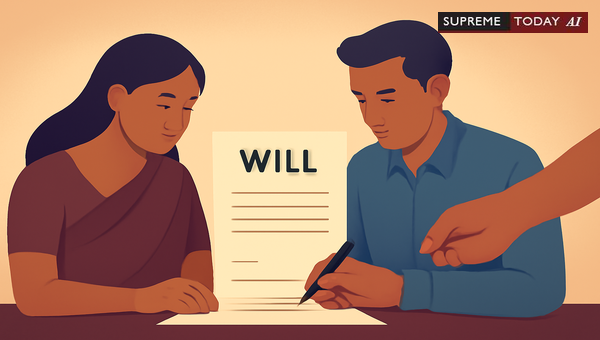
Imagine a couple who has built a life together, owning property in both their names. As they plan for the future, the husband wants to draft a will for this joint property, and the wife agrees to witness it. But is this legally sound? Many spouses face this dilemma when estate planning, especially in India where succession laws are strict.
Is it permissible for a husband to sign a will for property in both names, with the wife serving as a witness? This question touches on core principles of will execution, , and joint ownership under laws like the . While not explicitly prohibited, validity hinges on strict compliance with formalities. This post breaks it down, drawing from legal precedents and principles to guide you.
Note: This is general information based on legal documents and case law. Consult a qualified lawyer for advice tailored to your situation.
A will allows a person of to dispose of their property after death. For property in joint names—common among spouses—the husband can generally execute a will covering his share or the joint interest, provided he has the capacity and ownership rights.
Legal principles affirm that a person who is the absolute owner of property can dispose of it by will, and similarly, two or more Hindus owning property jointly can execute a , provided they have full ownership and capacity to do so. 2006 5 Supreme 438 The case of supports this, confirming Hindus can joint properties via will.
Joint wills by spouses are recognized if formalities are met. However, the will's validity depends on compliance with statutory formalities and the law governing wills and succession. 2018 7 Supreme 1 Simply stating the property is in both names doesn't invalidate it; ownership and intent matter.
Witnesses play a crucial role: they attest the 's signature and confirm mental capacity. The law requires competent witnesses who are not to avoid conflicts, but it does not prohibit a spouse from witnessing.
Witnesses to a will must be competent and not , but the law does not prohibit the spouse from being a witness. 2006 5 Supreme 438 Spouses often witness wills if disinterested—meaning they don't unduly benefit in a way that taints the document.
In practice, courts accept spouse witnesses if formalities are followed. For instance, one case notes attesting witnesses must prove they saw the sign or received acknowledgment, and a single competent witness's testimony can suffice. 2024 0 Supreme(P&H) 392 Another highlights that even if a witness is related, like a spouse, the focus is on proper under and . 2024 0 Supreme(P&H) 392
To ensure validity:- The must be of and act voluntarily.- Sign in the presence of at least two witnesses.- Witnesses must attest the signature.
The law requires that a will be made voluntarily by a person of , and that it be signed by the in the presence of witnesses. The witnesses then attest to the signing, and their signatures are appended. 2006 5 Supreme 438
Courts emphasize: A Will's validity hinges on proper execution and ; one attesting witness's testimony can suffice to establish its legitimacy. 2024 0 Supreme(P&H) 392 Registration isn't mandatory but strengthens proof.
For joint properties, recitals like property belonged to both the husband and the wife don't automatically transfer interests unless pre-existing rights exist. 2004 0 Supreme(Ker) 220 Thus, the husband's will should clearly address his dispositive powers.
Judicial precedents reinforce these rules while cautioning against pitfalls:
Spouse Involvement Scrutinized but Permissible: In a case, the wife of a beneficiary was revealed late, triggering review under relevant sections, but proper prevailed. 2024 Supreme(HK)(HKCFI) 109 Courts note it's an attesting witness, not an eye witness, and formal signing suffices.
Overcoming : Wills face challenges if or fraud is alleged. A testament executed and proved in accordance with the law should not be ignored based on conjectures and surmises. 2018 0 Supreme(P&H) 4445 One ruling restored a trial court's decision, holding testimony of one attesting witness enough despite appellate doubts. 2024 0 Supreme(P&H) 392
Proof Requirements: Propounders must prove execution per Section 63, Indian Succession Act. Failure, like not examining key witnesses, dooms claims. 2022 0 Supreme(Mad) 3221 In another, a court clerk witnessing (unusual but accepted) supported genuineness when executed in counsel's chamber. 2019 0 Supreme(Del) 422
Joint Testators: A document by husband and wife as joint testators was examined, underscoring witness availability and presence. 2025 0 Supreme(Kar) 2133
These cases show courts uphold wills with proper proof, even with family witnesses, but demand cogent evidence to dispel doubts. 2023 0 Supreme(Del) 3971
Not all scenarios are straightforward:- Beneficiary Witnesses: If the wife benefits substantially and the will is contested, courts scrutinize closely—but it doesn't automatically invalidate. 2006 5 Supreme 438- or Fraud: Challenges succeed if proven, regardless of witnesses. 2007 0 Supreme(Cal) 47- Incompetent Witnesses: Spouses must be competent; contradictions in testimony can raise red flags. 2023 Supreme(Online)(Chh) 14375- Collusion Concerns: Self-serving arrangements between spouses may invite dismissal. 2021 0 Supreme(Ker) 809
If the witness is also a beneficiary and the will is contested, the court may scrutinize the circumstances more carefully, but this does not automatically invalidate the will solely on that basis. 2006 5 Supreme 438
To minimize risks:1. Seek Professional Help: Draft with a lawyer to ensure compliance and clarity on joint ownership.2. Use Independent Witnesses: While spouses can witness, adding disinterested parties strengthens validity.3. Register the Will: Though optional, it aids proof.4. Document Capacity: Include medical notes if health issues exist.5. Consider : For spouses, joint or reciprocal wills can align intentions.
It is advisable to draft the will with legal assistance to ensure compliance with formalities and to prevent future disputes. 2006 5 Supreme 438
Estate planning protects your legacy. While spouses can collaborate closely, professional guidance ensures your will stands firm. Share your thoughts below—what estate planning questions do you have?
References:- 2006 5 Supreme 438: Core on joint wills and witnesses.- 2018 7 Supreme 1: Succession principles.- Additional insights from 2024 0 Supreme(P&H) 392, 2024 Supreme(HK)(HKCFI) 109, 2018 0 Supreme(P&H) 4445, etc., as noted.
#JointWill #WillWitness #EstatePlanning



Did Arasen sign merely as a witness, or for the purpose of signifying his consent to the transfer thereby made by his wife? ... Sale of immovable property by wife-Deed signed by husband-No express words signifying husband's consent-Ordinance No. 15 of 1876, s. 9. ... -The husband has merely attested the deed as a witness. The fact that the husband signed the deed as a witness is not sufficient to satisfy th....

Defendants contested the suit and pleaded that being collaterals of the husband of Lal Kaur, i.e. Bhagat Singh, they were entitled to inherit the estate of Smt. Lal Kaur, as the suit property was ancestral. They denied Achhar Kaur to be the daughter of Lal Kaur. ... Further, it is required for the attesting witness to prove that he had seen the testator sign or affix his mark to the WILL in his presence or that he received from the testator a personal acknowledgment of his signature or mark of the signature of such other....

Therefore, there appears a contradictory statement of an attesting witness and according to this witness, to sign the Will he was called by Jaspal Singh, one of the beneficiaries. ... In cross - examination, the attesting witness Bhanupratap Singh has further admitted that Bishen Singh Jabbal has told him that he (Bishen) wrote the Will and asked this witness to sign. The other propounder Jaspal Singh was not examined. A perusal of the statement of attesting witness D....
It is “attesting” witness, not “eye” witness, being named in sub (d). It is also the formal requirement under our law for the attesting witnesses to “sign” on the Will. ... being his wife). ... It was then first made known to the Court that Madam Wong was the wife of the Applicant and Beneficiary of the landed property in the Will. It thereafter triggered the applicability of s 10 WO herein. ... If the wife agrees that the wish of her late husban....

Adopting any other approach is not permissible. ... The testatrix trusted her son - in - law, and that she always had the intention to bequeath the entire property in favour of the defendant on the reasoning that the bank account was in the joint names of testatrix and the defendant. ... 5. ... Padamnath Upadhyay had categorically deposed that he had only signed one document, i.e., the Will as a witness and that he did not sign any other document other than the Will. This witness als....
The other daughter, who is alive, is agreeable to the proposal made by the father to bequeath the property in favour of one daughter, who is serving him after the death of his wife for a period of more than five years. 27. ... Kapoor, the other witness has stated that Will is typed and there were four persons in the room including husband of Sudarshna. (vi) Names of two other daughters, who had died, have not been mentioned in the Will. The date written by Sh. R.R. ... Her ....

Admittedly, Exhibit D5 is executed by Sri Sebastian and his wife. In other words, in Exhibit D5, there are two testators who are the husband and wife. 19. Exhibit D10 is the letter that has been written by Sri. ... In Exhibit P6 again on Email correspondence, the second witness to the Will would clearly state that she was not in India as on the date of execution of the Will being 03.04.1993 and she having lost her husband came alone to India in June 1993. ... Sebastian was owner of the suit pr....

Since then, Defendant No.2 had been staying with the husband- Parsuram as his legally married wife. She also allowed Chandrama to stay with them. Parsuram had strained relations with his brother and family members including the Plaintiff. ... He used to look after Parsuram and his wife and continued to stay there even after his marriage. Parsuram, therefore, out of his love and affection, executed a registered Will in his favour bequeathing the suit property on 27.08.1997. ... After completion of the obsequies, the Plain....

13(iv) Appellants examined one Jayalakshmi, wife of one of the attesting witnesses as P.W.3. She has not seen Srinivasa Pillai, her husband and other attesting witness signing the Will. ... The appellants have not stated anything about the other attesting witness and why they are not able to examine him to prove the Will. Hence, P.W.3 did not identify signature of her husband, attesting witness to the Will. ... Further, each of the witnesses shall sign the Will i....

Though the same was not signed by any attesting witness, the respondent no.2's wife had voluntarily made an endorsement thereon in hindi that they did not want any share in the testator's property being No.C-35, East of Kailash, New Delhi. ... My son and daughter-in-law, as heretofore, totally ignored me after the death of my wife and never bothered either to know my welfare or take care of me in my old and isolated life, whereas my daughter, her husband and her children stood by me-through thick and t....

It is a self serving decree at the instance of both the husband and wife, wherein the husband remained absent and caused to pass a decree as claimed by the wife and brought the property on sale under the said decree. As discussed in the earlier paragraphs, the decree obtained by the wife of judgment debtor and the court sale are the result of collusion between husband and wife, that too, without a cause of action.
Though the court clerk has not deposed, the fact that the second witness - Mr. Kamal Singh was the court clerk, is not disputed and in fact, admitted by all the witnesses. It is unusual for the court clerk of the counsel to sign the Will as a witness. This fact shows that the Will was perceived as a formality and not an unusual step. A perusal of the narration in the Will, as also the fact, that the same was executed in the chamber of the counsel of the Petitioner, would be a factor, which would go in favour of holding that the Will is genuine.

This was the document of November, 1988 being the month of his death whereas the Will is of July, 1988. Story of execution of deed of gift is belied by production of document. It really creates a suspicion in the mind of the Court as to why a husband will sell a property to his wife or for that matter why wife should pay for the same.
A mere recital that the property belonged to both the husband and the wife will not convey any interest in the property of the wife to the husband. Therefore, if the 1st defendant was not as a matter of fact the manager of a joint family, he will not become manager merely because he is described so in Ext.A3. The learned counsel for the appellant also relied on the decision in Sarojini v. Santha Trading Co. (1969 KLT 412) to contend for the position that a mere recital in confirmation of pre-existing rights in a person, who had no such right would not covey any right in the....

In view of the said proposition of law, unless the second respondent shows that he had also pre-existing right in the property purchased under Ex.A1, the mere recital in Exs.B1 and B2 that he is also a co-owner of the property along with his father will not convey any right on him. A mere recital that the property belongs to both the husband and the wife will not, therefore, convey any interest in the property of the wife to the husband." "A recital in confirmation of pre-existing rights in a person, who had no such right in fact, would not convey any right in the property ....


An indispensable Tool for Legal Professionals, Endorsed by Various High Court and Judicial Officers
Please visit our Training & Support
Center or Contact Us for assistance

Scan Me!
India’s Legal research and Law Firm App, Download now!


For Daily Legal Updates, Join us on :



 Back to top


