
Searching Case Laws & Precedent on Legal Query!
Scanned Judgements…!
Searching Case Laws & Precedent on Legal Query!
Scanned Judgements…!
Encroachment and Ground Rights - Owners of land can demand removal of encroachments or compensation, and in some cases, transfer of the encroached land. The Roman-Dutch law in South Africa supports claims for removal or compensation, but sale or lease of street reservations requires government sanction. Compensation claims can be made against the Crown or private parties depending on circumstances. ["
GUNATILEKE v. THE MUNICIPAL COUNCIL COLOMBO
"]Legal Proceedings for Encroachment Removal - Courts have directed authorities to survey and act against encroachments on public pathways, often requiring notices and considering representations from affected parties. Authorities like the Block Development Officer or land surveyors are tasked with identifying encroachments and initiating removal procedures under relevant land encroachment laws. ["2023 0 Supreme(Mad) 1212"]
Parties in Encroachment Disputes - Municipal Committees and private individuals often contest encroachment claims. The courts have held that municipalities or private entities owning the land or street are necessary parties in suits challenging encroachments, and non-joinder can be grounds for dismissing such suits. The ownership status (public vs. private street) influences the proceedings. ["2024 0 Supreme(P&H) 265"]
Encroachment During Construction - Encroachments made during building activities can be contested, and courts have emphasized that retaining such encroachments generally requires compensation, especially if they are made without proper authorization. Unauthorized encroachments after filing a suit are viewed skeptically, and courts may require proper identification and demarcation before action. ["2025 0 Supreme(HP) 584"], ["2025 0 Supreme(Mad) 5188"]
Legal Authority for Removal of Encroachments - Statutes like Section 156 and Section 288D empower authorities (municipal or commissioners) to remove or alter encroachments and obstructions from streets without prior notice if necessary, ensuring the maintenance of public roads and access. These provisions emphasize the state's authority to act swiftly to remove encroachments on public streets. ["
SAMARAWEERA et al. v. MOHOTTI et al.
"], ["2023 0 Supreme(Kar) 210"]Public Streets and Encroachment - Streets used by the public for over a century, with infrastructure like street lights, drainage, bus stops, and shelters, are recognized as public property. Access cannot be denied due to private claims, and encroachments on such streets are subject to removal by authorities. Courts have dismissed suits that attempt to deny access or challenge public street status, especially when parties suppress relevant legal directions or facts. ["2025 0 Supreme(Mad) 5188"], ["2025 Supreme(Online)(Mad) 69817"]
In cases where third parties encroach upon streets or public pathways, courts and authorities generally recognize the importance of maintaining public access and uphold the state's power to remove encroachments without prior notice, especially on public streets used for transportation and utilities. While landowners or institutions (like temples) may claim private ownership or usage rights, courts tend to side with public interest, emphasizing the need for proper legal procedures, notices, and necessary parties to be involved. Encroachment suits often involve complex considerations of ownership, public utility, and legal authority, but the overarching principle favors the removal of unauthorized encroachments to preserve public rights and infrastructure.
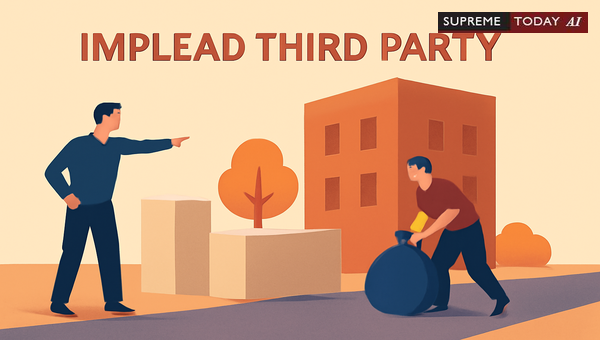
Street encroachments often spark heated property disputes, especially when they lead to injury claims or block public rights of way. Imagine a scenario where a neighbor builds a wall encroaching on a shared street, prompting an injunction suit. But what if a third party—like a municipal body or adjacent landowner—has a direct stake? Can they be brought into the fray?
The question arises: In Injection Suit Third Man can be Made Party for Street Encroachment Ground—likely referring to an injunction suit where a third party (or third man) seeks impleadment on grounds of street encroachment. Generally, yes, courts may allow this under the Civil Procedure Code (CPC), balancing justice, efficiency, and complete adjudication. This post breaks down the procedure, legal framework, and judicial insights, drawing from key precedents. Note: This is general information, not specific legal advice—consult a lawyer for your case.
Impleadment ensures all interested parties are heard, preventing fragmented litigation. It's primarily governed by Order 1 Rule 10 CPC, which empowers courts to add or remove parties at any stage if needed for effective resolution. Order 1 Rule 14 CPC supports joinder for proper adjudication. 2001 0 Supreme(P&H) 776
Courts typically evaluate:- Whether the third party has a direct interest in the subject matter.- If their presence is essential to resolve the dispute fully.- Risk of multiplicity of suits if excluded.- Potential impact of the suit's outcome on them.
Parties fall into two categories:- Necessary Parties: Indispensable for complete adjudication—without them, the matter can't be fully settled.- Proper Parties: Helpful for comprehensive resolution, though not strictly required. 2022 0 Supreme(P&H) 478
In street encroachment cases, third parties like local authorities often qualify due to public interest in rights of way. For instance, if a structure encroaches on a public street, municipal bodies may be impleaded as their regulatory role is pivotal. 2008 0 Supreme(Guj) 199
A party files an application under Order 1 Rule 10 CPC, detailing the third party's relevance. It must explain their interest—e.g., ownership claims or liability in injury claims—and how inclusion aids justice.
The court notifies the proposed party, allowing them to oppose or consent.
The court reviews pleadings and evidence, applying principles of necessity and equity. Discretion is wide but guided by avoiding injustice.
If approved, the third party joins as defendant/respondent, filing defenses. 2001 0 Supreme(P&H) 776
This process is flexible, even post-initial pleadings, to adapt to emerging facts like hidden encroachments.
Courts emphasize plaintiff autonomy but prioritize holistic justice. In one ruling, the court noted, the plaintiff is the master of their suit and cannot be forced to litigate against parties against whom they do not seek relief. Yet, impleadment was allowed where the third party's interest in encroachment or rights of way was crucial, avoiding multiple suits. 2001 0 Supreme(P&H) 776
Another case on street disputes permitted impleadment of parties with equal interest, observing that even unwilling plaintiffs may need them for proper adjudication. 2022 0 Supreme(P&H) 478
In encroachment litigation, timing matters. A defendant raising a wall just 2/3 days prior to the institution of the suit didn't bar mandatory injunctions, highlighting swift judicial intervention—and potential third-party involvement if streets are public. 2010 0 Supreme(P&H) 441
Analogous to property suits, impleadment succeeds when third parties claim superior rights, as in church property disputes where pastors intervened fearing collusion, overturning trial court denials: no third party application can be entertained in a suit for specific performance... It is not rule of thumb. 1998 0 Supreme(AP) 514 1998 0 Supreme(AP) 511
Public street cases often implead institutions. One suit dismissed for lacking S.80 CPC notice to public officers underscored governmental stakes in encroachments. 2024 0 Supreme(Mad) 72
Exclusions occur if interests are peripheral, but in interconnected disputes, courts lean inclusive to avert conflicting judgments.
Applicants must prove necessity early—delays risk denial. Opponents argue minimal impact. Success hinges on affidavits, maps, and precedents showing direct stakes.
For plaintiffs facing impleadment bids: Highlight your suit's focus, but courts may override if public interest looms.
Impleading a third party in street encroachment injunction suits is viable under Order 1 Rule 10 CPC when their presence ensures complete justice. Courts weigh necessity, especially in public nuisance or injury contexts, as precedents affirm. 2001 0 Supreme(P&H) 776 2022 0 Supreme(P&H) 478 2010 0 Supreme(P&H) 441
Key Takeaways:- File detailed applications citing CPC rules.- Expect court discretion based on interest and efficiency.- Public streets amplify inclusion likelihood.- Use evidence like deeds to substantiate claims.
This framework promotes fair outcomes but varies by facts. Always seek professional legal counsel tailored to your situation. For more on property litigation, explore our resources.
Sources:2001 0 Supreme(P&H) 776 2022 0 Supreme(P&H) 478 1964 0 Supreme(Guj) 11 2010 0 Supreme(P&H) 441 2008 0 Supreme(Guj) 199 1998 0 Supreme(AP) 514 1998 0 Supreme(AP) 511
#StreetEncroachment, #Impleadment, #CPCLawIntention is the intention of the man who made the improvements. The object is to compensate a man who is losing something. In considering the market price and the land improved one must take into consideration the possibility of the encroacher being a possible purchaser. ... as a definite principle of the Roman-Dutch law as accepted in South Africa that the owner of the ground encroached upon may demand that the encroachment be removed or that the encroacher shall take a transfer of the piece of....
This Court further directed the second respondent to conduct survey after issuing notice to the third respondent and in case any encroachment made by the third respondent, the second respondent shall proceed further under the provisions of the Tamil Nadu Land Encroachment Act, 1905. ... On 19.07.2022, this Court allowed W.P(MD)No.15587 of 2022 on the ground that the Block Development Officer is not a competent person to initiate eviction process under the provisions of the Tamil Nadu L....
No.1 had made paved road/street by putting soil etc. and that he had encroached upon the property of the Municipal Committee. ... It is averred in the application that between the house of the plaintiff-respondent No.1 and the petitioner herein, there is a 6 feet wide and almost 27-28 feet long street of the Municipal Committee which is a part of Street No.22 of the Municipal Committee and on the said street the plaintiff-respondent ... The Trial Court has rightly found that the petitioner is neither a ....
The house & ground No.11, situated at Appu Naicken Street, Nungambakkam and the house & ground No.41, situated at Village road, (old door No.22), Nungambakkam, Madras, were divided equally between the plaintiff and the defendants in the said suit. ... Accordingly, a partition deed was registered vide document No.621/1954 dated 13.08.1954 executed between Munusamy Naicker as one party and Balakrishnan Naicker and Arunachala Naicker as other party. ... Having regard to the pleadings, evi....
Over and above a street and did not start from a foundation in a street. ... The section inter alia speaks of " setting up any bracket, sunshade, or other obstruction or encroachment". ... Perera's contention was briefly that section 156 referred to an obstruction or encroachment which was caused as the result of a vertical erection or building from the base of a street upwards, but that here we are concerned with a sunshade and balcony that were the result of a lateral projection ... noticed woul....
Encroachment by a person in the course of erection of a building-Right of party building on another's land to retain encroachment on paying compensation. ... Next, the ground was filled up at the back; this encroachment, I hold, was acquiesced in (issue 4). ... After the first survey defendant got a second survey made by Mr. Roosmalecocq on September 21, 1914, and after that shifted his ground. There he claims the ground which was specially....
In a situation where the encroachment is alleged to have been made after filing of a suit, the indulgence by the Court in getting such fact verified may be justified but in a situation like this, where the petitioner has filed a suit for possession with the allegation of encroachment, the attempt made ... As per allegation of the petitioner, the encroachment was carried by the respondents in the third week of May, 2010. The plaint was instituted in J....
Removal of encroachment.-(1) The Commissioner may, by notice require the owner or occupier of any premises to remove or alter any projection, encroachment or obstruction (other than a door, gate, bar or ground-floor window) situated against or in front of such premises and in or over any street or any ... or an encroachment upon or a projection over, or to occupy any portion of such street, channel, drain, well or tank. ... Thus, the entire basis of the suit was the i....
The said public street is used by general public, vehicles and city buses for over hundred years. The third respondent/third defendant had erected street lights in the Teppakulam West Street. ... The public drainage vested with the third respondent/third defendant also runs under the Teppakulam West Street. There are several manholes projecting over the said street. A city bus stop exists in the said street. A bus ....
Even if it be assumed that entire wall had been raised by him to/three days prior to the filing of the suit, the same does not disentitle the appellant/plaintiff from claiming mandatory injunction directing the defendant/respondent to remove the said Wall. From the evidence on file, it is made out that the defendant had raised a wall of small height just 2/3 days prior to the institution of the suit and thereafter, he raised the height of the wall. But as per his own admission, the encroachment over the street had been made by the defendant about two days prior to the institution of the suit....
Act on the ground that suit structure is encroachment on public street. Act on the ground that suit structure is encroachment on public street. As stated herein above, that was not the relief sought by the plaintiff in the suit. Thus, learned Advocate appearing on behalf of the appellant is justified in making grievance that the reliefs granted by the learned trial Court is beyond the reliefs sought by the plaintiff. However, the learned trial court has further observed that said order shall not affect the right of the defendant, if any, to proceed against....
The Additional Subordinate Judge dismissed the application on the ground that on third party application can be entertained in a suit for specific performance. Apprehending a collusive decree between the parties, the Pastor of the Church filed the present application seeking permission to implead himself as a party defendant to the suit.
The Additional Subordinate Judge dismissed the application on the ground that no third party application can be entertained in a suit for specific performance. Apprehending a collusive decree between the parties, the Pastor of the church filed the present application seeking permission to implead himself as a party defendant to the suit.
But, we are of the view that the apprehension expressed by the appellant herein is not based on any material. There must be reasonable evidence also to satisfy that there was a real likelihood of bias. It is true that a reasonable apprehension of bias in the mind of a reasonable man can be a ground for appointment of a third party as Arbitrator.
Login now and unlock free premium legal research
Login to SupremeToday AI and access free legal analysis, AI highlights, and smart tools.
Login
now!
India’s Legal research and Law Firm App, Download now!
Copyright © 2023 Vikas Info Solution Pvt Ltd. All Rights Reserved.







