
Searching Case Laws & Precedent on Legal Query..!
Scanned Judgements…!
Searching Case Laws & Precedent on Legal Query..!
Scanned Judgements…!
Effect of Prosecution with Incorrect Name in Cheque Cases - The use of an incorrect or misspelled name on a cheque can impact the validity of the prosecution's case. Proper identification of the drawer and correctness of the name are crucial for establishing the issuance of a valid cheque. Alterations or discrepancies in the name may raise questions about the cheque's authenticity and enforceability. Sources: 2025 0 Supreme(HP) 90, ["2024 Supreme(Online)(Kar) 38461"], ["2024 0 Supreme(Chh) 44"], ["2022 0 Supreme(Kar) 1544"]
Importance of Correct Address and Notice Validity - Sending notices to the correct address is vital in cheque dishonor cases. If notices are sent to incorrect addresses or endorsements are manipulated, it may amount to non-compliance with legal requirements, affecting the presumption of validity and the prosecution's case. Proper service of notice is essential for maintaining the presumption of debt or liability. Sources: 2023 0 Supreme(Gau) 1542, ["2023 0 Supreme(Bom) 2291"]
Presumption of Legally Enforceable Debt - When a cheque bears the genuine signature of the drawer, courts generally presume a debt exists, shifting the burden to the accused to prove otherwise. However, if the cheque is issued under suspicious circumstances or is misused, this presumption can be rebutted. The accused can also demonstrate that the cheque was issued as security or under coercion, affecting the prosecution's case. Sources: 2025 0 Supreme(Kar) 818, ["2023 0 Supreme(Mad) 396"], ["2023 0 Supreme(Gau) 1542"]
Impact of Name Discrepancies and Alterations - Material alterations, such as changing the payee's name or adding words, can render a cheque void. Courts examine whether alterations were made with the drawer's consent or negligence. If alterations are proven to be unauthorized or fraudulent, the cheque's enforceability is compromised, weakening the case against the accused. Sources: 2025 0 Supreme(HP) 90, ["2024 Supreme(Online)(Kar) 38461"]
Role of Evidence and Witness Testimony - Courts rely heavily on oral and documentary evidence to establish issuance, execution, and authenticity of cheques. Discrepancies in handwriting, absence of proper documentation, or proof of misuse can influence the case outcome. Proper evidence presentation is critical to prove or rebut allegations of false issuance or forgery. Sources: 2022 0 Supreme(Kar) 1544, ["2025 0 Supreme(Kar) 818"], ["2023 0 Supreme(Mad) 396"]
Analysis and Conclusion:Prosecution in cheque cases hinges on the correctness of the name, proper service of notices, and the authenticity of the cheque. Incorrect names or addresses can weaken the case, especially if they suggest fraud or procedural lapses. Courts emphasize the importance of genuine signatures, proper alterations, and valid notices to uphold the presumption of debt. When discrepancies or fraudulent alterations are established, the validity of the cheque and the strength of the prosecution's case are significantly affected. Therefore, precise compliance with legal formalities and thorough evidence are essential for successful prosecution in cheque bounce cases.
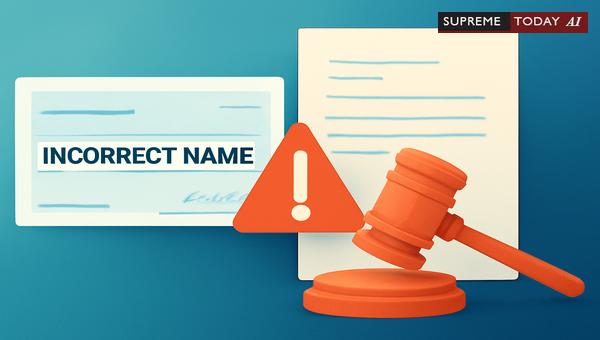
Cheque bounce cases under Section 138 of the Negotiable Instruments Act, 1881 (NI Act) are common in India, often arising from business disputes or unpaid debts. But what happens if the prosecution starts with the wrong name of the accused? Does a misspelling or clerical error invalidate the entire case? This is a frequent concern for both complainants and defendants.
The question at hand is: Effect of Prosecution with Incorrect Name in Cheque Bounce Case. While such errors can raise doubts about the proceedings' validity, Indian courts generally take a pragmatic approach, focusing on identity rather than perfection in nomenclature. This post explores legal principles, judicial precedents, and practical recommendations, drawing from key cases and statutes. Note: This is general information, not specific legal advice. Consult a lawyer for your situation.
A cheque is a negotiable instrument, and any material alteration can impact its enforceability. An alteration in the name of the payee is considered material because it affects the character of the instrument, the relationship of the parties, and their legal positions as originally expressed 2020 0 Supreme(AP) 320. Such changes can render the cheque void if they prejudice the rights or liabilities of the parties 2020 0 Supreme(AP) 320.
However, the issue here is not alteration of the cheque itself but errors in the complaint or prosecution documents. Courts distinguish between alterations on the instrument and clerical mistakes in legal filings.
Courts have consistently held that a wrong or incomplete description of the accused's name in the complaint or cause-title can be corrected if it's a mere mistake or misdescription, not involving wrong identity or fraud M/S EFFICIENT MARKETING (P) LTD vs M K ABDUL WAHAB @ YOOSUF HAJI - 2008 Supreme(Online)(KER) 48348. The correction does not vitiate the prosecution if the intended person is identifiable and the cheque was issued in the correct name M/S EFFICIENT MARKETING (P) LTD vs M K ABDUL WAHAB @ YOOSUF HAJI - 2008 Supreme(Online)(KER) 48348.
In K.S. Udayakumari's case, the petitioner challenged a name correction from K.S. Udayakumar to K.S. Udayakumari in a Section 138 complaint. The court dismissed the challenge, stating: Typographical errors in criminal complaints can be corrected if they do not influence the case's essence and do not cause prejudice to the accused 2025 Supreme(Online)(Ker) 56280. The petitioner did not dispute issuing the cheque, confirming her identity.
Indian courts prioritize substance over form to avoid miscarriage of justice. Amendments to correct names in criminal complaints are permitted, especially for typographical or clerical errors M/S EFFICIENT MARKETING (P) LTD vs M K ABDUL WAHAB @ YOOSUF HAJI - 2008 Supreme(Online)(KER) 48348. The key is distinguishing mere mistakes from fundamental identity issues.
For instance, courts emphasize: Courts have permitted amendments to correct names in criminal complaints or proceedings, emphasizing that such corrections are allowed to prevent miscarriage of justice M/S EFFICIENT MARKETING (P) LTD vs M K ABDUL WAHAB @ YOOSUF HAJI - 2008 Supreme(Online)(KER) 48348.
Errors in the payee's name can complicate matters further, especially in cases involving deceased payees or transfers.
In one case, a cheque issued to a deceased person was scrutinized. Legal heirs cannot file a complaint under Section 138 unless authorized by a succession certificate, probate, or letters of administration 2011 0 Supreme(Bom) 850 2010 0 Supreme(Bom) 120. The court held: Only a person who is authorized by succession certificate, letters of administration or probate granted by the Court, is entitled to call upon the drawer to pay the amount of dishonoured cheque 2010 0 Supreme(Bom) 120. Without this, the complainant lacks standing as payee or holder in due course.
Another precedent notes: In the present case, admittedly, the cheque was issued in the name of deceased after one month of his death 2011 0 Supreme(Bom) 850, highlighting the need for proper authorization.
These cases underscore that while accused name errors are often correctable, payee discrepancies demand stricter scrutiny to ensure enforceable liability.
Not all errors are overlooked. If the incorrect name results in identity confusion or ties to a time-barred debt, challenges succeed.
K Kurnaravel VS R. P. Rathinam
2010 0 Supreme(Mad) 5297.In a settlement scenario, where a post-dated cheque for a 2003 debt was issued in 2010, proceedings were quashed as the debt was time-barred 2010 0 Supreme(Mad) 5297.
Additionally, if the cheque is issued to the wrong entity, like a complainant's relative instead of them, locus standi is questioned 2018 0 Supreme(Bom) 793.
To navigate these issues:- File Early Corrections: Complainants should apply to amend the name at the earliest stage to bolster proceedings.- Prove Identity: Use evidence like cheque details, notices, and admissions to confirm the accused.- Seek Amendments: Courts allow changes under CrPC provisions to cure defects.- Challenge Strategically: Defendants can move to quash under Section 482 CrPC if prejudice is shown.
Summary: In cheque bounce cases, prosecution with an incorrect name is typically valid if clerical and identity is clear. Courts lean towards corrections to uphold justice M/S EFFICIENT MARKETING (P) LTD vs M K ABDUL WAHAB @ YOOSUF HAJI - 2008 Supreme(Online)(KER) 483482020 0 Supreme(AP) 320.
Disclaimer: Legal outcomes depend on facts. This overview is for informational purposes—engage a qualified advocate for tailored advice.
#ChequeBounce, #NIACT138, #LegalInsights
This case began with a traffic stop near West Memphis, Arkansas. In February 2020, Detective Jamie Counce, a narcotics officer with the West Memphis Police Department, stopped a truck for careless driving and improper display of a license plate, in violation of Arkansas law. ... The case did not address whether a particular set of facts was sufficient to prove knowing possession beyond a reasonable doubt, much less whether facts a....
On a perusal of Ext.P1 cheque, it is seen that the name “Kousthubhan” (the name of the accused) was initially written as the name of the payee. It is seen that the name of the payee, written as “Kousthubhan”, is struck off, and the name of the complainant is written in the cheque as the payee. ... In our opinion, the correct interpretation of section....
In fact, the accused has also deposed to this effect. ... Though accused has claimed that Ex.P1 cheque does not bear his handwriting, however the perusal of the same makes it evident that except the name of the payee the remaining writing is in the hand of accused. ... In the next sentence he states that at that time the brother of complainant i.e., PW-2 Ronald Monterio gave him Rs.5 lakhs and for the security took a blank cheque#....
In the case at hand, the petitioner does not dispute the fact that her name is K.S. Udayakumari and that she issued the cheque covered under Annexure A1 complaint. The only grievance is that since the respondent has shown the name of the accused as K.S. ... Subsequent to the filing of the complaint, the respondent had filed Annexure A2 application to correct the name of the accused as K.....
True, there was no averment to the effect that the notice was sent at the correct address of the drawer of the cheque by "registered post acknowledgement due". ... Further to that, in the list of witnesses, the name of the complainant was mentioned and it was further stated that any other witnesses with the permission of the court. ... It may be that the address is correct and even the addressee is avail....
Act, 1881 presumption of the case may be given to the appellant as the accused has admitted that he gave a blank cheque by signing it to the appellant, Therefore, the accused had to prove that the presumption made in favour of the complainant is not correct and should have refuted the presumption which ... -C-1 is in the name of “Bhardwaj Triaka Structural Eng.” and it was not established that the cheque ....
. 920020064756414; when the cheque was presented by the petitioner, it was returned for the reason that the name of the recipient was not correct; when the same was informed to Gowtham Ananth, he assured that he would set right everything after he returned from his business tour; the petitioner did not ... Gowtham Anand who had issued the fake cheque has not been arrayed as an accused; instead the petitioner who is an inno....
The factual matrix leading to the case of complainant can be stated in nutshell to the effect that the accused was in need of money in the month of September 2014 and approached the complainant for loan of Rs.5,00,000/-. ... In the present case the accused has not denied that he is residing in the address given in causetitle. The demand notice is posted to the correct address of the accused. ... DW2 has deposed to the #HL....
AIR 2023 SC 5018 in the case of RAJESH JAIN vs AJAY SINGH and brought to notice of this Court that when the signature of accused on Cheque was unchallenged, allowing presumption as to legally enforceable debt to take effect, High Courts erroneously ... It is also his case that he has intimated the bank not to accept the Cheque on 25.03.2003. Hence, there is no any liability to pay Cheque#HL_E....
It was not issued on correct address. If the correct address could have been given on the notice, presumption can be drawn about execution of notice. ... No case is made out to set aside conviction. 17. The trial Court in paragraph 38 has observed that, the transaction between the complainant and accused is of 2 crores and complainant had taken cheque of Rs.83,32,500/- in advance. Hence, the judgment in the case#....
The cheque in the present case is clearly issued in the name of the respondent/ plaintiff. In Vithal Krishna Shanbhag vs. Sogmal Nathmal and Co. AIR 1958 Bombay 92, this Court has held that the cheque being a bill of exchange, the provisions of Order XXXVII Rule 1 undoubtedly apply to a suit based on cheque.
In the present case, admittedly, the cheque was issued in the name of deceased after one month of his death. Prima facie, the applicants, who claim as legal heirs of Mahendrahhai Patel (deceased), were required to honestly inform the banker of the deceased Mahendrabhai of the fact of his death while they sought to present the cheque in the account of the deceased and to take further steps in respect of account of the deceased with his banker. None of the applicants were named....
The complainant issued a notice dated 27.4.2010 and the petitioner failed to pay the amount due under the cheque. The said Madheswari preferred a complaint and the petitioner came forward for a settlement and agreed to pay a sum of Rs.10,00,000 and gave a post-dated cheque for the same amount on 20.3.2010. The complainant deposited the cheque on 6.4.2010 with the State Bank of India, Mettur and on 13.4.2010, the cheque returned with an endorsement “Funds insufficient”. However, the c....
The complainant deposited the cheque on 6.4.2010 with the State Bank of India, Mettur and on 13.4.2010, the cheque returned with an endorsement "Funds insufficient". The complainant issued a notice dated 27.4.2010 and the petitioner failed to pay the amount due under the cheque. However, the cheque was issued in the name of the complainant. The said Madheswari preferred a complaint and the petitioner came forward for a settlement and agreed to pay a sum of Rs.10,00,000/- and ....
It is, therefore, argued by Advocate Shri Zarekar that the respondent complainant could not be "payee" in terms of definition as under Section 7 of the N.I.Act. In this case, admittedly the cheque was issued by the petitioner accused in the name of father of the respondent complainant. According to him, respondent complainant had not for consideration beco me possessor of the dishonoured cheque and, therefore, he is not "holder in due course" as defined in Section 9. The term....
Login now and unlock free premium legal research
Login to SupremeToday AI and access free legal analysis, AI highlights, and smart tools.
Login
now!
India’s Legal research and Law Firm App, Download now!
Copyright © 2023 Vikas Info Solution Pvt Ltd. All Rights Reserved.








