


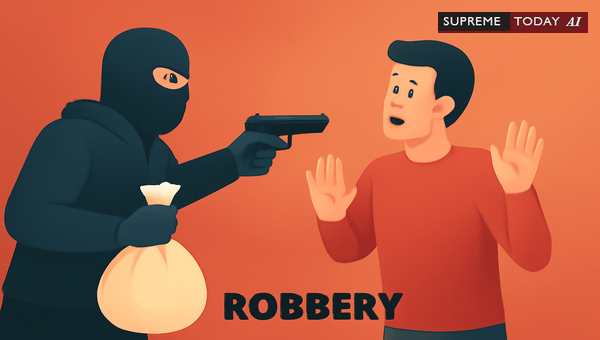
Key Ingredients of Under Section 390
Imagine a late-night where the perpetrator not only takes your valuables but also threatens you with a weapon to ensure compliance. What elevates this from simple to the serious offense of ? Understanding the ingredients for under Indian law is crucial for victims, legal professionals, and anyone navigating criminal justice matters.
In this post, we break down the core elements of as defined in the (), drawing from Section 390 and supported by judicial interpretations. This is general information based on legal precedents and should not be considered specific legal advice—consult a qualified lawyer for your situation.
What Constitutes in Indian Law?
is an aggravated form of or . According to , In all there is either or . becomes if, in order to the committing of the , or in committing the , or in carrying away or in the attempt to carry away the property obtained by the , the offender, , voluntarily causes or attempts to cause to any person death or hurt or or or of or of .
2023 0 Supreme(Raj) 465 2024 0 Supreme(Cal) 402
Key ingredients for establishing typically include:- Commission of or .- Accompanied by the offender voluntarily causing or attempting to cause death, hurt, or .- Or inducing fear of such harm in the victim.- All occurring in the course of or for the purpose of the or .
2023 0 Supreme(Raj) 465 2024 0 Supreme(Cal) 402
Actual injury isn't required; an attempt or credible threat suffices if linked to the property-taking act. 2024 0 Supreme(Cal) 402
The Role of Violence or Threat: Timing Matters
The phrase is pivotal—it means the violence or threat must directly facilitate the or , not occur afterward. The violence must be in the course of and not subsequently. 2024 0 Supreme(Cal) 402
The offender must be sufficiently near to induce fear or cause harm: The offender is said to be present if he is sufficiently near to put the other person in , of , or .
2023 0 Supreme(Raj) 465
encompasses both actual violence and attempts: Even attempt to commit violence is enough and No need that violence should be actually committed; even attempt suffices. 2023 0 Supreme(Raj) 465 2024 0 Supreme(Cal) 402
Distinguishing from Related Offenses
differs from plain (), which lacks violence. () involves coerced consent via fear but without immediate taking by force.
vs.
escalates when committed by five or more persons conjointly (). But, for the to be termed as , the act of or its attempt should have been made by five or more persons conjointly. 2020 0 Supreme(Ker) 301 As provided by when five or more persons conjointly commit or attempt to commit a every persons so committing or attempting to commit a is said to commit . 2013 0 Supreme(Gau) 365
In one case, evidence showed six persons forcing a victim into a van and stealing after causing hurt, satisfying ingredients but requiring group involvement for . 2020 0 Supreme(Ker) 301
Exceptions Where Fails
Courts strictly scrutinize ingredients. Recovery of stolen items alone doesn't prove : Therefore, only on the basis of of jewelry/articles from the possession of appellants, they cannot be fastened with liability of offence under ... Ingredients of has been defined in Section 390 of and said ingredients are apparently missing. 2020 0 Supreme(MP) 231
In another instance, failure to prove identity and violence led to acquittal under Sections 458/392, with conviction shifted to (). 2020 0 Supreme(MP) 231
For (voluntarily causing hurt in /attempted ), missing the hurt element during the act voids the charge: In order to constitute an offence under , it must be shown that voluntary hurt is caused in committing or attempting to commit —Since essential ingredient... being absent... conviction... under cannot be justified. 2017 0 Supreme(All) 724
ingredients overlap with but add numbers: Some of the ingredients taken together, would constitute ... The offence of takes place when 5 or more persons conjointly commit . 2016 0 Supreme(Bom) 497
Judicial Insights on Presence and Intent
Proximity is key: The offender must be close enough during the act. Post- violence doesn't qualify.
In cases like with violence, courts assess if it meets thresholds or warrants commitment to sessions court for (). 2013 0 Supreme(Gau) 365
Note unrelated offenses: Forgery () requires false document-making with intent, not mere forced signatures on blank paper. 2020 0 Supreme(Ker) 301
Practical Recommendations for Prosecutions and Defenses
- Prove linkage: Show violence/threats were of /, with offender's proximity. 2023 0 Supreme(Raj) 465
- Timing evidence: Focus on sequence—violence before/during/while escaping with property.
- Victim testimony: Corroborate fear induced by nearness and immediacy.
- Avoid overreach: Mere possession post- leads to , not 392 (punishment for ). 2020 0 Supreme(MP) 231
Investigations should gather witness accounts, medical evidence of attempts, and timelines.
Key Takeaways
| Ingredient | Description ||------------|-------------|| / Base | Must start with taking property dishonestly. || Violence/Threat | Voluntary cause/attempt death, hurt, restraint, or fear thereof. 2024 0 Supreme(Cal) 402 || Timing | In order to, committing, or carrying away property.
|| Proximity | Offender sufficiently near to induce fear.
|| Sufficiency | Attempt/threat enough; no actual harm needed. 2023 0 Supreme(Raj) 465 |
convictions hinge on these precise elements. Exceptions abound if timing or nexus fails, as seen in acquittals for lacking proof. 2017 0 Supreme(All) 724 2020 0 Supreme(MP) 231
In summary, under Indian law combines or with violence or threats during the act and in the offender’s presence sufficiently near the victim.
Always seek professional legal counsel for case-specific guidance.
References:1.
: Offender presence and threats.2. 2023 0 Supreme(Raj) 465: Core ingredients and violence necessity.3. 2024 0 Supreme(Cal) 402: Attempt suffices; timing critical.4.
: Legal criteria summary.5. Additional cases: 2020 0 Supreme(Ker) 301, 2020 0 Supreme(MP) 231, 2017 0 Supreme(All) 724, 2016 0 Supreme(Bom) 497, 2013 0 Supreme(Gau) 365. #IPCRobbery #Section390IPC #IndianLaw















