


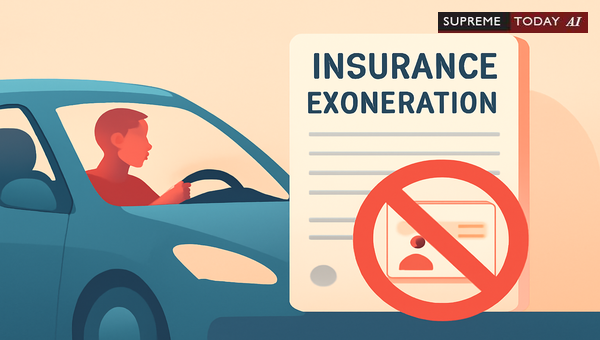
Insurance if Driver Lacks License: MV Act Guide
In the high-stakes world of road accidents in India, one burning question often arises: Whether Insurance Company will Get if Respondent has no Licence as Per New Amendment? This issue strikes at the heart of liability for vehicle owners, insurers, and third-party claimants. With rising motor vehicle accidents and amendments to the , understanding insurance is crucial for everyone—from policyholders to accident victims.
Recent judicial interpretations highlight that while insurers may seek relief from paying claims directly, nuances like , policy breaches, and for third parties complicate the picture. This post breaks down the legal landscape, drawing from key court rulings and MV Act provisions, to provide clarity without offering specific legal advice.
Understanding Under the
refers to an insurance company's release from liability to pay compensation in motor accident claims. Under the MV Act, particularly and related amendments, driving without a valid license is a of insurance policy conditions. However, it's not always straightforward.
Key Principle: If the driver involved in the accident lacks a valid driving license, the insurance company can be exonerated from direct liability to the third party. This is grounded in multiple precedents: 2008 7 Supreme 89. Courts have consistently held that the absence of a license at the time of the accident allows insurers to avoid payout obligations 2001 3 Supreme 84.
For instance, If the driver of the vehicle involved in the accident does not have a valid driving license at the time of the accident, the insurance company can be exonerated from liability to pay compensation to the third party 2008 7 Supreme 89.
Lies with the Insurance Company
The insurer cannot simply claim ; they must prove the driver had no valid license. This burden is pivotal: The insurance company has the burden to prove that the driver did not have a valid license at the time of the accident in order to get 2001 3 Supreme 84.
Mere allegations aren't enough. Insurers often issue notices or summon records, but failure to substantiate can lead to liability. In one case, Mere issuance of notice or witness summons itself would not be suffice to say that the Insurance Company has discharged its burden in getting the fact established that the driver of the offending vehicle did not posses the driving licence 2021 0 Supreme(Kar) 900.
Additionally, if a license appears renewed—even if allegedly fake—the insurer gets an opportunity to prove forgery: However, the mere renewal of a fake or forged license by the licensing authority does not make it valid, and the insurance company should be given an opportunity to prove the license was fake 2001 3 Supreme 84.
: Pay First, Recover Later
Even if exonerated from direct liability, insurers remain protected for third parties under the MV Act. They must pay compensation to claimants and then recover from the vehicle owner or driver. This is a statutory safeguard: Even if the driver lacks a valid license, the insurance company is still liable to pay compensation to the third party under the 1985 0 Supreme(SC) 151 2008 0 Supreme(SC) 83.
The recovery right is clear: The insurance company can then seek to recover the amount paid from the owner of the vehicle, if the vehicle was being driven by an unlicensed driver 2001 3 Supreme 84 2008 0 Supreme(SC) 83. precedents reinforce this, as in cases where insurers were directed to despite no license 2014 0 Supreme(Mad) 4590.
Therefore, even in case of no licence if the Insurance Company establishes that the driver of the insured vehicle was not in possession of any type of licence, the Insurance Company is to be exonerated but as per of the Act, they can be directed to 2014 0 Supreme(Mad) 4590.
Exceptions and Limitations to
isn't automatic. Several exceptions apply:
Entrustment to Licensed Driver: If the owner proves the vehicle was given to a licensed driver who then allowed an unlicensed person to drive without the owner's knowledge, the insurer may not be exonerated 2001 3 Supreme 84.
Duplicate or Renewed Licenses: Issuing a duplicate doesn't imply the original was fake; insurers must prove invalidity 2008 0 Supreme(SC) 83.
Insurer's Knowledge: If the insurer knew or should have known about the license issue, courts may deny 2025 0 Supreme(Kar) 929 2024 Supreme(Online)(KER) 50035.
From other rulings: It was pointed out that, even if the 2nd respondent was did not have a driving licence, that would not enable the insurance company to get exonerated from the liability 2024 Supreme(Online)(KER) 7091. And, The crucial question here is whether such a use of the vehicle by the 2nd respondent would entitle the Insurance Company to get exonerated from the liability or to get the right of recovery 2023 0 Supreme(Ker) 690.
Courts emphasize whether the breach is fundamental. Driving without a license typically qualifies, but facts matter: 2023 0 Supreme(Ker) 455 2024 0 Supreme(Kar) 2 2023 0 Supreme(AP) 676.
Judicial Precedents and MV Act Amendments
Post-amendments, the MV Act strengthens third-party rights while allowing insurer recovery. and the have varied:
- In some, tribunals exonerated insurers outright for no license 2012 0 Supreme(AP) 1278.
- Others modified awards, holding insurers liable to 2016 0 Supreme(Ker) 70.
Since we have set aside the finding of the Tribunal exonerating the insurance company from liability... the third respondent is not entitled to recover the amount from the first respondent 2016 0 Supreme(Ker) 70.
Consistency issues arise with license issuance: It is submitted that if there was no valid licence, as can be seen in this case, even from bare perusal of the complaint, then, the insurance company... 2016 0 Supreme(Bom) 1307.
Overall, precedents like National Insurance Co. Ltd. affirm for fundamental breaches but mandate pay-and-recover for third parties
- Delhi
.Practical Implications for Stakeholders
- Vehicle Owners: Ensure drivers are licensed; otherwise, face recovery claims.
- Insurers: Gather robust evidence early—RTI queries, RTO records.
- Claimants: Benefit from statutory liability; focus on quantum of compensation.
Under amendments, penalties for unlicensed driving have increased, indirectly bolstering insurer defenses.
Key Takeaways and Conclusion
Generally, insurance companies may secure if they prove the driver lacked a valid license under the MV Act—shifting liability to owners via recovery. However, they bear the proof burden, must protect third parties, and face exceptions like unknowing entrustment or unproven forgeries.
This analysis draws from established rulings, but outcomes depend on case specifics. Courts exercise discretion, prioritizing claimant relief.
Disclaimer: This is general information based on precedents like 2001 3 Supreme 84, 2008 7 Supreme 89, and others—not legal advice. Consult a qualified lawyer for your situation.
Stay safe on roads, verify licenses, and insure wisely. For more MV Act insights, subscribe!
#MVAct #InsuranceLaw #UnlicensedDriver












